- SY-100 Expression Pedal Shoot Out! Comparing the Roland EV-5, Boss EV-30, Moog EP-3 and Mission Engineering SP-1
- SBC-1324 New Videos Posted!
- BX-13 Do-It-Yourself Cooper tracing and silk screen available for download.
- Roland Centerstage - Roland Makes !t Happen! 1984 Winter Namm - First time ever!
- Boss SY-1000 All About Program and Bank Change Commands - Boss SY-1000 Webpage
- Boss SY-1000 All About Program and Bank Change Commands YouTube Video
- Email Blast Archive! 4 Years Plus of Email Blasts Archived.
- Roland BC-13 Full review on YouTube
- NEW Interior Photos - First time ever!
- The Most Requested GR-700 Patch A breakdown of how to recreate the classic Roland GR-700 Factory Patch 3-5, "Lead II" as used by Glen Tipton of Judas Priest, adding a signature sound to the excellent track 'Turbo Lover'.
- High Res PG-200 Manual (NEW) NEW! I tracked down a mint PG-200 Owner's Manual, newly posted.
- Roland GR-500 MINT Stunning Photos As seen on Reverb! A really stunning example of a Mint Roland GR-500/GS-500 combination. Includes the very, very rare GR-500 case, never seen before!
- The Swallow's Dream is a performance piece made only using sounds from the Boss SY-1000 with an Epiphone Dove Pro equipped with the Graphtech GHOST Acoustic Steel String Midi Kit.
- Mastering Resynthesis with the SY-1000 This video shows how to record the master stereo output of the SY-1000 in the USB audio to a stereo track. In this way many tracks of guitar synthesizer can be recorded and layered to create a final composition.
- Epiphone Dove Pro with Graphtech GHOST Midi Kit In this video I share a few insights about a Epiphone Dove Studio Acoustic-Electric Guitar Vintage Burst I purchased with the Fishman Sonitone and Sonicore System and the Graphtech GHOST Acoustic Steel String Midi Kit installed.
- Roland GM-70 MIDI Polyphonic Expressions: Using the vintage Roland GM-70 with the Arturia Pigments Soft Synth with MPE MIDI Polyphonic Expressions
- Roland GM-70 Alternate Tunings and MIDI Continuous Controllers: Using the vintage Roland GM-70 alternative tunings, and assigning MIDI continuous controllers
- Roland Hardware GR-700: Vanguard to Synth Frontiers: Announcing the Roland GR-700! From the Roland Users Group, Volume 2, Number 4
- Boss SY-1000 On The Run Sequence - Step By Step Tutorial - EMS Synthi AKS - Analog Recreation: This is a step-by-step tutorial showing how to recreate the famous 'On The Run' sequence from Pink Floyd's album The Dark Side of the Moon.
- Boss SY-1000 Guitar Synthesizer Sequence Step By Step Dynamic Synth Tutorial: Tutorial on using the Sequencer in the Boss SY-1000.
- Jeff Baxter - How I Became An Electronic Musician: Read this interview with guitarist Jeff Baxter from the first issue of the Roland User's Group Magazine.
- Boss SY-1000: Resynthesis - YouTube Video: Multitrack Guitar Synthesis Recording
- Boss SY-1000 Reaktor 6 - DIY Build Your Own Guitar Synth YouTube Video: Use Reaktor with the Boss SY-1000 to build your own software guitar synthesizer.
- Korg MS-03 Forget MIDI! Forget the Hex Pickup! Direct Guitar to Analog Synthesizer with the mighty Korg MS-03 and the Arp Odyssey and Behringer K-2 (Korg MS-20)
- Korg MS-03 Video - Demo of the RareKorg MS-03 with the (Korg) Arp Odyssey and the Behringer K-2 (MS-20 Clone)
- Roland SPV-355 Guitar to Synthesizer Video - Roland G-303 Direct to the Roland SPV-355
- Behringer K-2 Guitar to Synthesizer Video - The hidden Guitar Synthesizer in the Behinger K2!
- GR-700 Tech Tips from Roland! Originally published in the Roland User Group magazine, Volume 2, Number 4.
- GR-700 Performance Tips! Originally published in the Roland User Group magazine, Volume 3, Number 3.
- Guitar Greats and the GR-700 Originally published in the Roland User Group magazine, Volume 2, Number 3.
- Roland Hardware - GR-700 G-707 Originally published in the Roland User Group magazine, Volume 2, Number 3.
- Synth Ethics Featuring the Roland GR-700 Tips on using the GR-700 from Mark Wood, Guitarist Magazine May 1985
- Three Favorite GR-700 Patches By Steve Carnelli, Guitar PLayer June 1986.
- Roland GR-700 Guitar Synthesizer Product Review By John Themis Guitarist May 1985
- Pat Metheny and Lyle Mays Interview - 1989 Pat and Lyle interviewed during the height of the popularity of the Pat Metheny Group in Music Technology Magazine.
- Pat Metheny Interview - 1985 Vintage interview from the era of 'First Circle', and 'The Falcon And The Snowman' - Guitarist Magazine
- Pat Metheny Interview - 1984 Vintage interview from the Roland Users Group covering Pat's early career as musician and highlighting the Roland GR-300.
- Boss SY-1000 Recreating the Pat Metheny GR-300 Solo Sound YouTube Video detailing tweaks to recreate the dramatic Pat Metheny GR-300 solo sound with the Boss SY-1000.
- Pat Metheny - New England Digital Synclavier Demonstration YouTube Video Old Grey Whistle Test - Roland G-303
- Pat Metheny with NED Synclavier Prototype YouTube Video Early Guitar Synthesizer Controller
- Pat Metheny and the NED Synclavier Read Pat's notes on using guitar synthesizers and the New England Digital Synclavier.
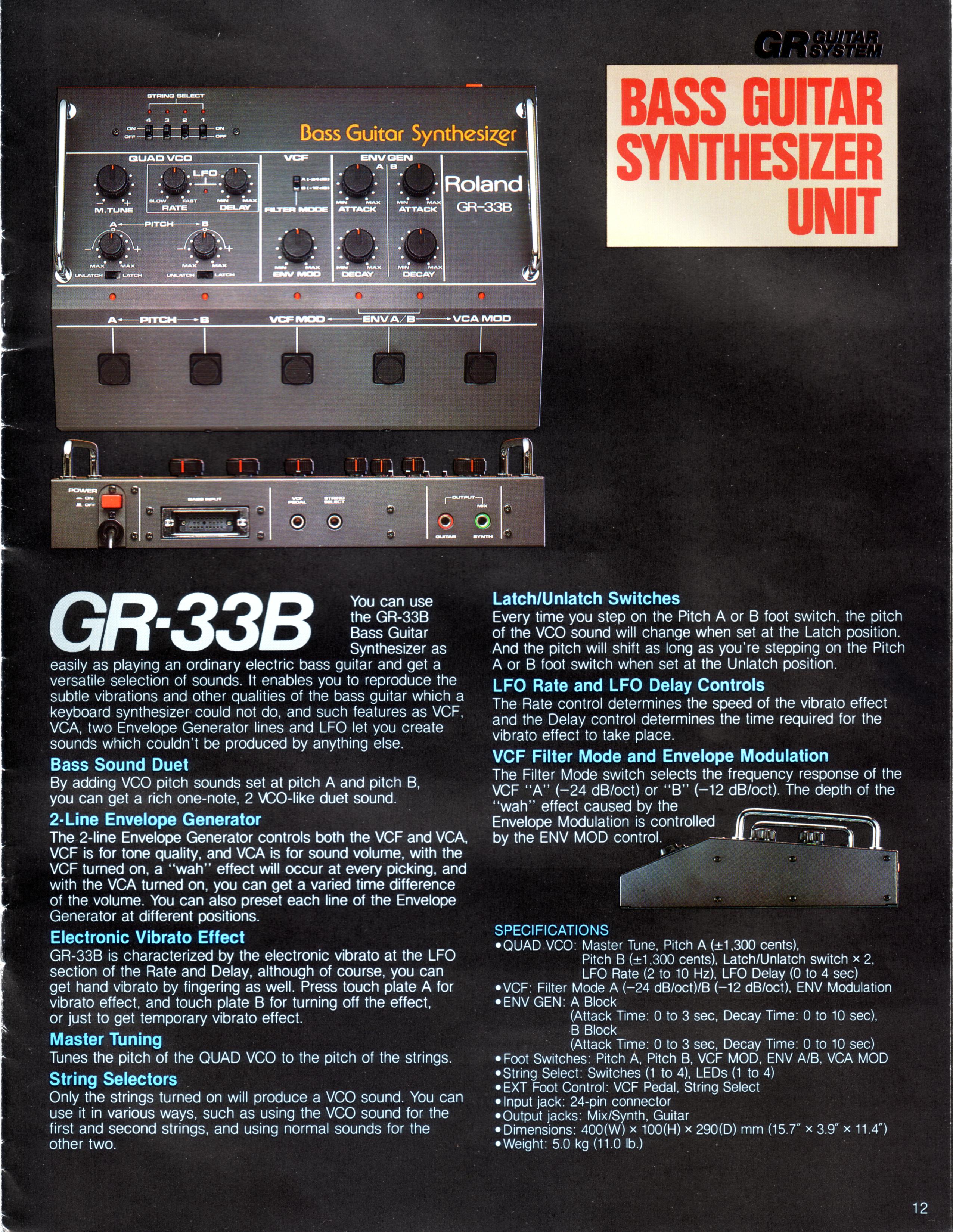
- Van Halen Michael Anthony Roland GR-33B G-33 Bass Guitar Synthesizer Solo YouTube Video From 1982 Largo and 1983 Devore In Concert Live Performance! FILTER SWEEPS!!! DELAYS!!!
- Spicetone 6Appeal Guitar Processor Analog Hexaphonic Distortion Pedal The Spicetone 6Appeal is a modern take on the poly distortion, hexaphonic (hex) fuzz pedal.
- GR-100 GR-300 Power Supply Repair New video on the one GR-100 or GR-300 or GR-33B power supply mod you MUST do!
- Roland GR-D Interior Photos: First time on the web! Interior photos of the Roland GR-D!
- Gibson Les Paul Custom LPK-1 Repair In depth step-by-step repair of the Gibson Les Paul with LPK-1 kit.
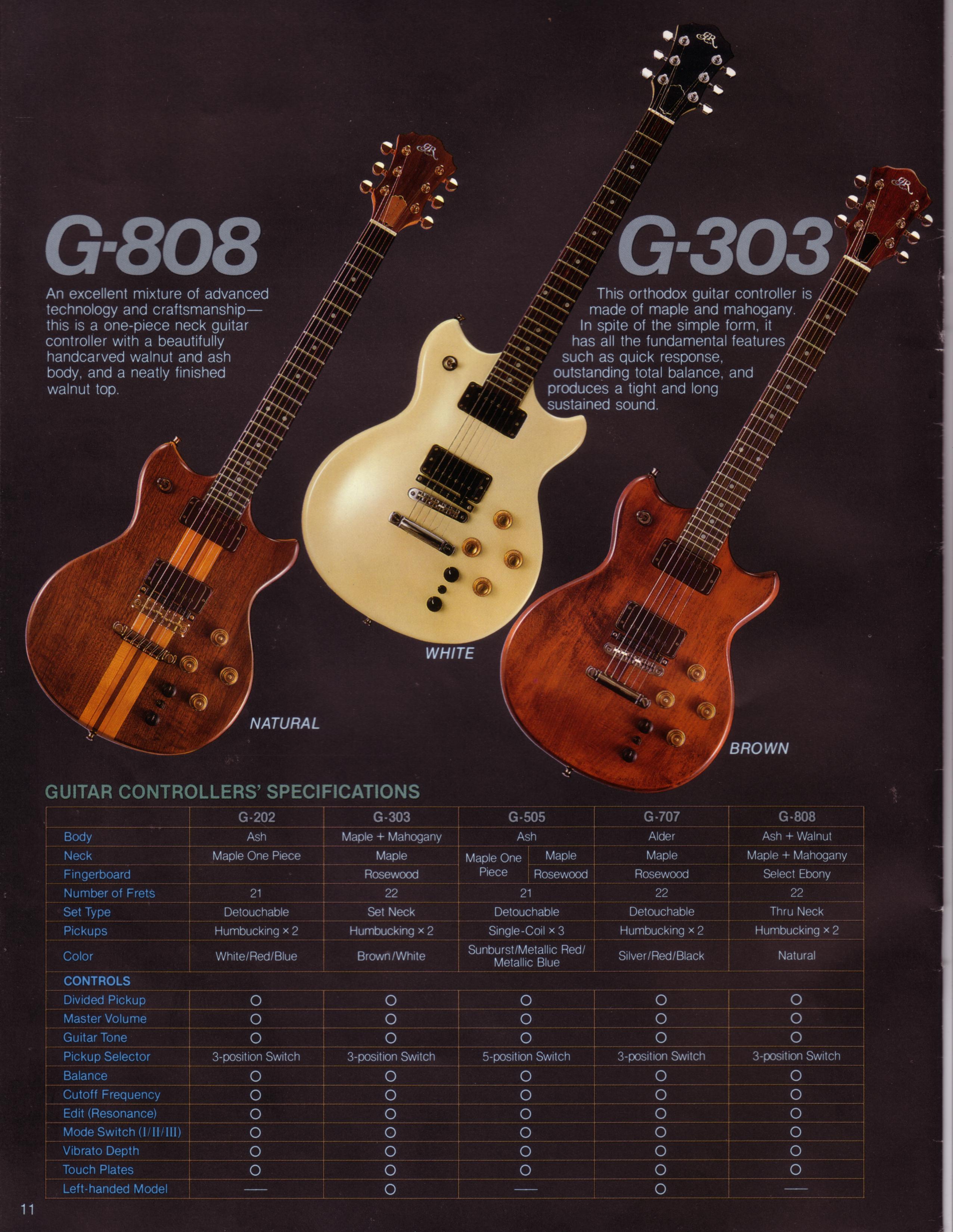
- Roland G-303 A Fresh Look! Trevor Harley sent me these photos of his Roland G-303. The guitar was refinished with a flame maple top and back by the Canadian Luthier George Furlanetto. Note that the touch pads have been relocated below the bridge pickup.
- Steinberger Time! Newly posted photos of a White Steinberger GL-4T-GR
- Ultimate 24-Pin Custom Guitar Stunning photos of the most amazing custom built 24-pin guitar ever made! The solar system on the fret board and more!
- More PINK Please! Hamer Phantom A7 Nothing says vintage 80s guitar styles link a solid pin finish! Samuel Cuevas sent me a few photos of this very, very rare pink Hamer Phantom A7 Roland-Ready guitar.
- Boss SY-1000 with Roland G-33 YouTube video with a demonstration of all 200 Bass patches for the SY-1000
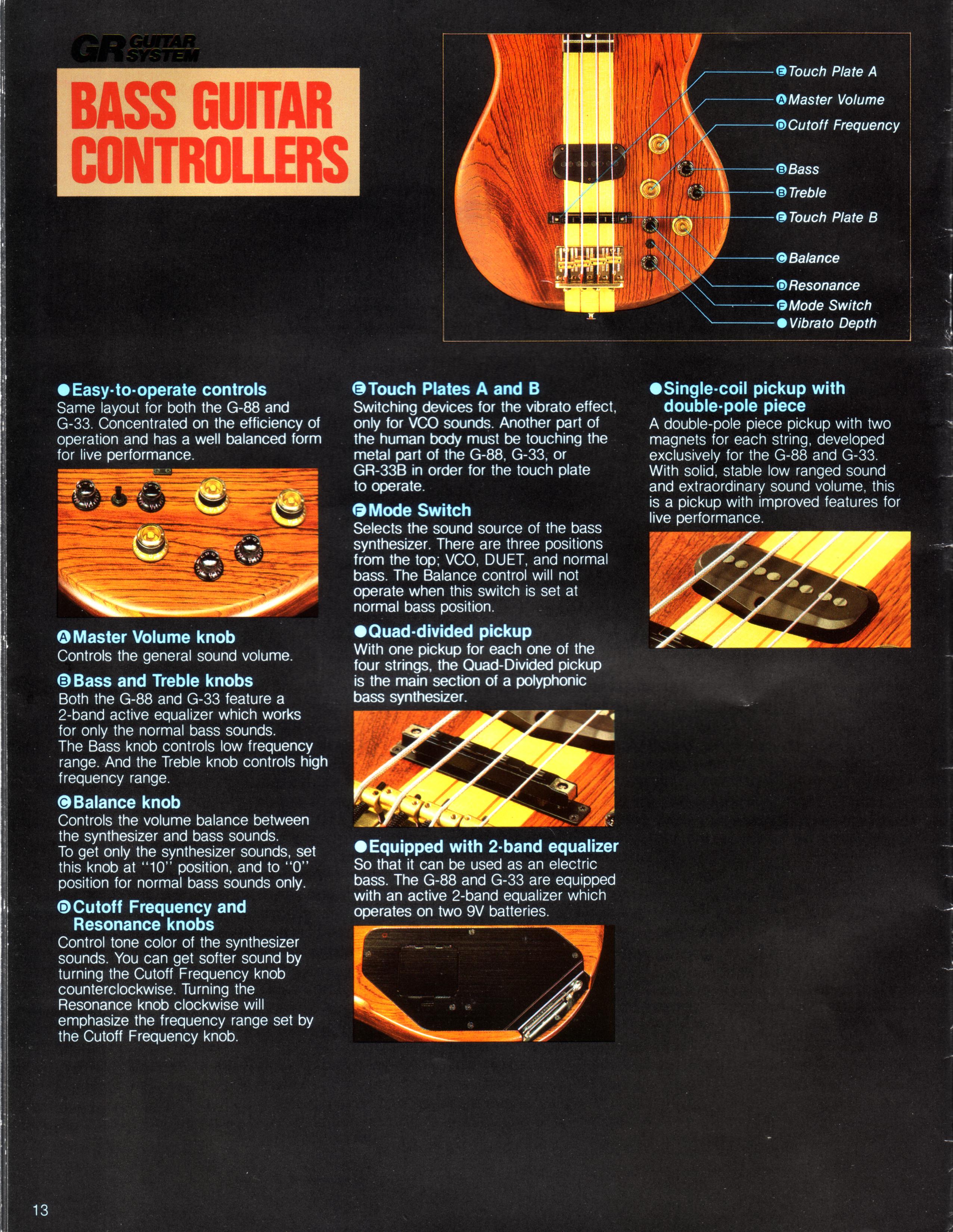
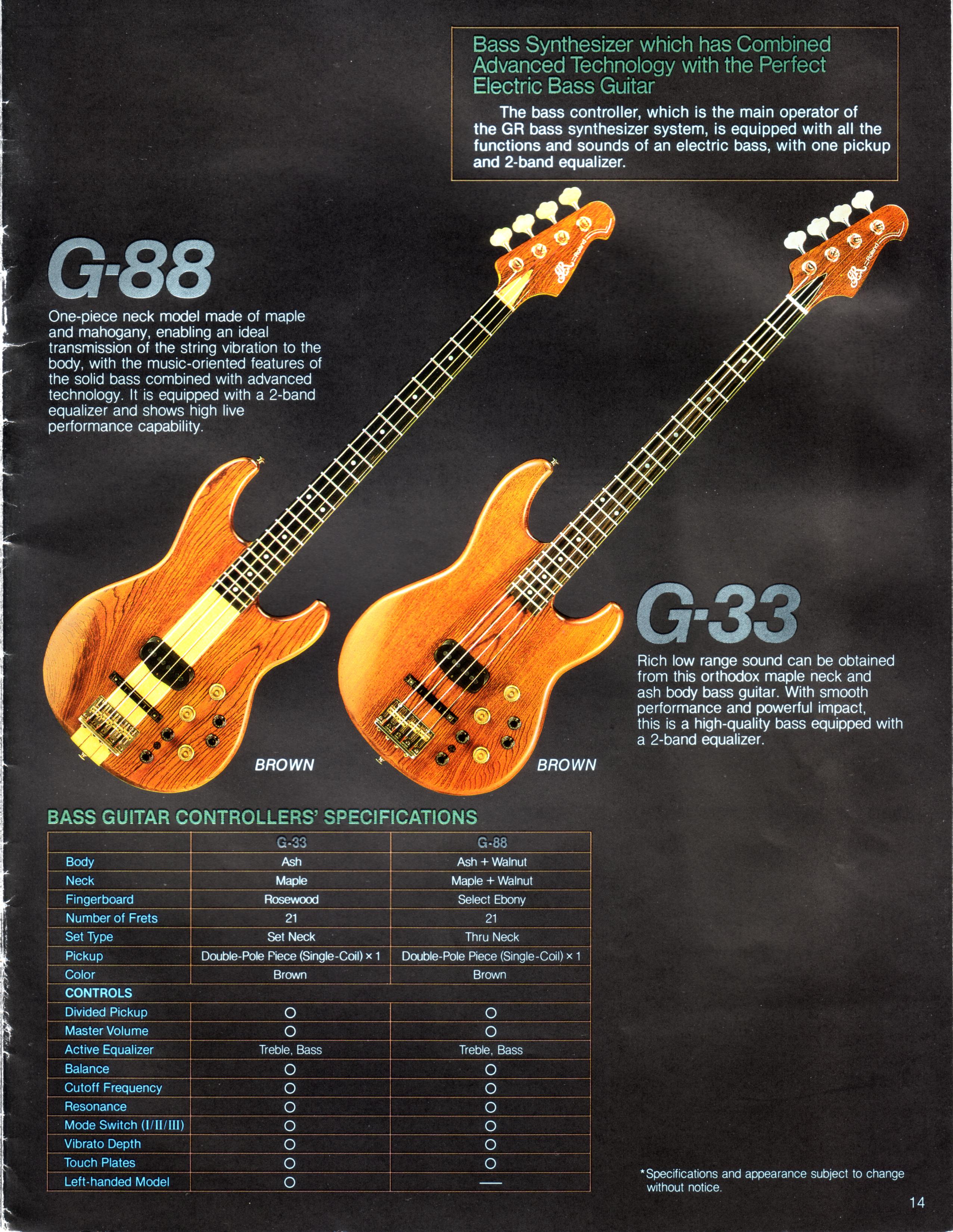
- BAK-1 Videos A new video on the BAK-1 Electronics card, plus comparison of the G-88 and G-77 electronics
- BAK-1 Photos Newly posted photos of the BAK-1 Bass Guitar Synthesizer Installation Kit
- Roland G-33 G-88 G-77 BAK-1 Vintage Analog Bass Guitar Controller Assembly - Comparison
- G-77 Fretless First time on the web! New photos from Skylark of his pristine G-77 Fretless bass.
- Clone 24-Pin Cable At long last there is a quality clone of the impossible to find Roland 24-pin cable. This is a quality, made in the U.S.A. cable produced by 'MagicTrashMan' in North Carolina. Check out the description and video on the cables page.
- Roland GR-500 Mods - Part 1 Thanks to the Phantastic Jimi Photon who pointed me to the March April 1981 Polyphony magazine with the first list of Roland GR-500 modifications.
- Boss SY-1000 All Bass Patches! Complete on YouTube (no talking)!
- Read The Full Interview The year was 1983, and the Police were exploding on the charts. The inventive and adventurous Andy Summers was busy rewriting what a rock guitar player could be. The smash hit "Don't Stand So Close To Me" prominently featured the Roland GR-300, played by Andy with the Roland G-808. Volume 2, number 2, of the Roland Users Group magazine featured a great interview with Andy, reproduced for the first time on the web!
- Read The Full Review Roland shifts direction in 1987, releasing the Roland GK-1 and GM-70. This combo said goodbye to Roland guitars and dedicated guitar synthesizers like the GR-300 and G-808 in favor of a system that could be mounted on any guitar, and used to control any MIDI synthesizer. Read Warren Sirota's review of the GK-1, GM-70, and the MKS-50 and MKS-70.
- Roland GR-500 Mods and Tips! Electronic Musician magazine started life as Polyphony magazine, edited by young writer named Craig Anderton. Seemingly produced by on a single typewriter in the early eighties, this Polyphony article features insights and modifications for the Roland GR-500!
- History of the Guitar Synthesizer Travel back in time, before MIDI, before the Roland GR-700, to the early 1980s, when the Roland GR-300 was the pinnacle of guitar synthesizer technology.
- Steve Howe and Steve Hackett Prog Rock Guitar Titans Teamed up for GTR, Chart-Topping Band Centered around the Roland GR-700!
- Steve Howe Roland Profile A detailed profile of Steve Howe, his Roland G-505 and GR-700 from the 1984 Roland Users Group Magazine
- Boss SY-1000 Tutorial Videos New vidoes on setting up Guitar-To-Midi and blending normal guitar sounds with modeled sounds.
- Washburn JB100 Profile A look at the Washburn Roland-Ready JB100. Detailed photos and videos!
- Lyle Mays Remembering Lyle Mays - New YouTube Playlist with Unreleased Tracks from live Radio Broadcast
- Boss SY-1000 Interior Photos and Unboxing Photos
- Parker NiteFly SA with Factory Internal GK-2A Just Added! A profile of a Parker NiteFly SA with factory Roland GK-2A. Demos with Roland GR-100, GR-300 and GR-700.
- Behringer Deep Mind 12 The New Roland GR-700? Vintage Sounds in a Modern Analog Synth
- GR-300 Case Rare spotting of the Original Roland GR-300 Case!
- Roland Ready Les Paul Photos of Bob Welch's Custom Shop Les Paul Paul with Roland electronics.
- Peter Frampton With Roland G-303 Thank you Eric Fisher for finding this rare live video!
- Picture This 30th Anniversary Release - Wayne Scott Jones Album from November 1989.
- Converting the M-16C into an M-64C - Detailed tips on converting the M-16C into a M-64C with four times the memory capacity!
- Roland G-33 Major Update! 18 new photos, PLUS 4 YouTube videos!
- Switch Roland-Ready MIDI Guitar Complete details on the Switch Wild-IV, PLUS all the Switch Guitars!
- Boss GP-10 and Hex Fuzz Details on great hex fuzz sounds from the Boss GP-10
- Steve Hackett - Roland GR-500/GS-500 Performance - Please Don't Touch From the 'Please Don't Touch' tour, November 8, 1978. Great GR-500 showcase!
- Vintage Roland GR-300 Review from Electronics & Music Maker - Nov 1981
- Roland GR-77B for Reaktor - Download a modeled Roland GR-77B for Native Instruments Reaktor 5!
- Roland GR-700 Blue - Remake with 'GR-300' blue finish, new handles, and handsome natural wood end blocks! Thank you Chuck Nin!
- PG-200 - Updated NOS New-Old-Stock photos of the Roland PG-700, programmer for the Roland GR-700. Thank you Eric Rusack!
- G-707 White Ever wonder what a G-707 would look like redone in a brilliant white finish? With Steinberger folding leg rest!
- 3D Printing Vintage Roland Guitar Parts - 24-to-25 pin Plate - Courtesy of Jusin Casey
- David Gilmour - Solo with Roland STK-1 and GR-700!
- Moog Voyager XL (with Casio MG-510 Cameo) Space Music - Melodic Downtempo, Ambient, Ambient& PsyChill Mix.
- Roland GM-70 Guitar-to-MIDI Converter - Review by Paul White, Music Technology Magazine, April 1987
- Theme from M*A*S*H. Arranged using only the ARP Odyssey for all sounds, synths, drums, efx, etc.
- Ibanez IMG2010 - Owned by George Benson. Rare 'Endorsee' finish with Silver hardware.
- Arp Avatar Review by Paddy Kingsland. Vintage review of one of the very first analog guitar synthesizers, the Arp Avatar - Competitor to the Roland GR/GS-500.
- 24-to-25 Pin Mounting Plate. You can download the newly posted '24-25.dxf' CAD file to make your own 24 to 25 pin mouting plate. I used the company Big Blue Saw to make my 24-to-25 plates from aluminum. The price for a single piece can be expensive, but if you order in quatity the price will drop considerably. Plus, they have specials from time to time!
- Roland GR-100 Samples Sounds. The Roland GR-100 Owner's Manual has a list of "Factory Presets", Sample Sounds, at the end of the Owner's Manual. These sample sounds were intending to give some direction on how to use the GR-100, using features such as Filter Modulation, Chorus, and Vibrato, all served up with the classic hex fuzz sound the GR-100 is famous for. Check out this new YouTube video I posted which goes through the Sample Sounds to get a little flavor of what this vintage 'electronic guitar' synth sounded like!
-
SBC-1324 Roland 24 or 13 Pin Input to 13 and 24 Pin Output
Back in 2009 I was approached by a very talented Canadian guitarist who wanted to be able to control both vintage Roland 24 pin GR-series synthesizers and modern Roland 13 pin GK-series synthesizers with one guitar, either a 13 or 24 pin guitar.
The SBC-1324 is the unit I built to meet this need. The unit has both 13 and 24 pin inputs, and a master analog switch to select between the two. There are six amplifiers for each string input, used primarily to boost the 13 pin signals to the 24 pin format, but they can also be used individually to amplify any single string input, whether 13 or 24 pin.
-
Artist Highlight: Neal Schon
Journey guitarist Neal Schon was frequently seen in the early eighties playing a Roland G-505 guitar paired with the GR-300. Schon is not usually thought of as a 'Strat' player, much less a guitar synthesist, but he makes great use of the G-505/GR-300. An outstanding track is the tune 'Valley of the Kings', using the 'Duet' mode of the GR-300.
- Roland SIP-300 Fresh Photos! Super clean photos from an auction by Tone Tweakers.
- Roland GR-300 Emulation with Kontakt 5 or Roland SR-JV80-04 / SRX-04 Ultimate Keys / INTEGRA-7. Download a complete Kontakt 5 patch and trigger a GR-300 with MIDI! Or check out a demo of the Roland GR-300 patch created by the legendary Scott Summers.
- UX-20 - 13-Pin Splitter/Distributor with Buffered Guitar Input Schematic
- Pat Metheny writes about on using the NED Synclavier Digital Guitar Option - First Time Online! From the 1984 NED Owner's Manual.
- Steinberger XL2-GR Guitar Synthesizer Controller - Vintage Roland Ready Bass Guitar Synthesizer Controller
- Pedulla MVP-S Guitar Synthesizer Controller - The phantom Roland Ready Guitar Synth Controller!
- GK QuadBox Schematic Build your own GK QuadBox, 1 input, 4 output 13-pin Guitar Synth Signal Distributor - Combined US-20 and GKP-4 clone!
- RC-1324-VR Roland 13-in to 24-pin Converter Detailed schematic on the acclaimed RC-1324. Control vintage 24-pin Roland guitar synths like the GR-700 and GR-300 with modern 13-pin controllers like the GK-3, GK-2A or the Godin series of guitar controllers
- Modulus Graphite Blackknife Special Guitar Synthesizer Controller
- Roland GR-700 Operating System Upgrade New Sounds! Faster Response!!
- Do-It-Yourself DIY Roland and Ibanez Guitar Synthesizer Control Panel Overlays
- The summer NAMM 1985 show was the year when MIDI became accepted as a standard across the industry, and guitar manufacturers unleased a variety of MIDI guitar products not seen since. From Roland to Steinberger to Ibanez to the ultra rare Octave-Plateau Voyetra MIDI guitar, MIDI was everywhere.
- Detailed information on the vintage IBM-PC music production software from Voyetra. Voyetra is the same company that produced the Kat and Kitten analog synthesiers, the ground-breaking Voyetra Eight polyphonic analog synthesizer, and the ultra rare Octave-Plateau Voyetra MIDI guitar.
- WBRA Public Television Music Video featuring Wayne Joness using Voyetra Sequencer Plus - Live Performance.
- Vintage Interview with Jazz Fusion pioneer John McLaughlin about using the Roland G-303 guitar synth controller and the New England Digital Synclavier with Digital Guitar Option
- Details on the amazing Synclavier II Digital Guitar
- East Side West Side by John McLaughlin From the Album Mahavishnu - Transcribed by Steve Vai.
- Vintage 1980 Full Page Roland G-808 Advertisement featuring Bernie Marsden (Whitesnake) - Who knew? Hard rock icon Bernie Marsden with a Roland G-808!
-
Gibson Custom Shop Les Paul "Studio Custom" Roland Ready Synthesizer Controller Update
More pictures on the Gibson Custom Shop Les Paul Roland Ready Synthesizer Controller page, plus an update on the number of models built. - Musico Resynator | Hexsynator - 1980s Pitch and Envelope Tracking Synthesizer with Roland 24-pin Guitar Synthesizer Input - Detailed photo gallery from November 2017 fundraiser at Sound City Studios in Van Nuys, CA.
-
Gibson Custom Shop Les Paul "Studio Custom" Roland Ready Synthesizer Controller
Beyond the standard Roland offerings in the G-X0X series, there are vintage 24-pin Roland-Ready guitars for just about every niche: the Hard Rock Hamer A7, the traditional player's Zion Strat, or the cutting edge Steinberger GL-2T/GR.
But the classic, eternal, "Cadillac" of the series has got to be the Limited Edition 1985 Gibson Custom Shop Les Paul with the Roland LPK-1 Electronics. Every guitar was the product of Gibson's acclaimed Custom Shop in Kalamazoo, Michigan. Kalamazoo made Gibson Les Pauls have been called the 'Holy Grail' of electric guitars. These vintage guitars combine all the craft and musicality with the feature-rich Roland LPK-1 electronics package, the same electronics found in the G-303 or G-808 guitars. - Jazz and the GR-50! Acclaimed Jazz Guitarist Brad Rabuchin rocks the Roland GR-50 in this track 39 Steps: A Spacewalk. This is Space Station MIR, a collaboration with Flugelhorn Horn genius and composer Michael Wetherwax, with Wayne Joness on keyboards and programming. Watch Now on YouTube.
- BX-13 Micro Schematics Yes! At long last! The final schematic for the BX-13 Micro is available on the website! This design incorporates a VCA (voltage controlled amplifier) with an option to select either guitar or hex fuzz as the guitar signal, plus using controller 2 (resonance) as secondary control source acting as a EV-5 pedal.
- At long last the Vintage Roland Guitar Synthesizer Resource site has a full profile on the Steinberger GL-2T/GR Guitar Synthesizer Controller, with unseen schematics, photos and video, with additional information on the GL-3T/GR and GL-4T/GR.
- Musico Resynator | Hexsynator - 1980s Pitch and Envelope Tracking Synthesizer with Roland 24-pin Guitar Synthesizer Input.
- Korg Z3 Patch Editor Adaption for the Korg Z3 - Thanks to Korg Z3 user David for this free software download.
- GS-500 Video Playlist featuring Terje Rypdal - Luc Bertels hipped me to videos of Terje Rypdal using the Roland GR-500 and GS-500.
- Roland GR-700 and GR-77B AB-700 Case - Image gallery with 12 photos of the rare official Roland factory road case.
- Xotica EA-1 with Roland Ready Guitar Graph Tech Ghost Pickups - Detailed information on this very rare, Rland ready 13-pin Acoustic/Electric Roland guitar synthesizer controller.
- Factory Blue Roland GS-500 - Last year while visiting Japan I stumbled upon a factory BLUE Roland GS-500 in a Tokyo music store! Check out the exclusive photos published for the first time.
- Sounds of the GR-77B! New video posted featuring a layered bass combination of the Roland MKS-70 (same sound engine as the GR-77B) and the GR-77B.
- Pat Metheny Extended Interview - I tracked down the original Guitarist Magazine, May 1985, and have posted the complete interview with Pat Metheny. The previous interview was an abbreviated version.
- GR-300 Synthcheck - A detailed 2000 word review from "The Complete Music Magazine", dated November 1980
- Gibson Explorer - Finally! A home for one of the rarer custom Gibson vintage Roland guitar synth controllers
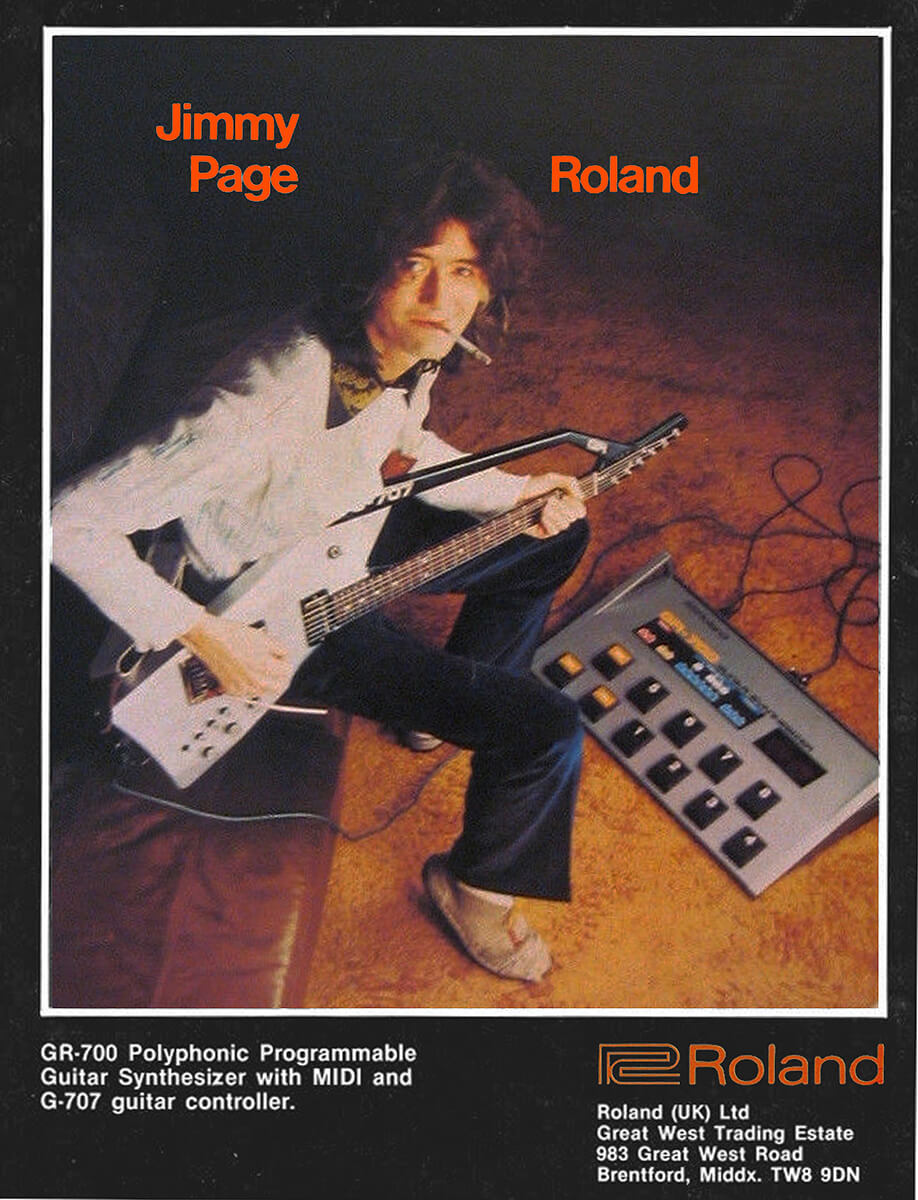
- Jimmy Page - Vintage 1985 magazine ad featuring the guitar legend and his G-707/GR-700 rig!
- LPK-1 Installation Diagram thanks to John Doucette for emailing the scans.
- GK-20 Schematic - 13-pin Guitar Switcher, Schematic ready for download
- Filter/Buffer Schematic - Schematic ready for download.
- Roland GR-700 and GR-77B Updates: From the Roland User Group Archives, a complete MIDI guitar and MIDI bass system profile!
- Roland GR-77B Updates: Finally! The Roland GR-77B and G-77 pages have been updated. Be sure to check out the G-77 page as well.
- Vintage Roland G-505 and GR-300 combination magazine advertisement.
- GR-700 One Step Beyond!: From the 1985 Roland User Group Magazine
- GR-700 4x Memory Expansion!: Easy to do, super DIY Memory Expansion!
- Ibanez IMG2010 and MC1: Updated! High-Res Brochure from 1985
- G-707 Steve Hunter: Vintage Product Review from 1985, Part 2!
- G-707 Steve Hunter: Vintage Product Review from 1985, Part 1
- GR-500 Steve Hackett: Vintage Product Review from 1978!
- GR-500 Patch Sheet: Original Blank Patch Sheet
- GR-500 - Solo Voice Tuning : Adendum on Tuning the Solo Section
- GR-300 Filter Mod: LFO to Filter Modification
- GR-300 Output Mod: Increase the output of your GR-300!
- GR-55 Schematics, Service Notes: Full factory service notes for the Roland GR-55
- Ibanez MIU8: Specs, photos, details on the rarest of rare!
- MIU8 Schematics: Schematics and Service Manual (pdf)!
- Korg Z3 Product Page: From early Product catalog!
- Hamer A7 Guitar: Added to the guitar pages, a tribute to the Hamer Phantom A7! Tubo Lover rocks!
- GR-500 24-pin Connector Change: Documentation of the change from the original, pin-type C24 connector to the much more common C24 positive (locking frame) connector.

Features and Specifications
Introduction
MKS-30 Samples
Links
4x Memory Expansion
Versions
EPROM Software
Photos
Custom Blue Finish
Videos
Patches - Downloads
Initialize Patches
Roland GR-700 Turbo Lover Repairs - Service Bulletins
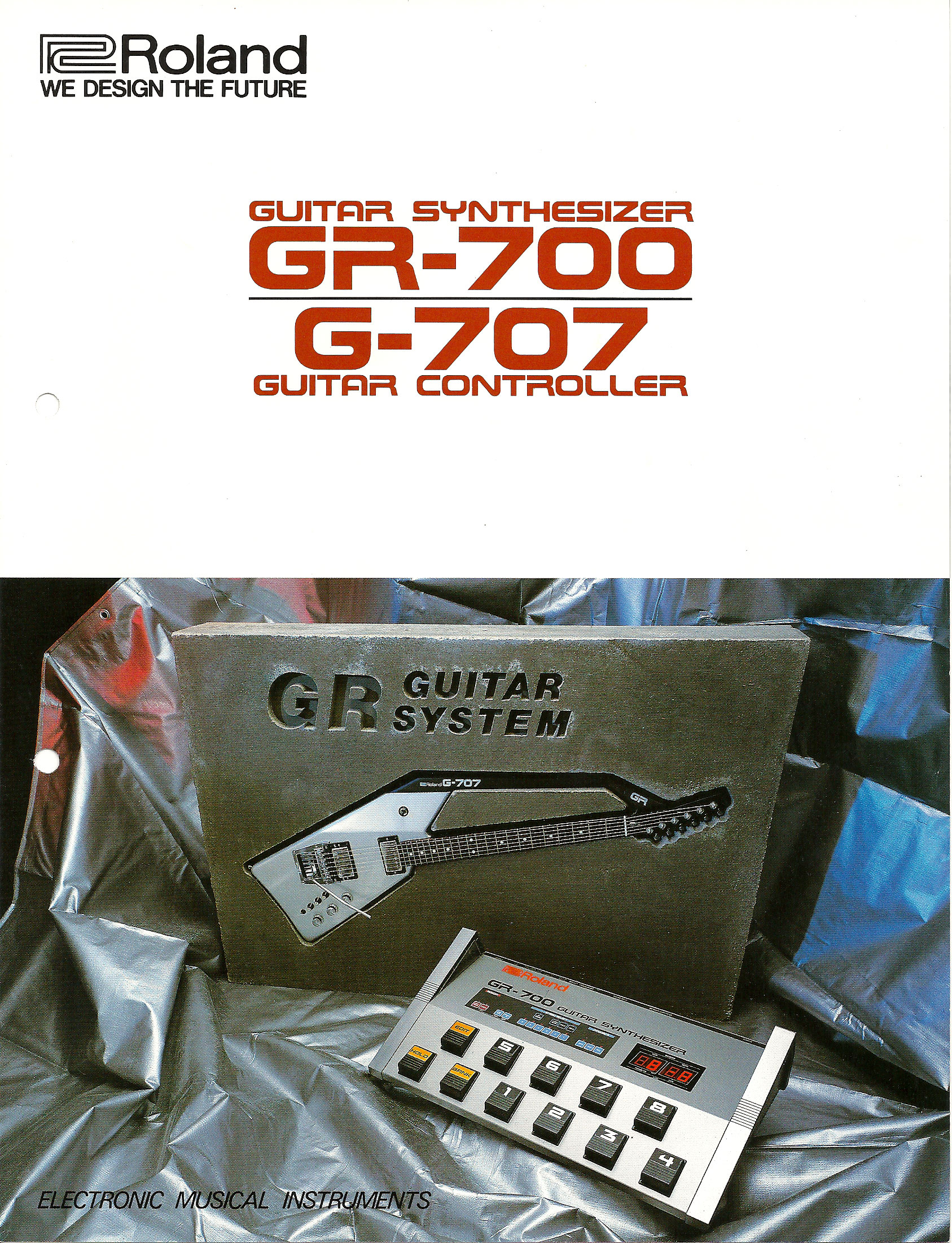
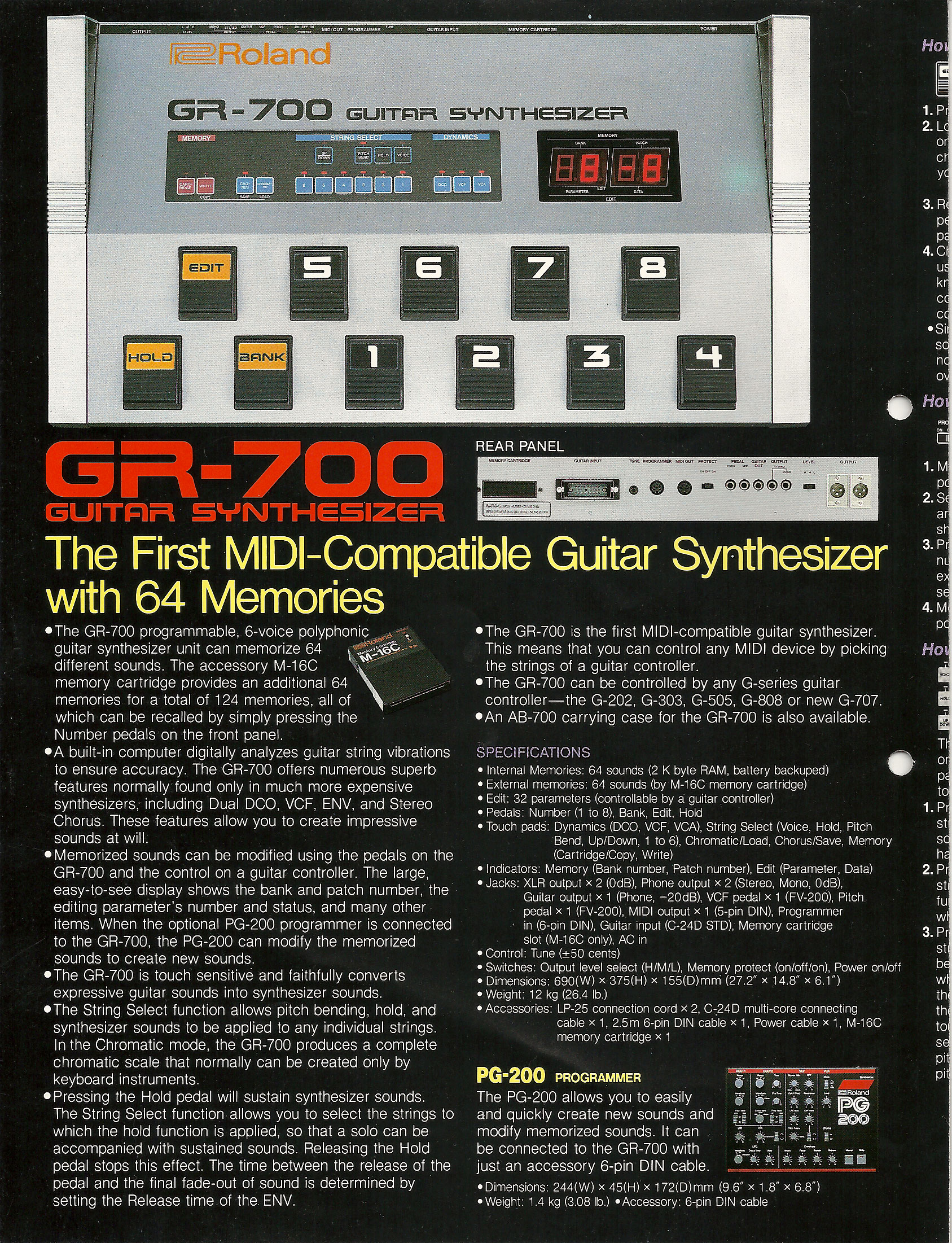
1984 Brochure
1984 Roland Brochure
Calibration
Accessories
Filter and Pitch Pedal
--- Modifications ---
GR-700 MIDI Input
GR-700 Plus - 13 Pin Output
GR-700 Turbo - 13 Pin Input
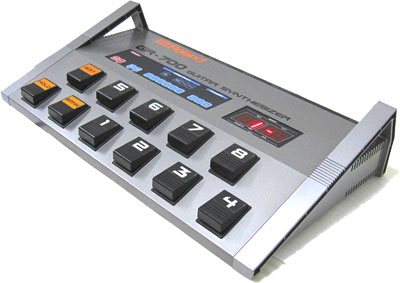
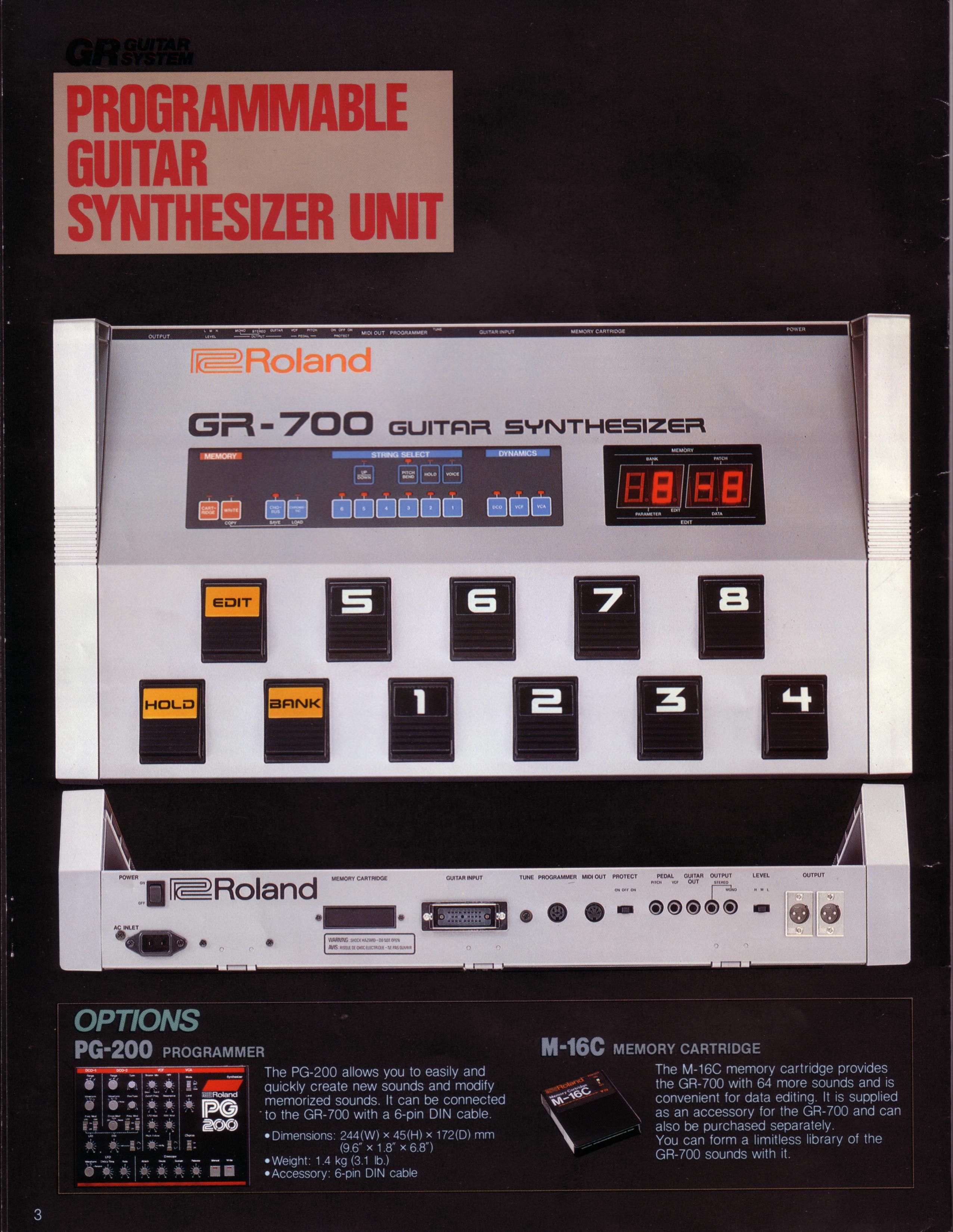
Roland GR-700 Programmable Analog Guitar Synthesizer
Features and Specifications:
- 6 voice, Dual Oscillator Synth Engine Based on the Roland JX-3P/MKS-30
- 3 - Selectable Octave Settings for Each Oscillator, 2’, 4’ and 8’
- Choice of Square, Sawtooth or Pulse Waveform, plus Noise for Oscillator 2
- Cross Modulation Between Oscillators
- Frequency Modulation with Envelope and/or Modulation
- VCF Low-Pass Filter with LFO, Envelope and Pitch Modulation
- Variable High-Pass Filter
- Four Stage Envelope Generator
- Low Frequency Oscillator for Vibrato Effects
- Selectable Dynamic Control Over Pitch, Filter and Amplifier per string
- Selectable Pitch Bend, Hold and Voice On/Off per String
- Lush Analog Chorus Mode
- Programming Via Foot switches or with optional PG-200 Programmer
- Dimensions: 27 3/16" (W) 14 3/4" (D) 6 1/8" (H)
- Power Requirements: 45 watts
- Response Time: 29.88 ms
 |
|
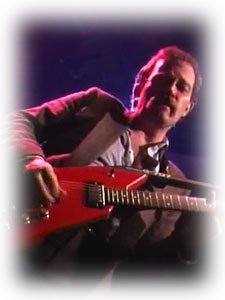
John Abercrombie (see YouTube for video)
|
Introduction to the Roland GR-700:
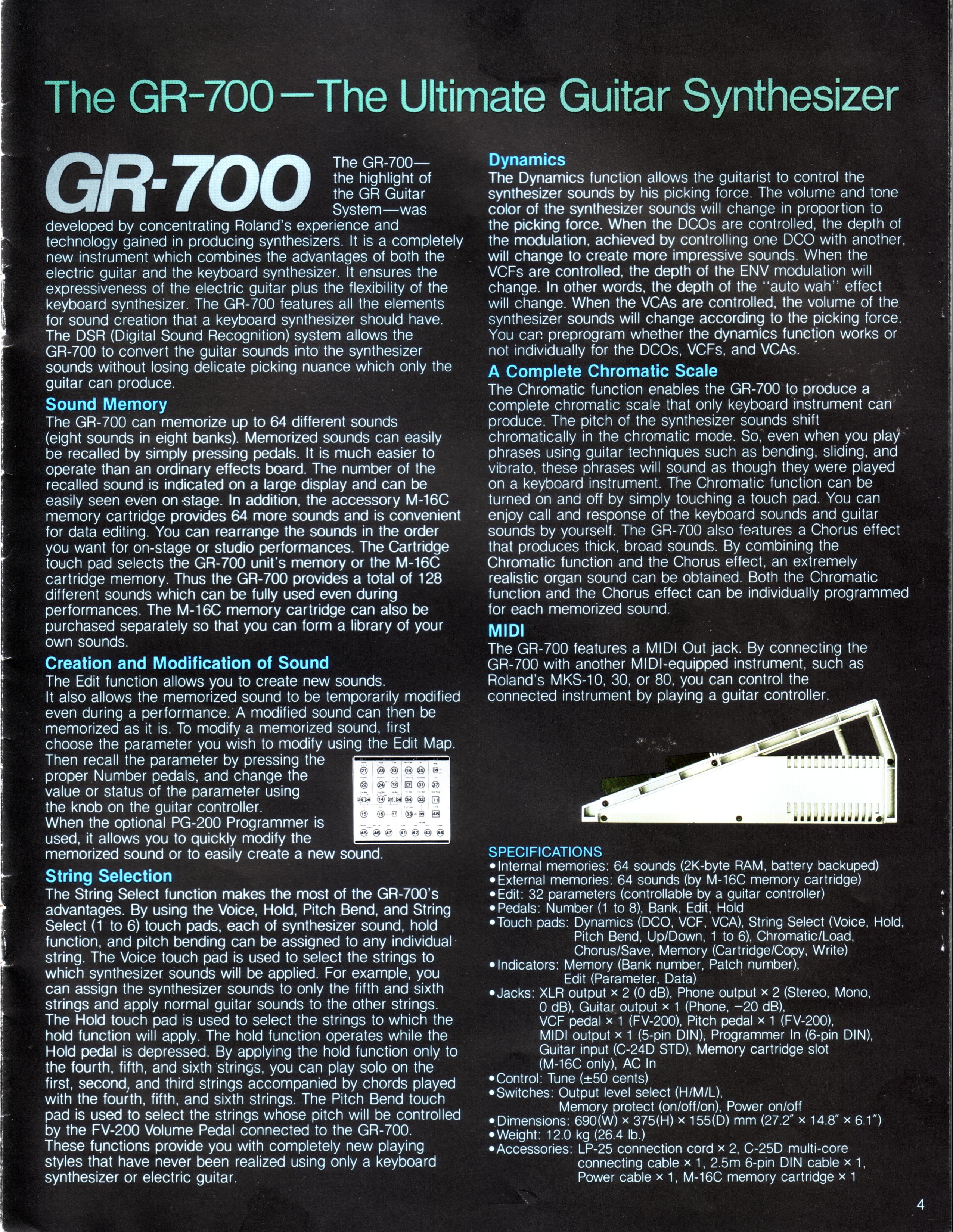
The GR-700 is classic Roland 1980s analog synthesizer technology. Released in late 1984, the GR-700 is the pinnacle of early Roland guitar synthesizer design. The distinctive and futuristic GR-700 features both a digital CPU for guitar tracking and a warm, fat hybrid digital/analog synthesizer engine for lush sounds.
A look at articles written about the GR-700 in Guitar Player, Guitarist, and other magazines, plus the synthesizer's appearance on television shows like The Tonight Show (US) and the Rock School series (UK), demonstrate the enthusiasm in the belief that the long anticipated age of the guitar synthesizer had finally arrived. The GR-700 launched just as the MIDI standard was being introduced, and musicians were entering a brave new world of electronic music where relatively inexpensive CPUs made possible instruments like the Prophet 5, Simmons drums, and the GR-700, instruments unimaginable a decade earlier.
 |
|
Jimmy Page and GR-700
Click to enlarge |
Generally speaking, the GR-700 has not held up as well as its 24-pin brethren, like the GR-100 or GR-300. But for a guitar player in 1985, the GR-700 offered an astonishing range of sounds that could never have been triggered from a guitar: strings, basses, electronic effects, synths, and more. It was assumed that guitar players eventually would become fluent in GR-700 programming, and that the great silver box could become as ubiquitous as the wah-wah pedal.
Like the current generation of Roland guitar synths, the GR-700 controls the internal synth engine directly for faster response. But, make no mistake about it, when it comes to tracking the GR-700 is not a GR-300. Of all the products Roland has ever made, the GR-700 has the trickiest and most erratic tracking. The GR-700 is certainly better than equivalent products made by other manufactures at the time, but it is inferior to the GR-100, GR-300, GM-70, Korg Z3, or the Ibanez MC-1. The GR-700 has a MIDI out port for controlling other MIDI modules, but the MIDI output is erratic and unreliable. In addition, no pitch bend information is sent via MIDI.
Stand alone converters like the GM-70 became more popular toward the end of the eighties. They were faster and more accurate than the GR-700, plus via MIDI the range of sounds available to guitar players expanded considerably. The GR-700's combination of clunky pitch tracking, married to a limited synth engine, boxed up inside a huge, heavy foot pedal crammed with complex electronics made it more of a curiosity than a must-have piece of gear for the gigging musician. Still, for those who love the GR-700, nothing else sounds or responds quite like this unique guitar synthesizer.
The GR-700 was played and recorded by such prominent guitarists as Al Dimeola, Robert Fripp, Chuck Loeb (video), Jimmy Page and Andy Summers. The GR-700 was the top-of-the-line guitar synthesizer system in the mid-eighties. Retail price on a GR-700 was almost two-thousand dollars. More recently, Amir Derakh has used the Roland GR-700 extensively on several records.
The GR-700 Synth Engine:
 |
|
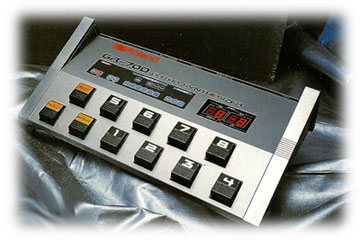
Roland GR-700
|
The GR-700 has six, independent, analog synth voices, two oscillators on each voice. Roland digitally clocked these oscillators and called them "DCOs", as a response to the fact that the earlier Roland oscillator’s pitch had a tendency to drift in performance. The DCOs on the GR-700 generate classic analog waveforms: sawtooth wave, square wave, and pulse width modulated wave, as well a noise for special effects.

|
| Click on image for larger view. |
The oscillators on the GR-700 can also be synced with cross modulation for hard, biting analog sounds or with ring modulation for metallic sounds. The GR-700 has a sweet Low Pass Filter with Resonance on each voice, with an additional High Pass Filter. And of course there are complete LFO and Envelope controls. To top it all off, the GR-700 adds a classic Roland analog Chorus circuit! If you like that expansive Roland Chorus found on early 80s products, you will love the Chorus on the GR-700.
The synth engine in the GR-700 is the same synth engine found in the Roland MKS-30 and Jupiter JX-3P. And, like these synths, the Roland GR-700 can use the PG-200 as a programming tool.
| Basses |
| Bourree |
| Dark |
Links to more information:
- GR-700 One Step Beyond! From the Roland User Group magazine, 1985
- John Themis in-depth GR-700 system review from Guitarist magazine, May 1985.
- GR-700 and GR-77B System Review and Details Guitar Player, June 1986.
- Steve Carnelli article on three favorite GR-700 patches, with performance and programming tips.
- Mark Wood article guitar synthesizers, featuring the Roland GR-700.
- Vintage Guitar Player Magazine Interview with John Abercrombie highlighting the Roland GR-700.
- Vintage Guitar Player Magazine Interview with Steve Morse highlighting the Roland GR-700.
- Download the GR-700 Owner's Manual (pdf).
- Download 64 GR-700 Alternate Sounds (Alternate Patches #2) (pdf).
- Download 64 GR-700 Alternate Sounds (Alternate Patches #3) (pdf).
- Behringer DeepMind 12 As Modern GR-700 Guitar Synth Module
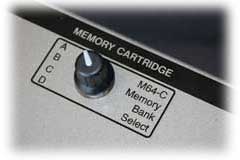
M-16C 4x Memory Expansion Using M-64C Memory Cartridge - 320 Patch Memory:
Click here to learn how to easily modify your GR-700 to expand the memory to 320 patches
Features and Specifications:
- Expand patch memory from 128 patches to 320 (5 x 64 = 320)
- Adds four selectable external memory banks of 64 patches each
- Use either 1, 4-position, to pole rotary switch or 2 SPST switches to select banks
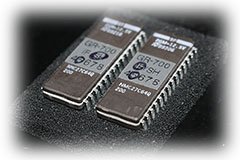
DIY Roland GR-700 Software Version Upgrade
Click here to learn how to upgrade the GR-700 operating system software.
Features and Specifications:
- Faster Response Time
- New Factory Presets
- MIDI Input (Requires Hardware Modification)
Version History Hardware and Software:
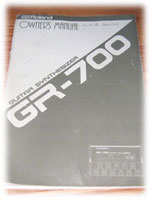 |
|
Original manual
|
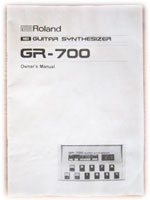 |
|
Later manual
|
|
|
|
|
|
|
|
Click on image to enlarge
|
|
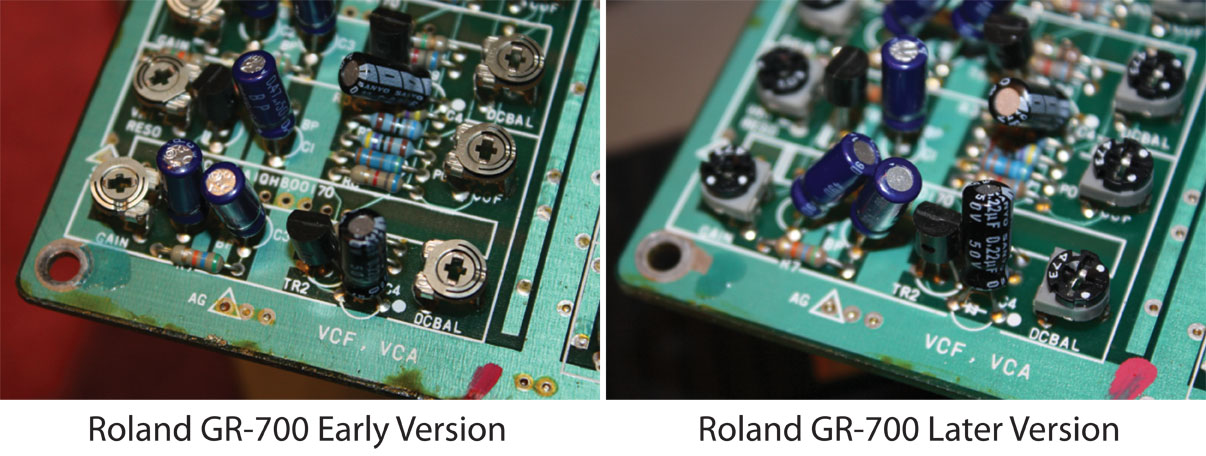
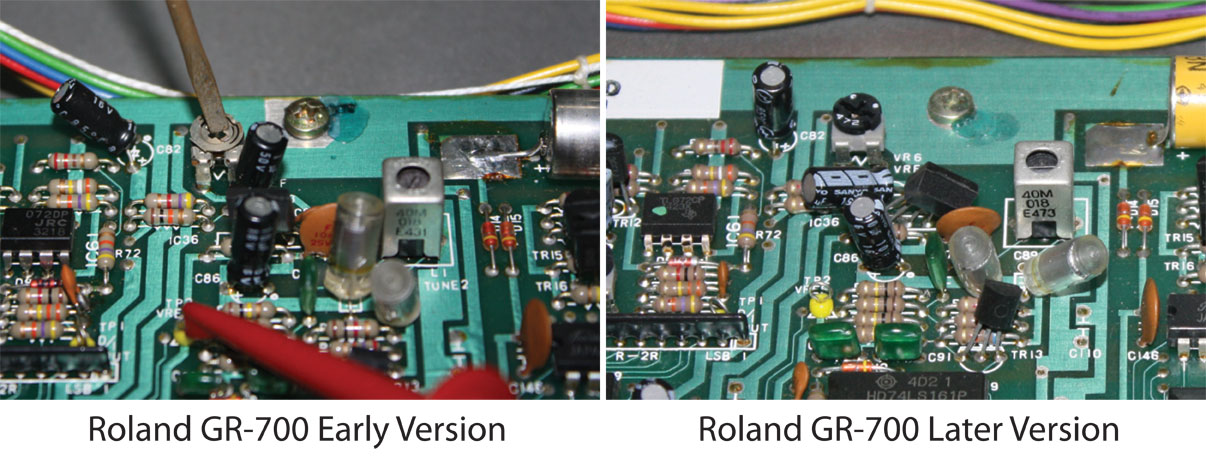
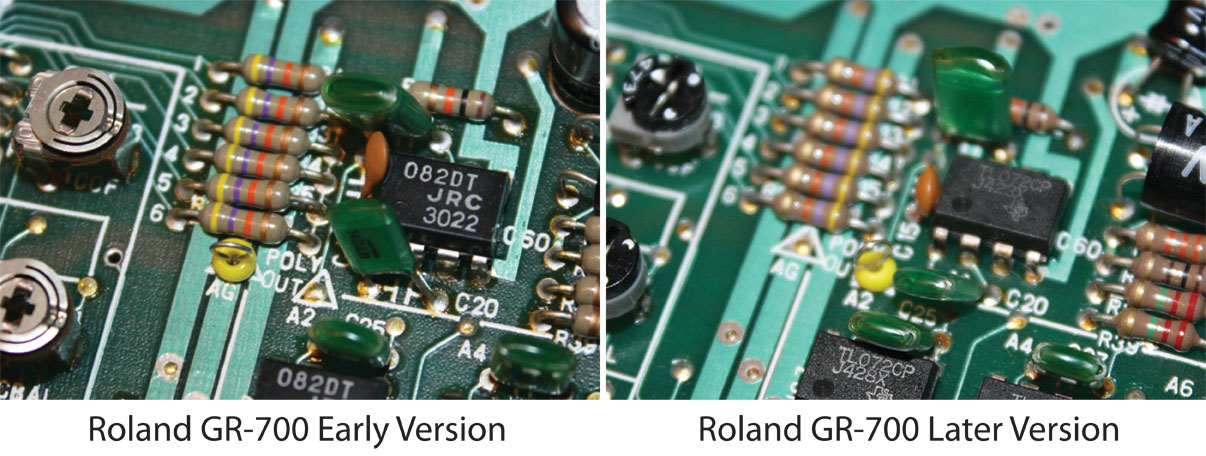
Generally speaking, the Roland GR-700 shipped in two different versions. There is an early, and later, version of the hardware, an early and later version of the factory patches, and early and later versions of the owner's manual.
I have not had the chance to see if the changes in manual, patches, and software are related to each other. The cosmetic changes to the GR-700 manual seems to be related to achieving uniformity with other Roland products from the same period.
Hardware Versions:
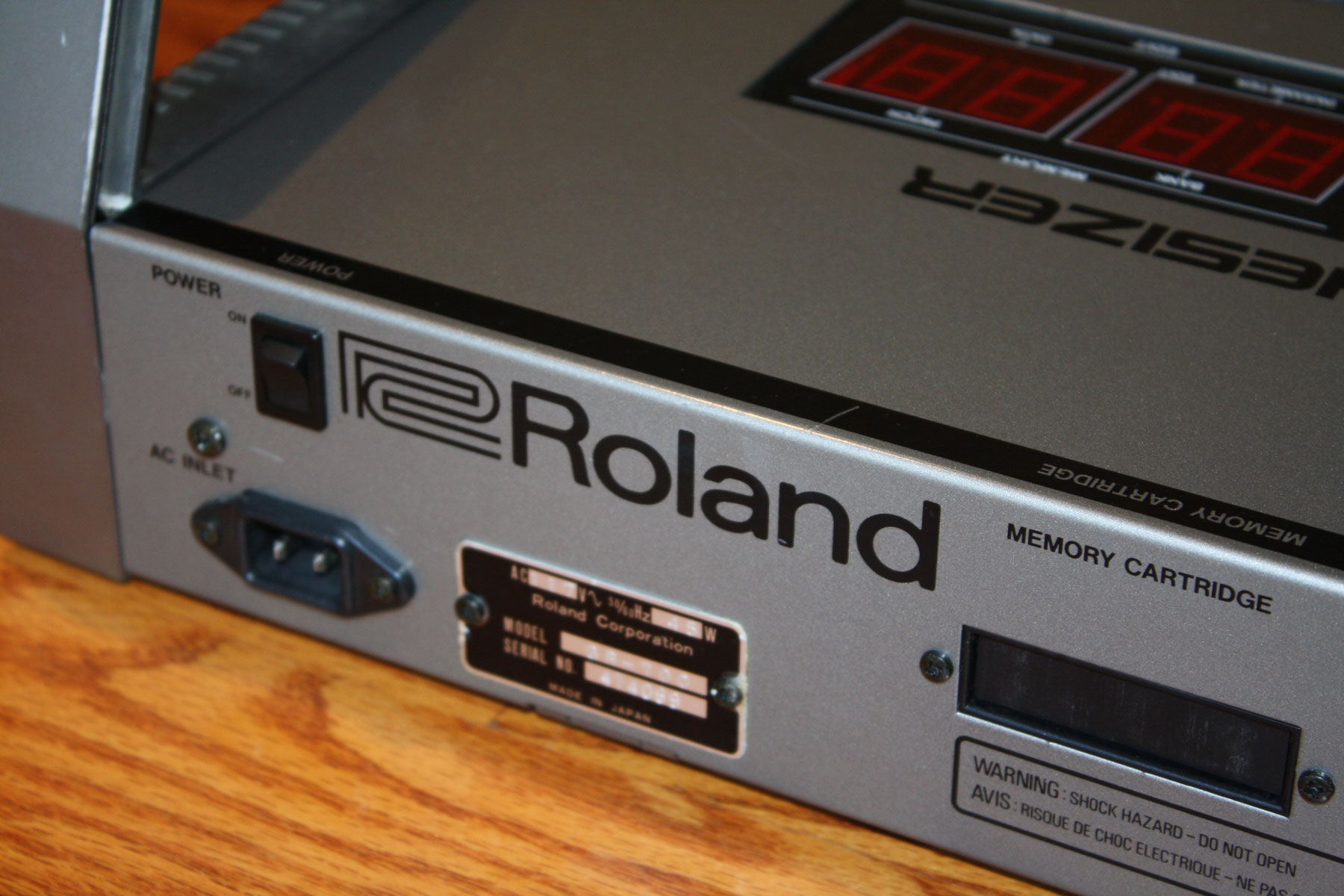
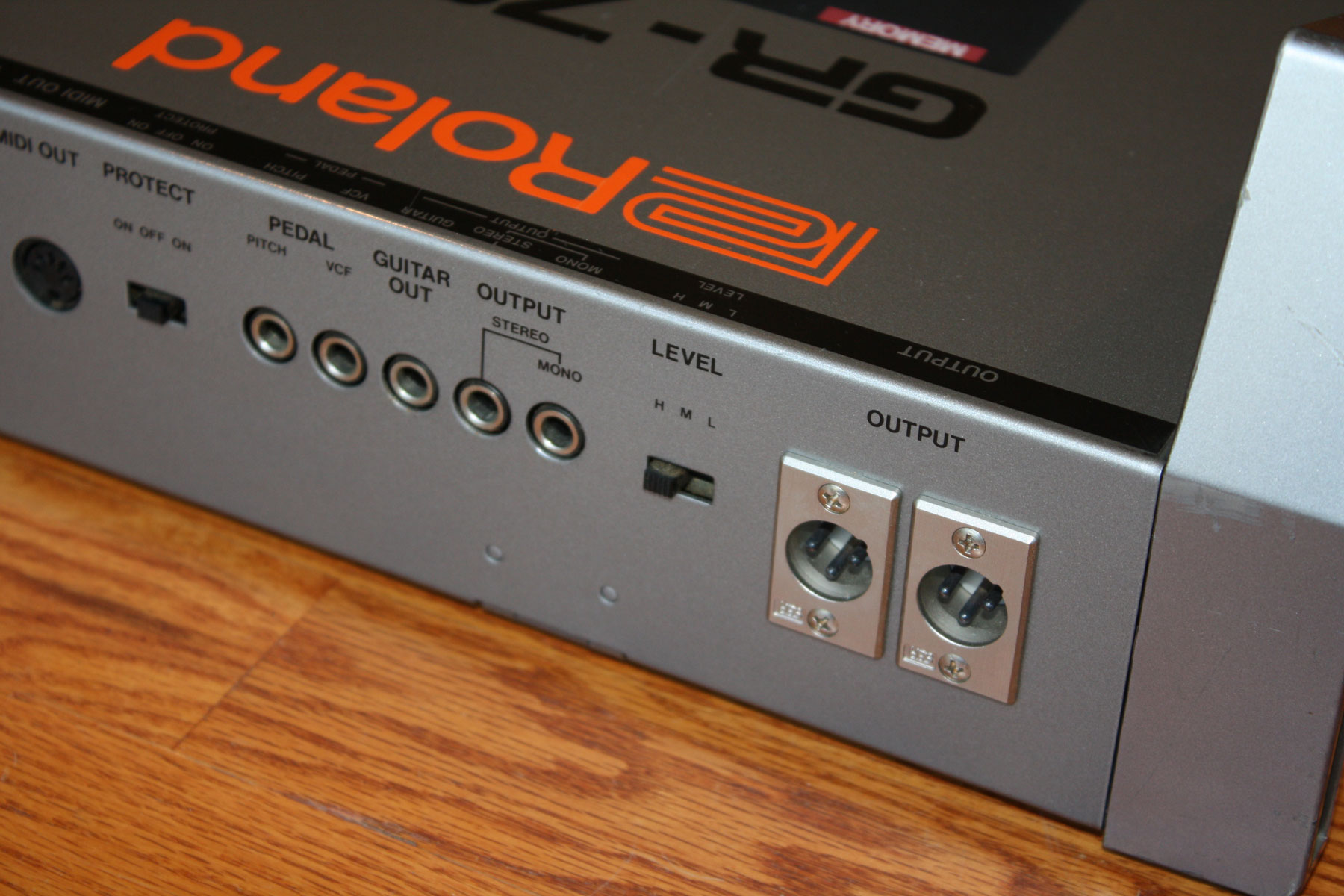
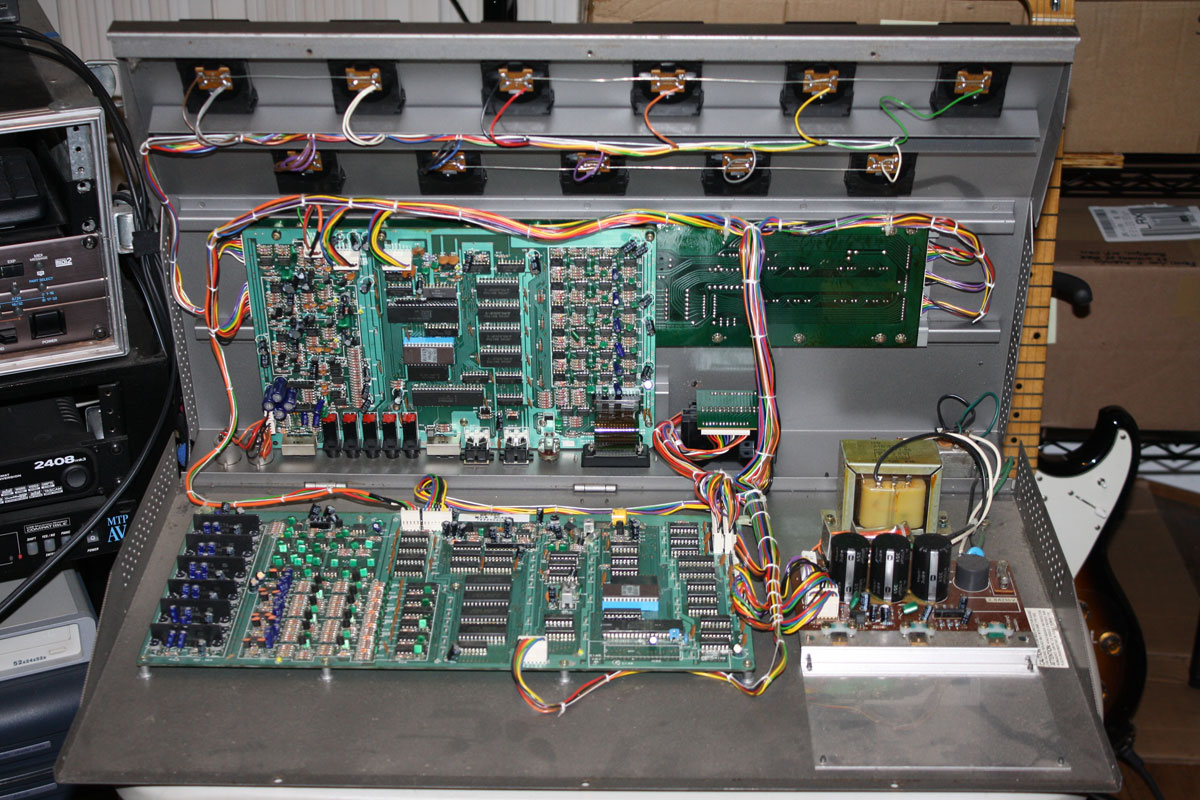
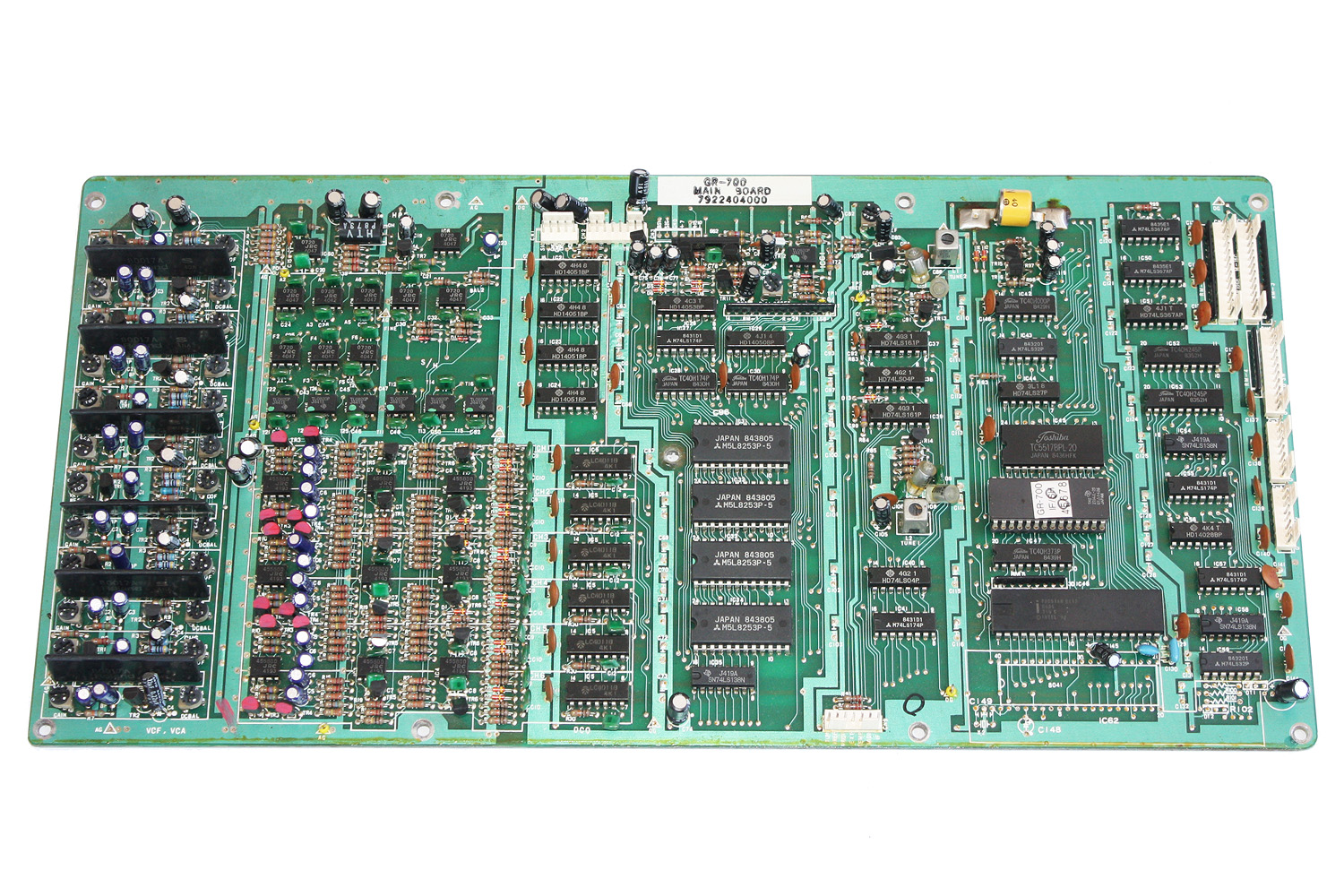
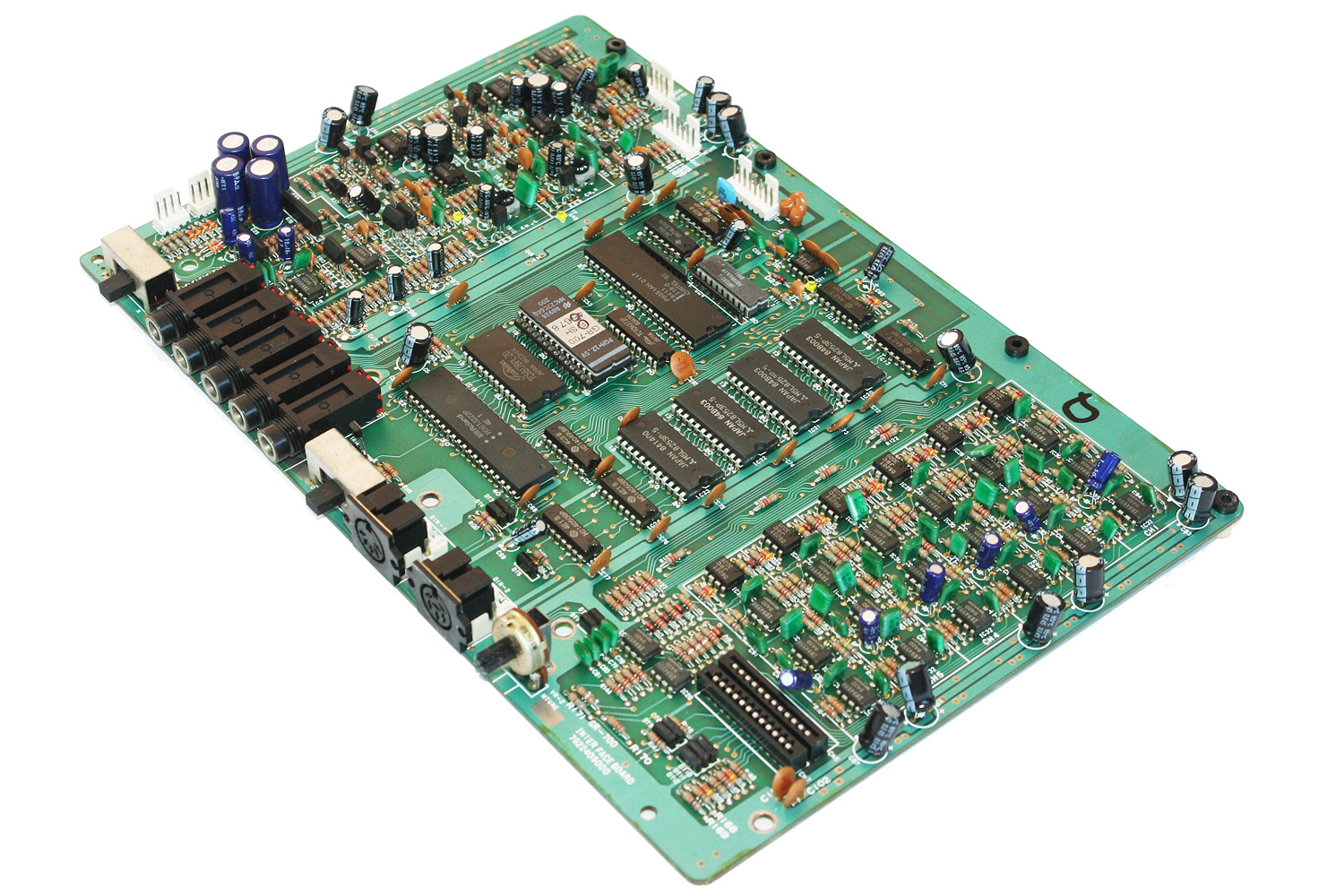
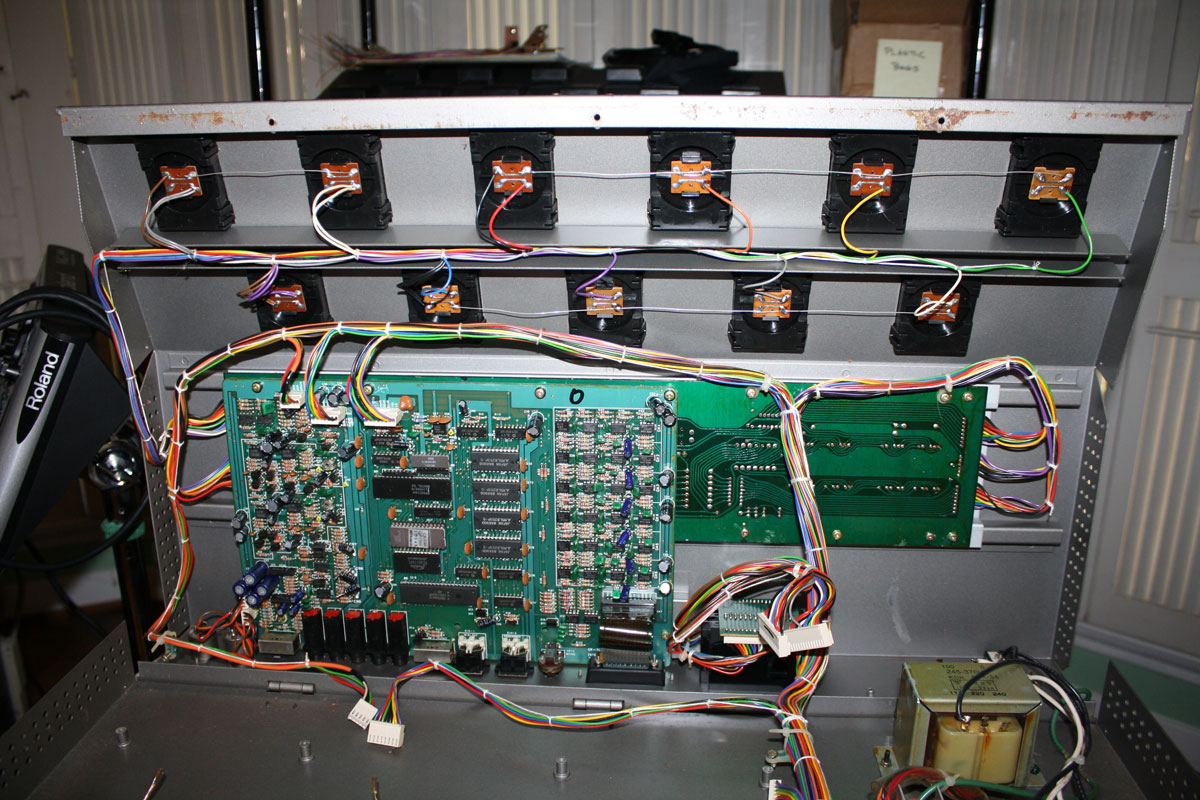
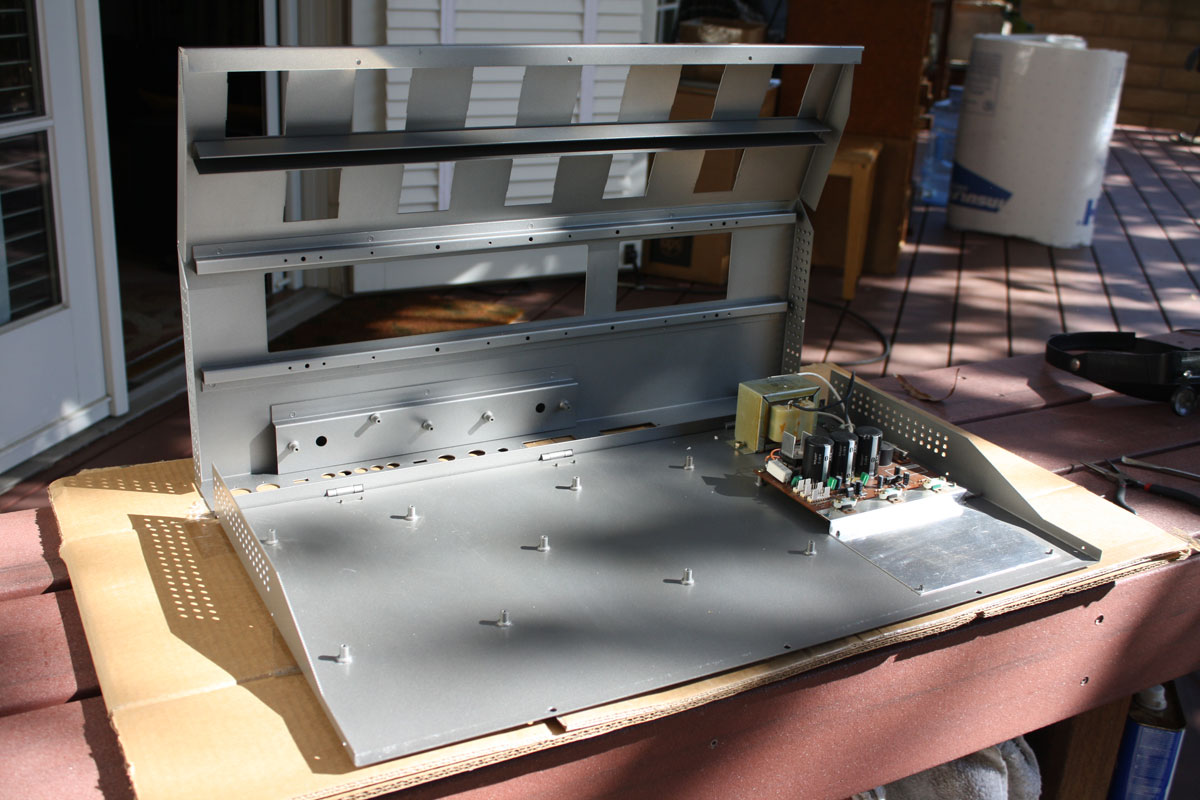
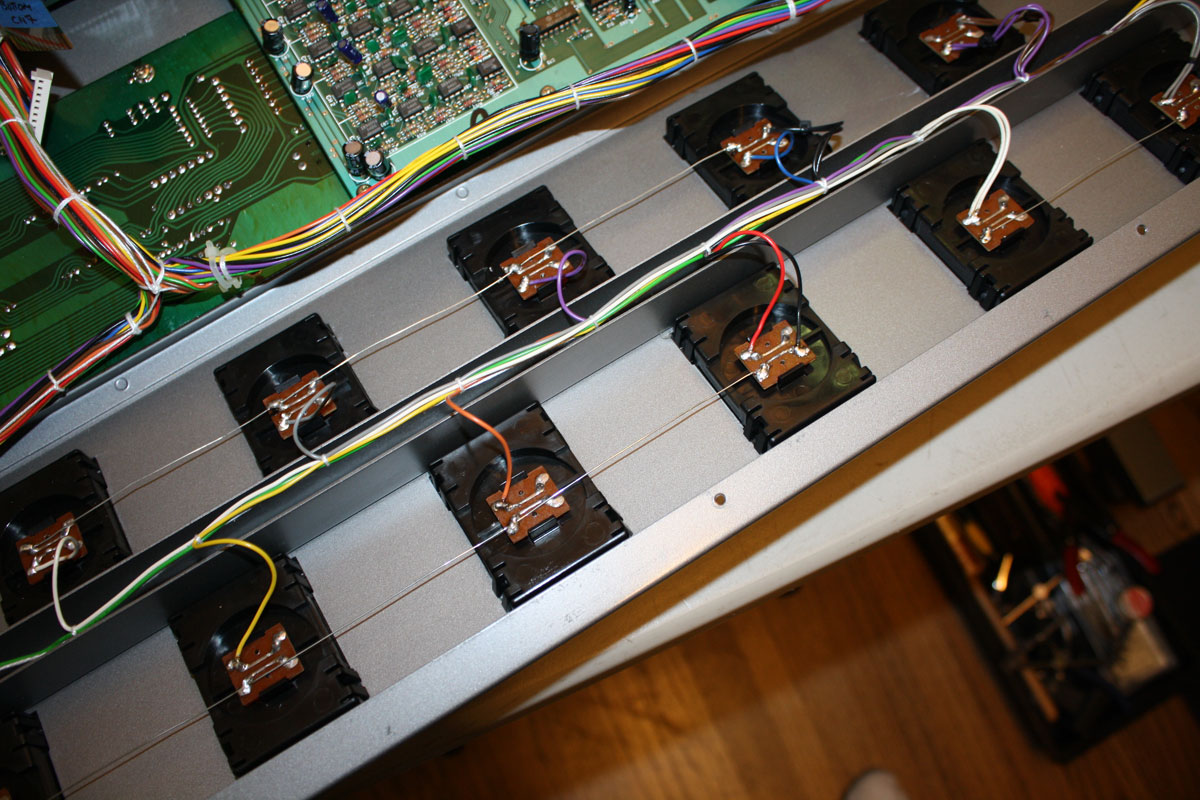
The early hardware versions are immediately recognizable for the open, metal frame trim pots. The later versions replaced these with more durable trimmers using a sealed plastic enclosure. This is shown in the first two photos at right.
Also, test points were added to reflect the calibration procedures outlined in the service manual. The bottom picture shows the "poly output" test point. In the early version, there is an analog ground test point, but no test point to easily attach your scope probe to analyze the poly out waveforms. In the later version a poly test point was added by moving the ground test point just a bit to the right.





Custom Blue Finish - Chuck Nin:
 |
 |
| Click on any image for larger view. |
|
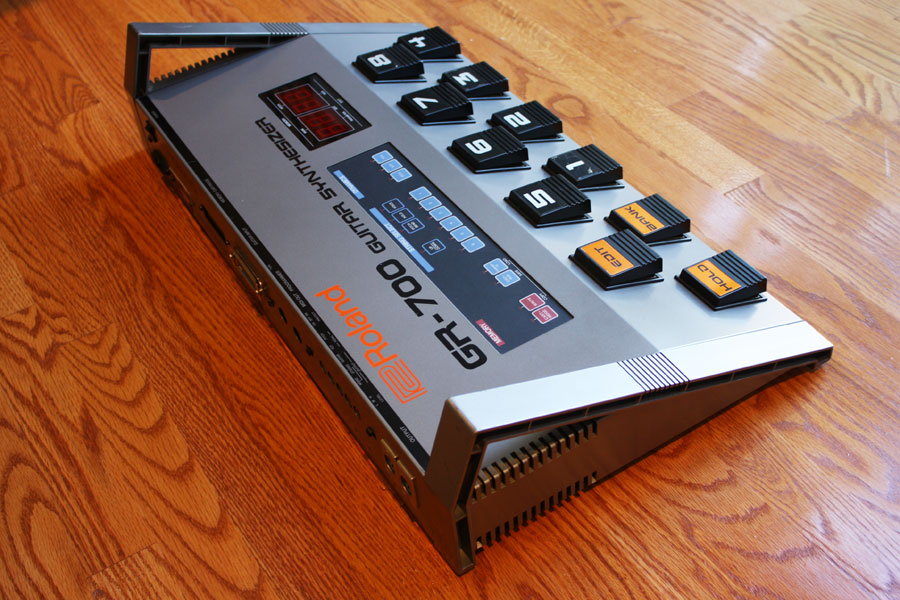
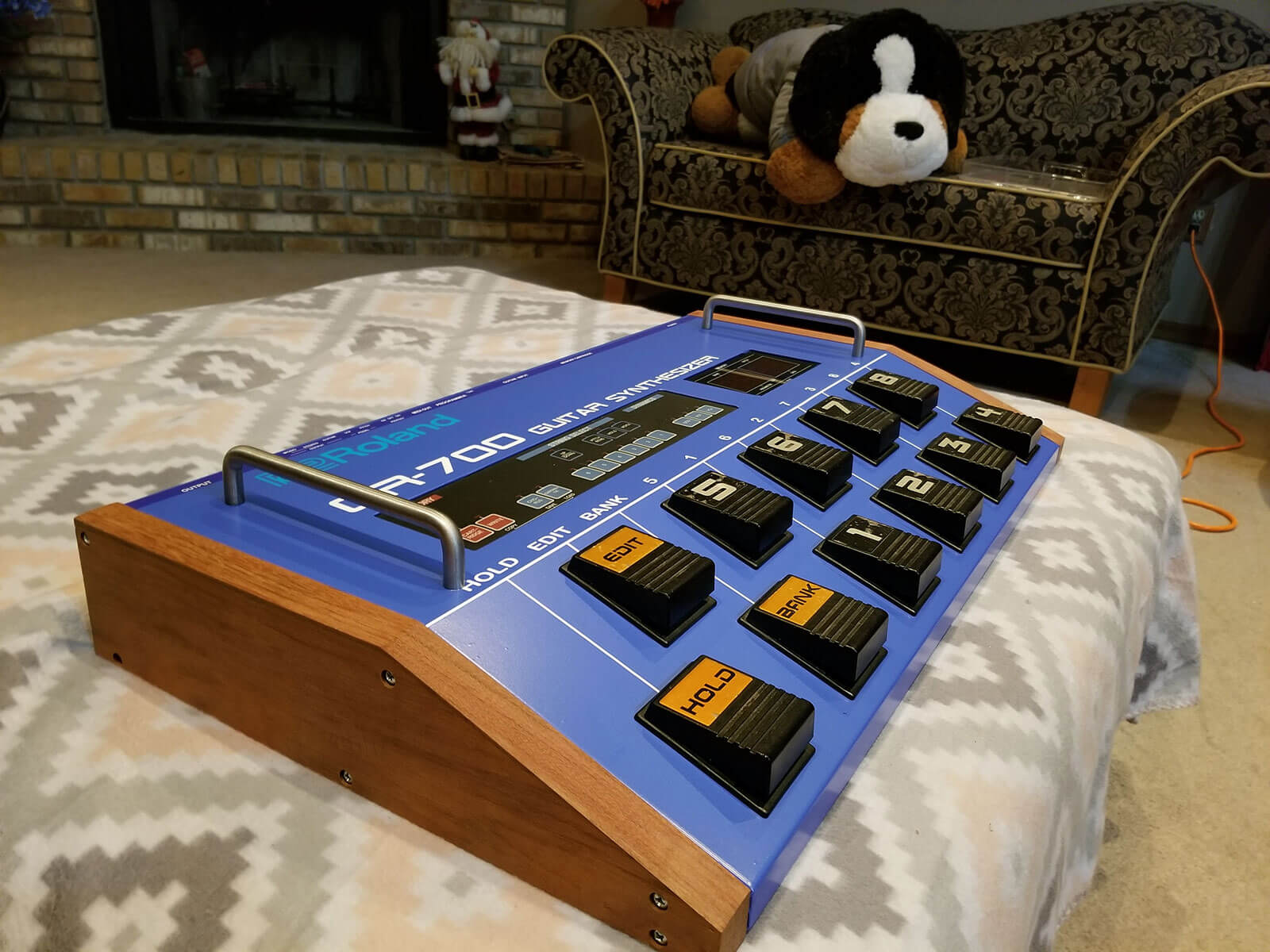
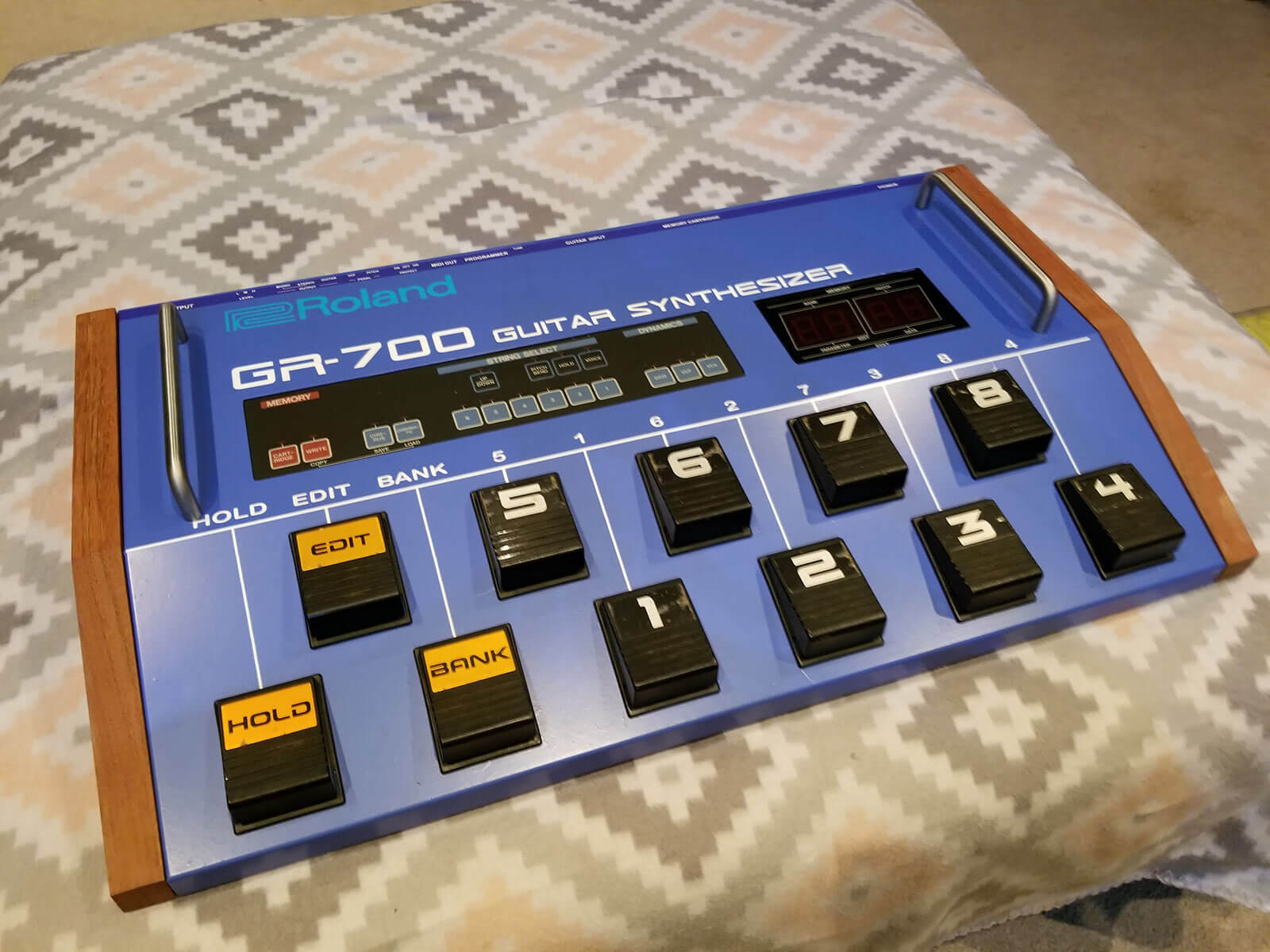
Chuck Nin got creative with the GR-700 makeover. I love the combination of the blue finish, expanded graphics, new handles, and of course the handsome natural wood end blocks!
Check out his YouTube channel for details on the modifications, and other great synth mods!
Original and Alternate GR-700 Patches:
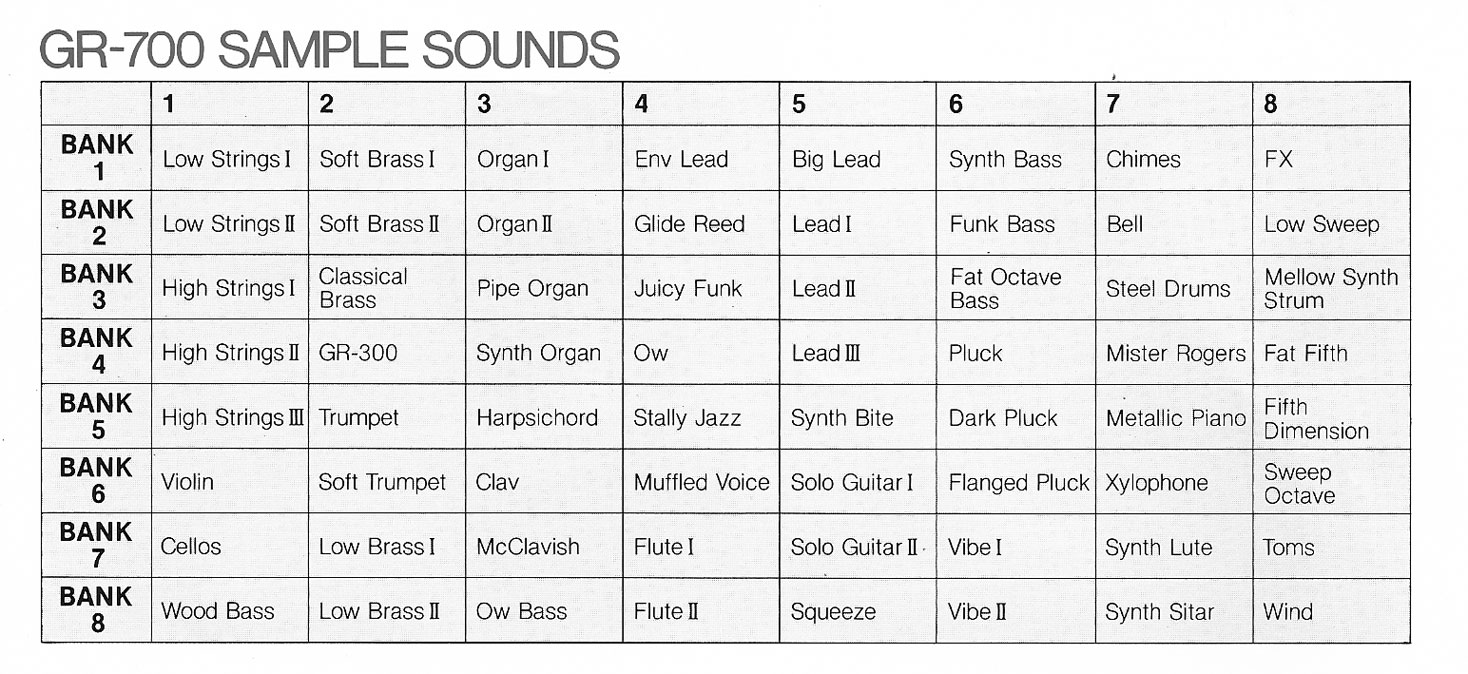
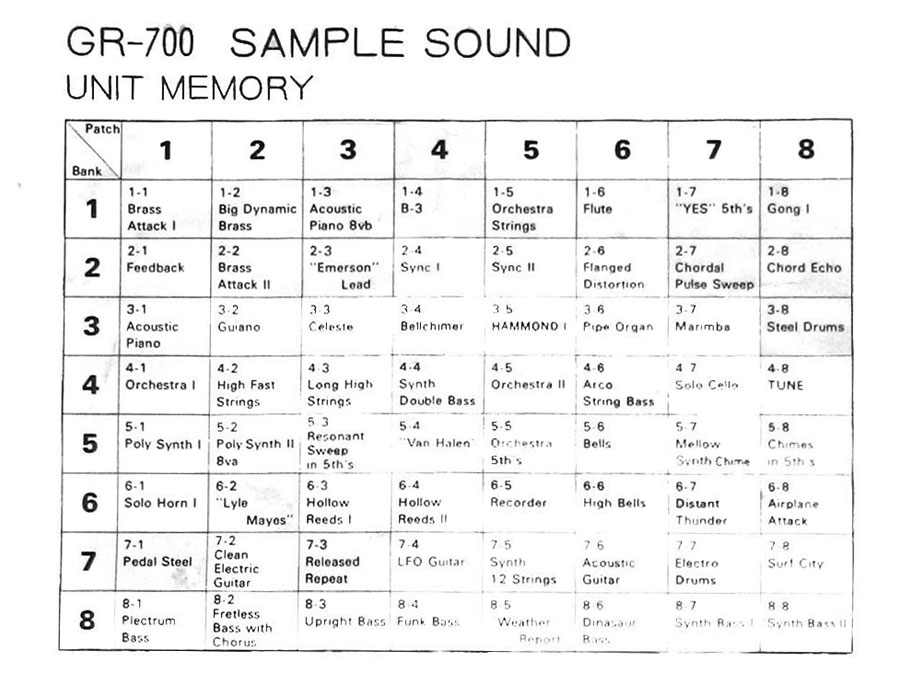
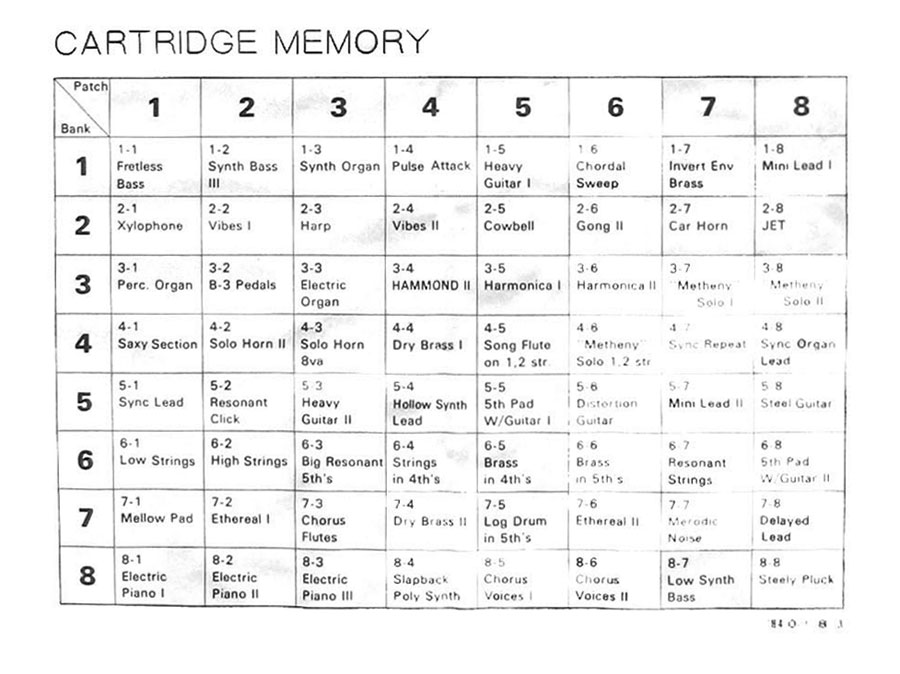
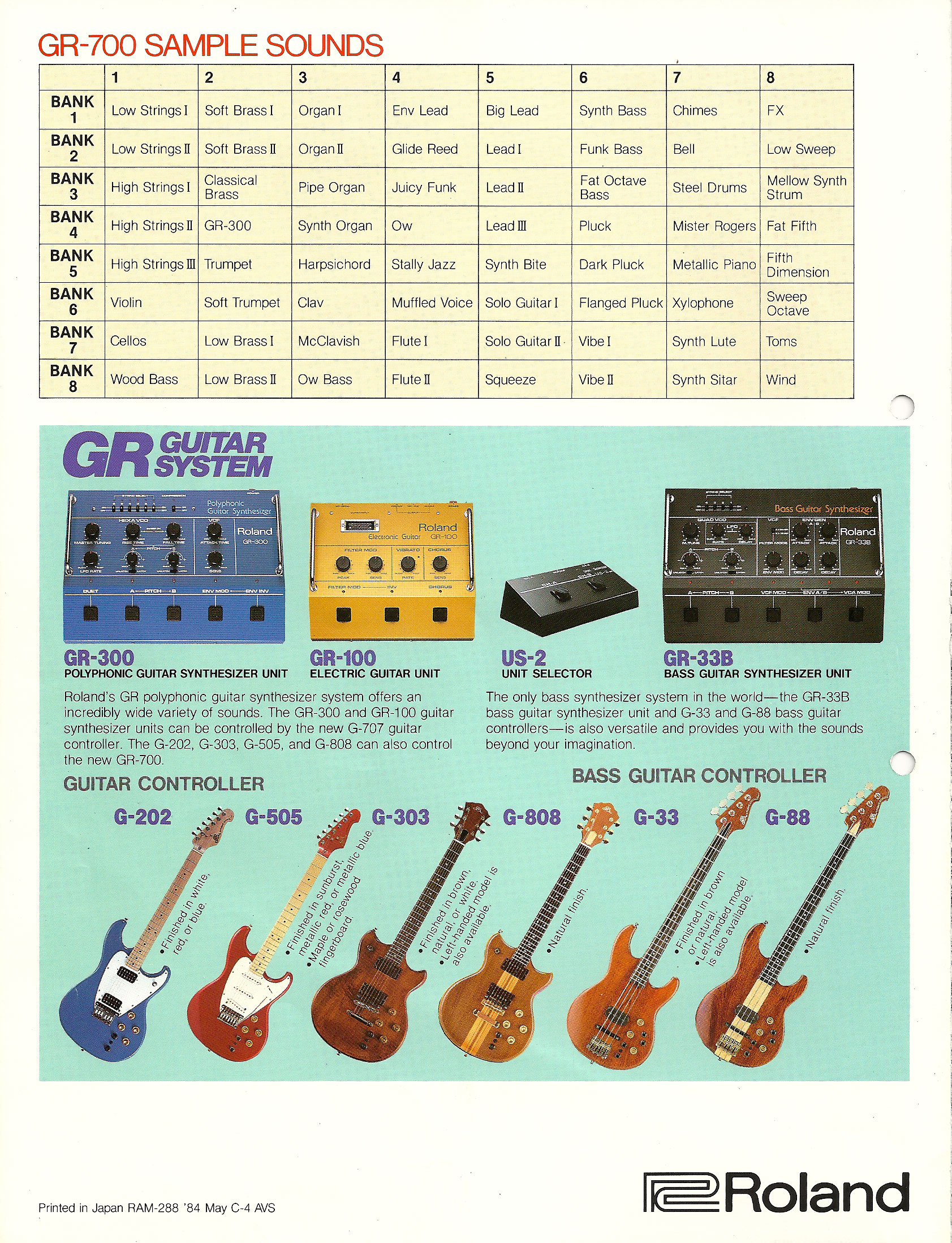
Broadly speaking, there are two sets of internal sounds for the GR-700. The most common set is programmed into the EPROM chips for version 1.1 through version 1.4 software. This is the list of sounds included in the Roland GR-700 brochure. With version 1.5 software, Roland changed the internal sounds.
|
|
|
| Patch list from Roland GR-700 brochure. Version 1.1 - 1.4 patches |
Later patches from Version 1.5 software |
Cartridge sounds listed with version 1.5.
|
| Click on any image for larger view. |
||
For me, the most distinctive GR-700 patches are the special effect sounds. Sometimes it is a little hard to distinguish a GR-700 brass patch from a poly synth patch, but the sound in the first list above, 1-8, "FX" is very cool. It features inverted filter resonance modulation, and I use it quite a bit.
GR-700 Factory Patch Lists:
Banks 1 - 4 Version 1.5 Software
| 1-1 Brass Attack I | 1-2 Big Dynamic Brass | 1-3 Acoustic Piano 8vb | 1-4 B-3 |
| 1-5 Orchestra Strings | 1-6 Flute | 1-7 "YES" 5ths | 1-8 Gong |
| 2-1 Feedback | 2-2 Brass Attack II | 2-3 "Emerson" Lead | 2-4 Synth I |
| 2-5 Sync II | 2-6 Flanged Distortion | 2-7 Chordal Pulse Sweep | 2-8 Chord Echo |
| 3-1 Acoustic Piano | 3-2 Guano | 3-3 Celeste | 3-4 Bellchimer |
| 3-5 HAMMOND I | 3-6 Pipe Organ | 3-7 Marimba | 3-8 Steel Drums |
| 4-1 Orchestra I | 4-2 High Fast Strings | 4-3 Long High Strings | 4-4 Synth Double Bass |
| 4-5 Orchestra II | 4-6 Arco String Bass | 4-7 Solo Cello | 4-8 TUNE |
Banks 1 - 4 Version 1.1 to 1.4 Software
| 1-1 Low Strings I | 1-2 Soft Brass I | 1-3 Organ I | 1-4 Env Lead |
| 1-5 Big Lead | 1-6 Synth Bass | 1-7 Chimes | 1-8 FX |
| 2-1 Low Strings II | 2-2 Soft Brass II | 2-3 Organ II | 2-4 Glide Reed |
| 2-5 Lead I | 2-6 Funk Bass | 2-7 Bell | 2-8 Low Sweep |
| 3-1 High Strings I | 3-2 Classical Brass | 3-3 Pipe Organ | 3-4 Juicy Funk |
| 3-5 Lead II | 3-6 Fat Octave Bass | 3-7 Steel Drums | 3-8 Mellow Synth Strum |
| 4-1 High Strings II | 4-2 GR-300 | 4-3 Synth Organ | 4-4 Ow |
| 4-5 Lead III | 4-6 Pluck | 4-7 Mister Rogers | 4-8 Fat Fifth |
Reinitializing Patches:
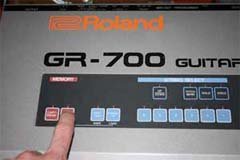
It is possible to reinitialize the first four banks of patches for the GR-700, banks 1 though 4. There is no way to recover patches in banks 5 through 8 if they have been lost.
To reinitialize patches in banks 1 - 4, turn on the power switch while pressing down the WRITE (copy) button.
Be sure to set the rear panel memory protect switch to the off (middle position) to have the memory protect circuit turned off. Since the GR-700 only restores the contents of banks 1-4, banks 5-8 may contain random data after reinitialization.
Repairs - Service Bulletins:
Roland Service Bulletin No. 1000229 - Juno-106/MKS-30/GR-700 December 21, 1984
80017a Chip Failures:
Roland released a service bulletin regarding the problematic 80017a chips in the Roland GR-700. This problem continues to persist for GR-700 users. Perhaps one day one string on your GR-700 suddenly stops working. Or you can hear the string, but it plays very softly, followed by intermittent bursts of noise. Or you turn the GR-700 on, and after a few minutes, it starts making loud noises.
- Download the original Roland 80017a chip failure bulletin.
- Download the GR-700 Service Manual Schematics.
- LISTEN - GR-700 80017a Failure Sample - Intermittent Burst of Noise
- LISTEN - GR-700 80017a Failure Sample - Notes Continues Softy in Background
- GR-700 replacement battery for internal memory or M-16C.
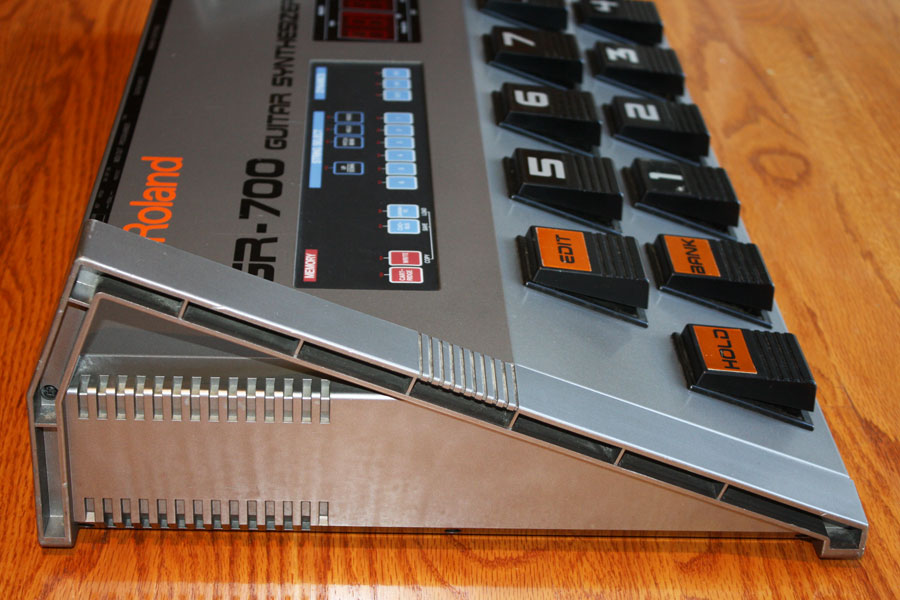
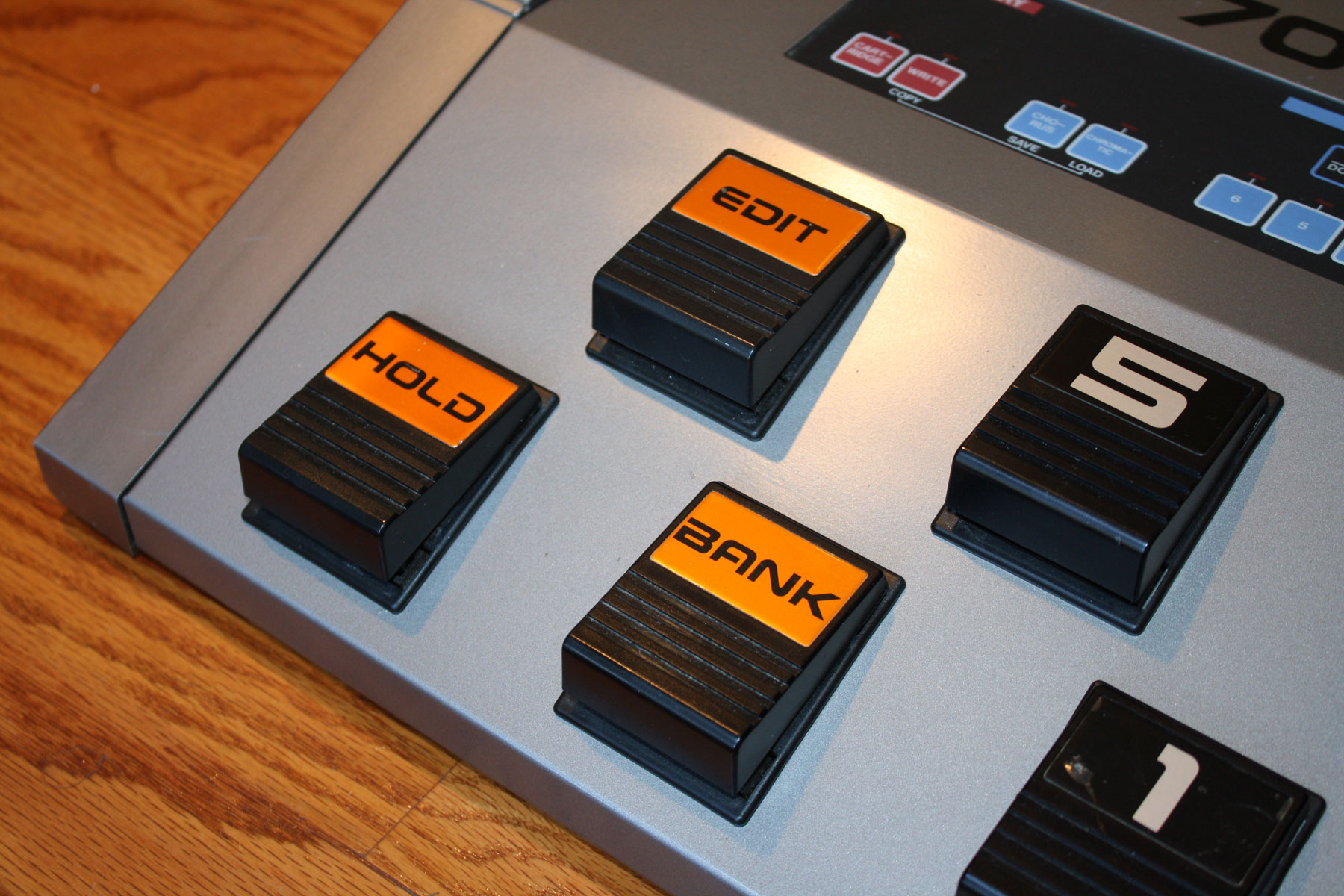
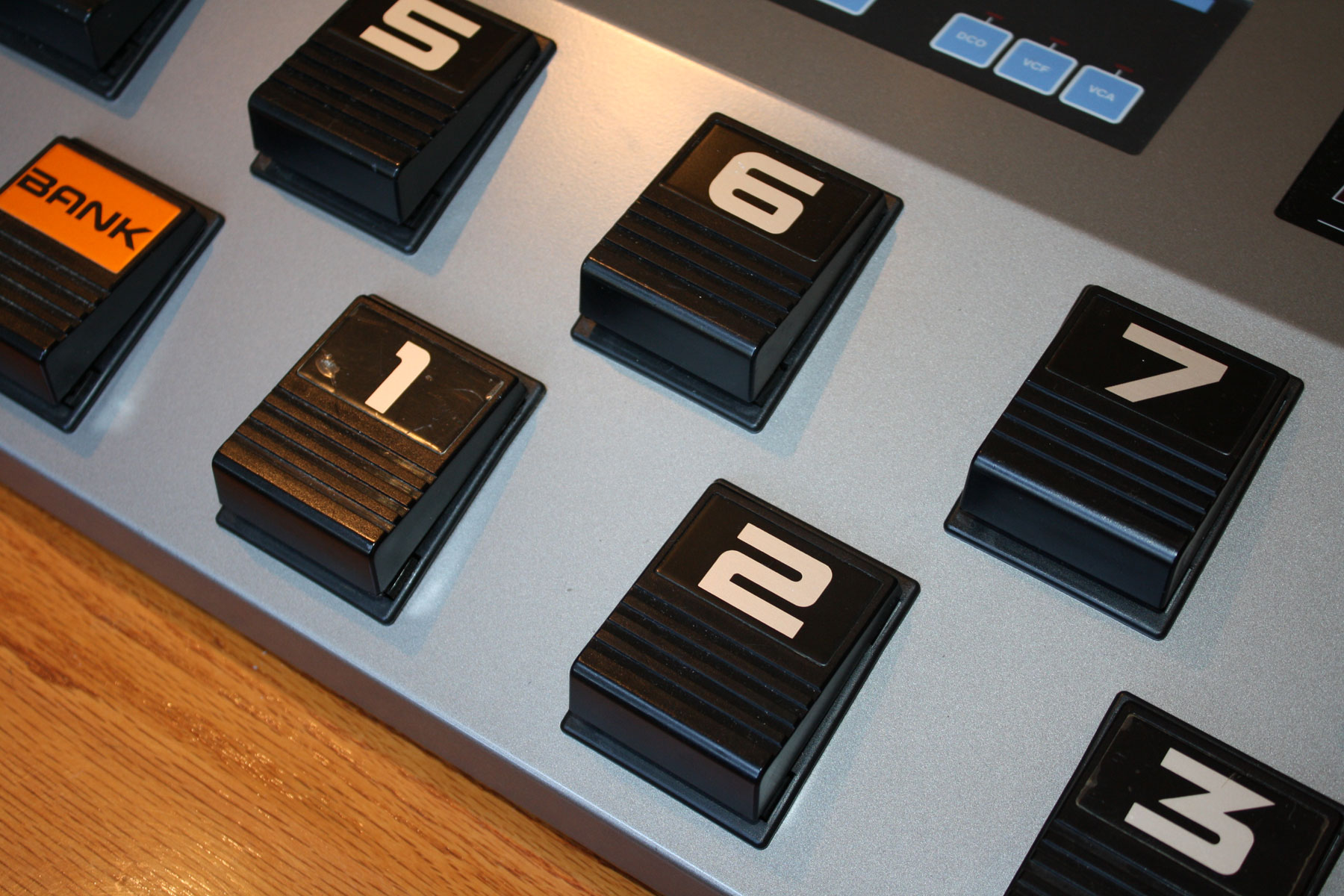
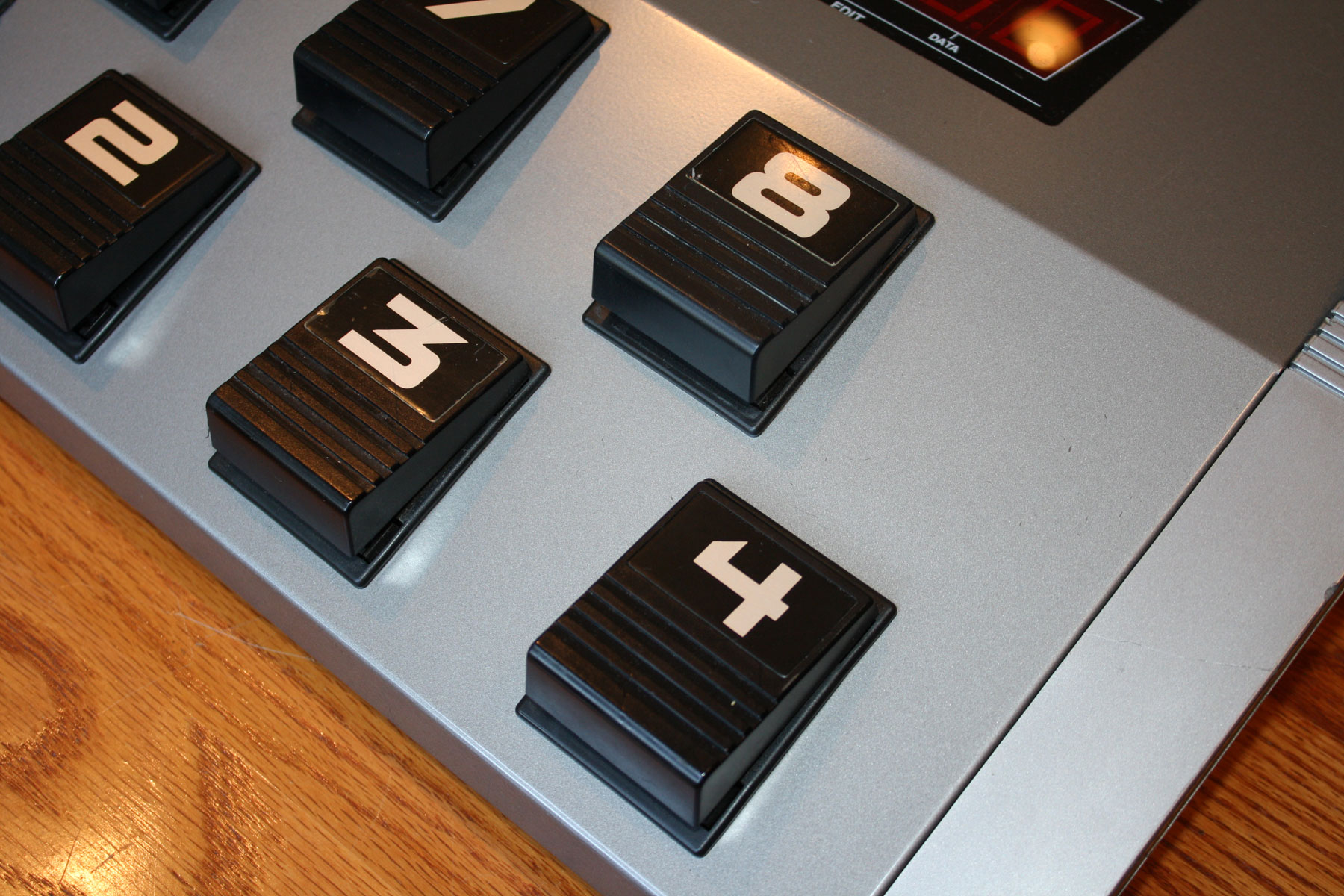
- GR-700 Foot Switch Repair - Failed Switch or Broken Pin Mechanism.
- 6-Pin inline connectors for PG-200 and GR-700.
You most likely have a failed 80017a VCF/VCA chip. Here is a list of typical 80071a symptoms:
- Erratic or sudden loud noise from synthesizer output, particularly after 10 minutes of powering up.
- Note hang-ups or long sustain
- One synth voice will not respond to filter or amplifier changes.
- Unstable operation.
- One particular voice or string will not sound, "D" string, "A" string etc.
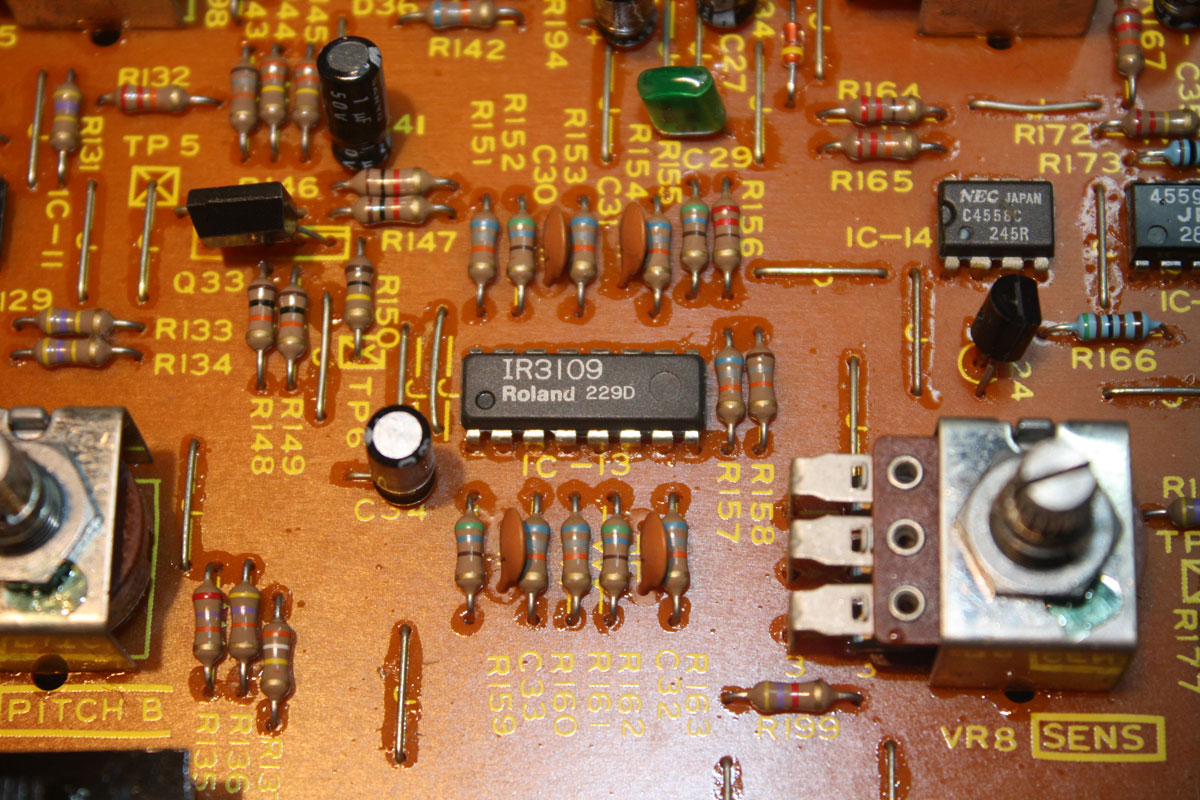
If you are familiar with the eighties Roland synthesizers, then you have likely heard about the dreaded 80017a VCF/VCA chip failure issue. Many synthesizers built by Roland in this period used the 80017a chip: the Juno 106, MKS-30, HS-60 and of course the GR-700. The 80017a is basically a voltage-controlled filter and a voltage-controller amplifier on a single, customized chip made for Roland. The actual components in the 80017a were found as individual elements in the earlier Juno 60 synthesizer: an IR3109 and two BA662 chips. The IR3109 was also used as the heart of the excellent -24 dB low-pass filter in the Roland GR-300.
Why exactly Roland chose to consolidate those three chips (and some surface mounted resistors and capacitors) onto a single ceramic chip dipped in plastic remains a mystery, though Roland seems to have an ongoing policy of creating custom chips that cannot be replaced or replicated. In any case, early in the process there were failures with the chips, and Roland issued a service bulletin and replaced lots of chips. Then, as the chips aged, problems started to show up with again. Third party suppliers started making clones of the original chips using modern equivalents. And I sold quite a few working chips on ebay after gutting GR-700s for parts. I extensively tested these chips, and no one had a subsequent failure from the chips I pulled. But this bothered me: would it be possible to modify a GR-700 in some way that would guarantee against a future 80017a chip failure?
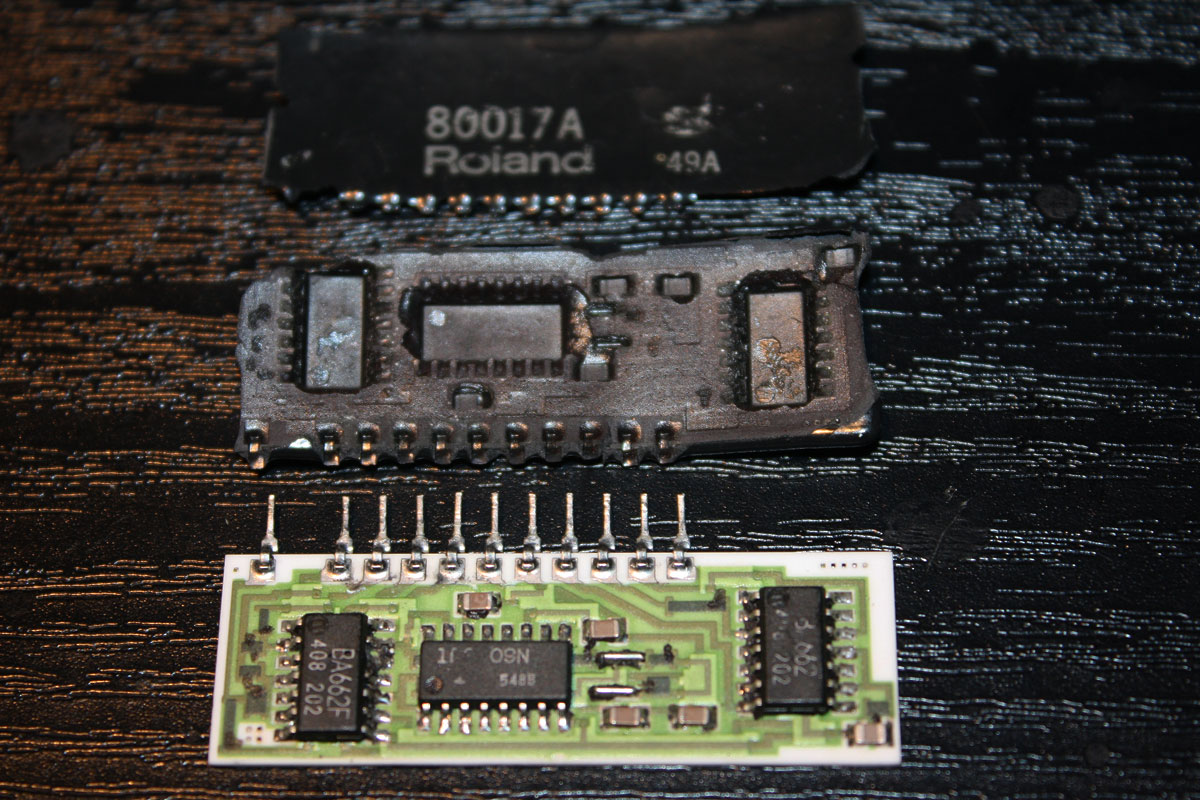
As it turns out, the answer is to remove the problematic resin coating around the components. And this was not my idea, someone sent me a link to a YouTube clip showing how to get the job done. I happened to be working on a GR-700 that needed five (!) 80017a chips. I had five failed chips on hand, and used the Acetone procedure to remove the resin. Each chip was then individually tested in a special socket, running continuously for 12 hours with no failure. As each chip passed the test, I labeled it and replaced it in the GR-700.
The result is flawless operation. I do not know why the resin causes problems, but I am guessing that with aging the resin builds up electronic capacitance, causing the chip to fail once the temperature in the synthesizer warms up. This is the best possible solution to the 80017a problem. You keep the original chips that Roland designed, maintaining the sound of the instrument, and you protect against future failures as well.
If one string does not sound, make certain that it is not your 24-pin cable!
An easy way to determine if you cable is working correctly on the GR-700 is to press the EDIT foot pedal, followed by 4 and 8. This puts the GR-700 in tuning mode. Play each string on the GR-700, and you should see the display change for each string. The displays shows "1" for the high E string, "2" for the B string, down to "6" for the low E string. If the GR-700 responds to all six strings, then your cable is good, and most likely you have a failed 80017a chip.
If you need to have your GR-700 chips repaired, watch the YouTube repair clip and this yourself, or you can also contact Allen Coppock at the website Synth Spa. He can repair and calibrate your Roland GR-700. To restore the chips to factory specification, your really need some test tools, including an oscilloscope.
|
|

|
|
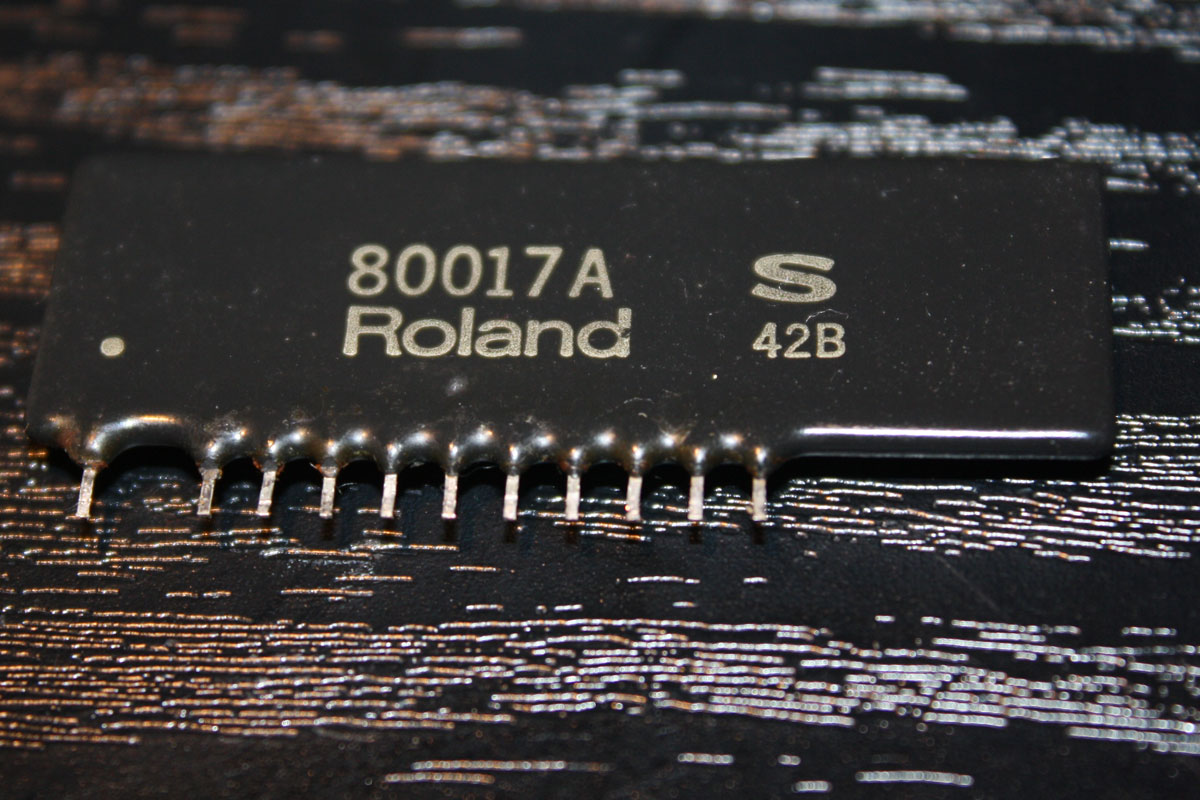
| Failed 80017a chip from lot number 42B, with resin in place. | Resin shell removed from the chip by soaking in Acetone. | Tested and relabeled chip, ready for installation in the GR-700. | The custom Roland IR3109 chip shown in the GR-300. This chip is part of the 80017a assembly. |
|
Click on any image to enlarge in new window.
|
|||
Locating Specific 80017a Chip Failure:
 |
 |
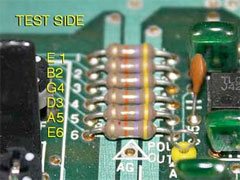 |
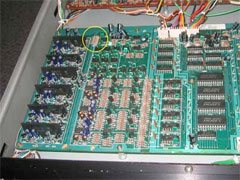
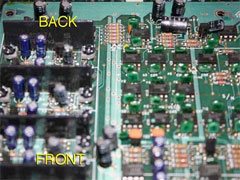
| MKS-30 interior Photo. Summing resistors circled in rear. | Detail from GR-700 Interior. Resistors in rear. | Summing Resistors Close-up, GR-700. Test side is on left. |
There are six summing resistors used to combine each voice in these synthesizers. In the Roland GR-700 and MKS-30 example, shown above, the resistors bridge across the voice section to the output section. If you are not sure which voice is causing a problem, you can use a scope to see the VCF/VCA output by touching the left side of each resistor. If you do not have a scope, then attach a wire to chassis ground, and then touch the wire to the left side of each resistor. This will mute the output of the synthesizer voice. When you mute the output of the bad VCF/VCA, the erratic sound should stop.
Channel and String Identification:
It is very important to correctly identify the failed 80017a chip. The chart below shows how the guitar strings map to the channels inside the GR-700:
- Channel 1 = High E string
- Channel 2 = B string
- Channel 3 = G string
- Channel 4 = D string
- Channel 5 = A string
- Channel 6 = Low E string
Analog Calibration:
Since the GR-700 is an analog unit, it requires calibration from time to time. The many analog components in the GR-700 give it a fat, unique sound. However, with time these functions can drift, and many GR-700s may not sound as good as they originally did from the factory. With some basic test components, such as a multi-meter and oscilloscope, it is fairly easy to re-calibrate the GR-700 to factory specification.
When the 80017a chip is replaced, the small trimmers around the chip may have to be adjusted. These trimmers adjust the level, DC balance, resonance and filter cutoff for each chip. Level controls how loud each chip is, Resonance fine tunes the amount of feedback resonance, Filter Cutoff is a fine tune control for the low-pass filter cutoff. Finally DC Offset adjusts the start and ending output of the chip so that when the sound stops, the amount of voltage is zero.
The synth will work without making these fine adjustments, but you may find one voice louder than another, or you may hear soft clicks as a sound decays, indicating some DC offset. While the technical documentation provides specific procedures for setting each chip, most experienced technicians rely on their ears for the final judgment. Also, Roland tends to be cautious with their recommended settings, so users may use these adjustment options to expand the tonal range of their synth.
- Main board Voltage reference set to 4.7 plus/minus 0.01V
- DCO-1 reference tuning set
- DCO-2 and DCO-1 tuning set
- D/A Offset for maximum output before clipping
- Level adjustment for each individual voice
- VCA DC Balance set for each voice
- VCF filter level adjustment for each voice
- Final chorus bias adjusted for proper stereo imaging and fattest chorus tone



Accessories:
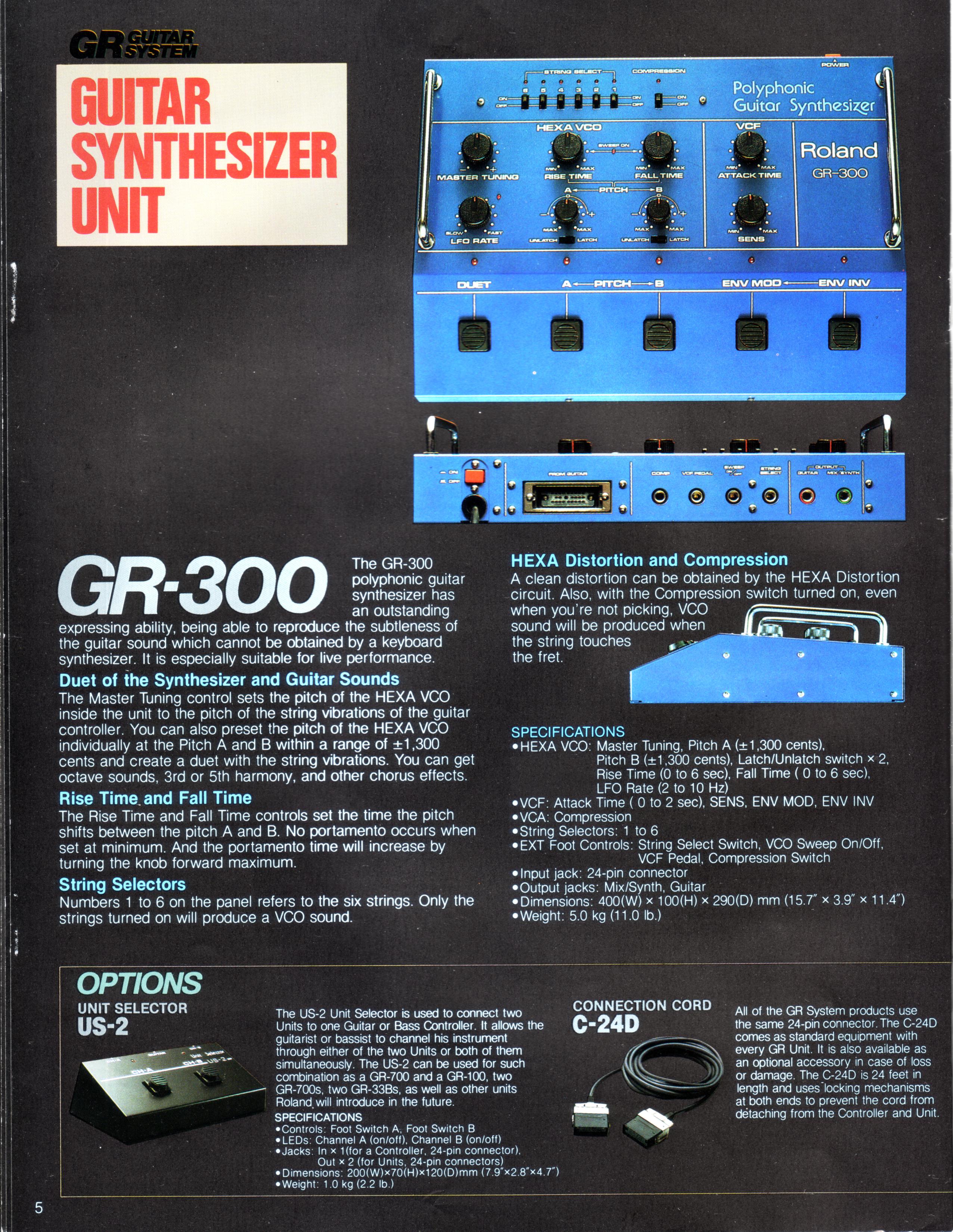
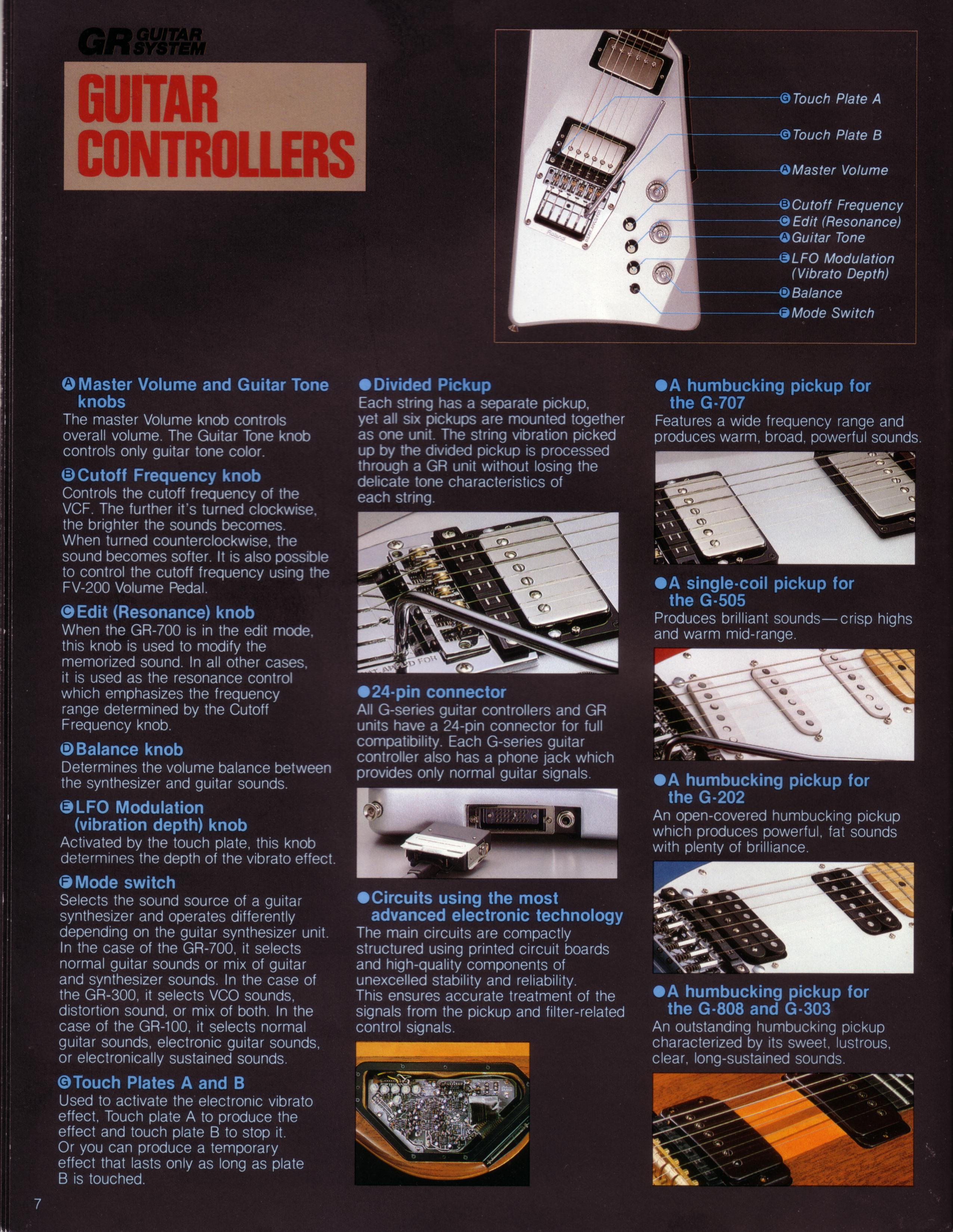
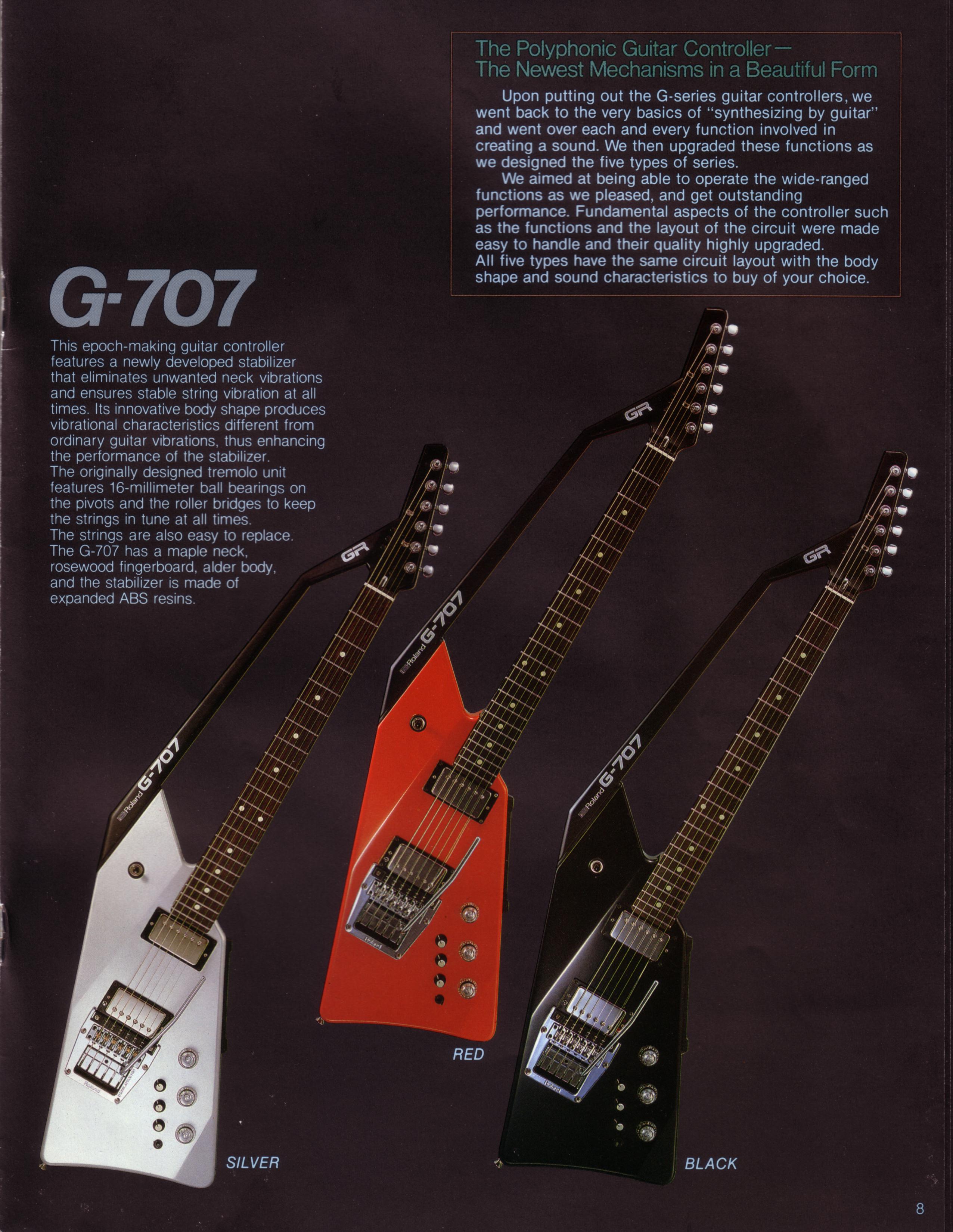
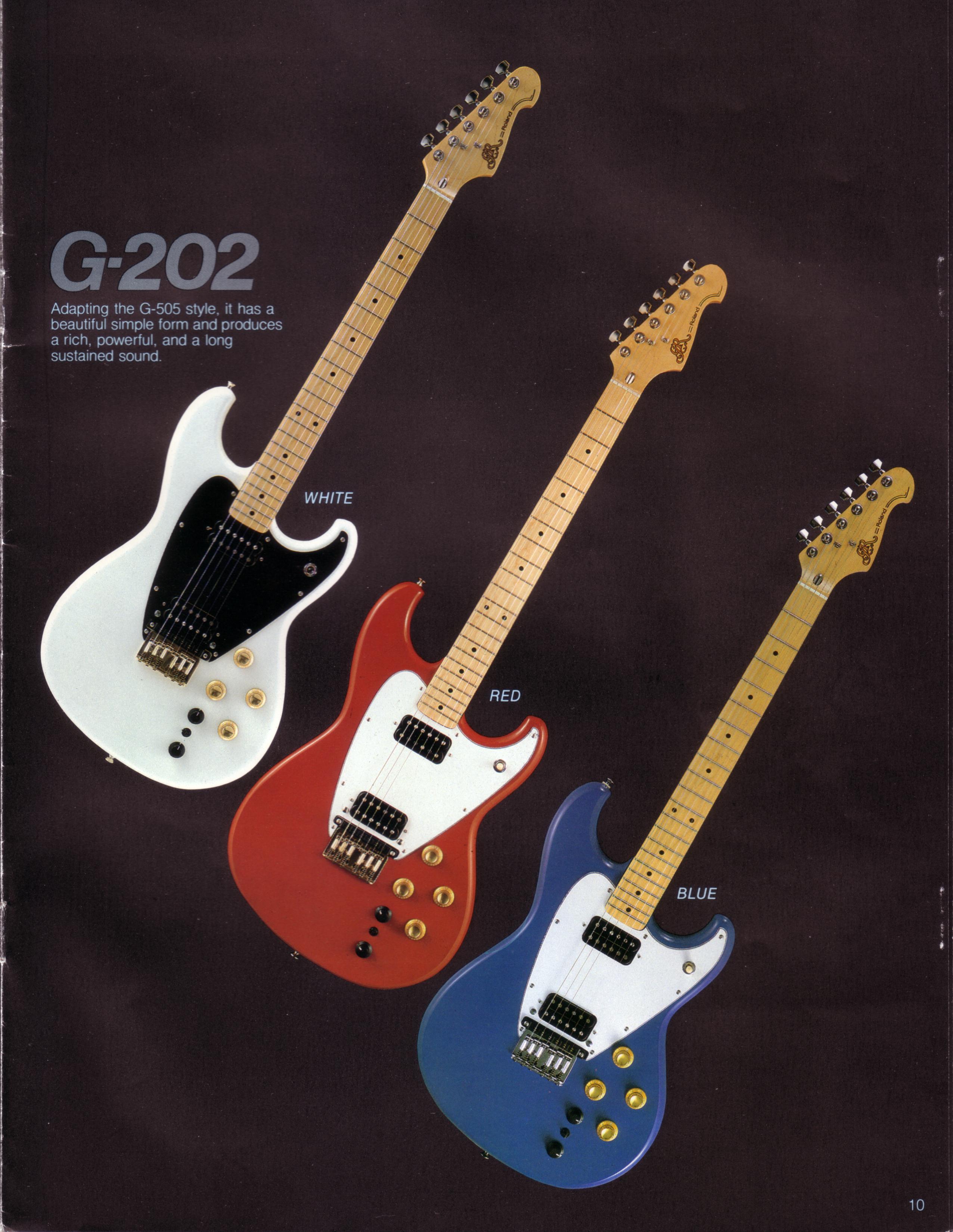
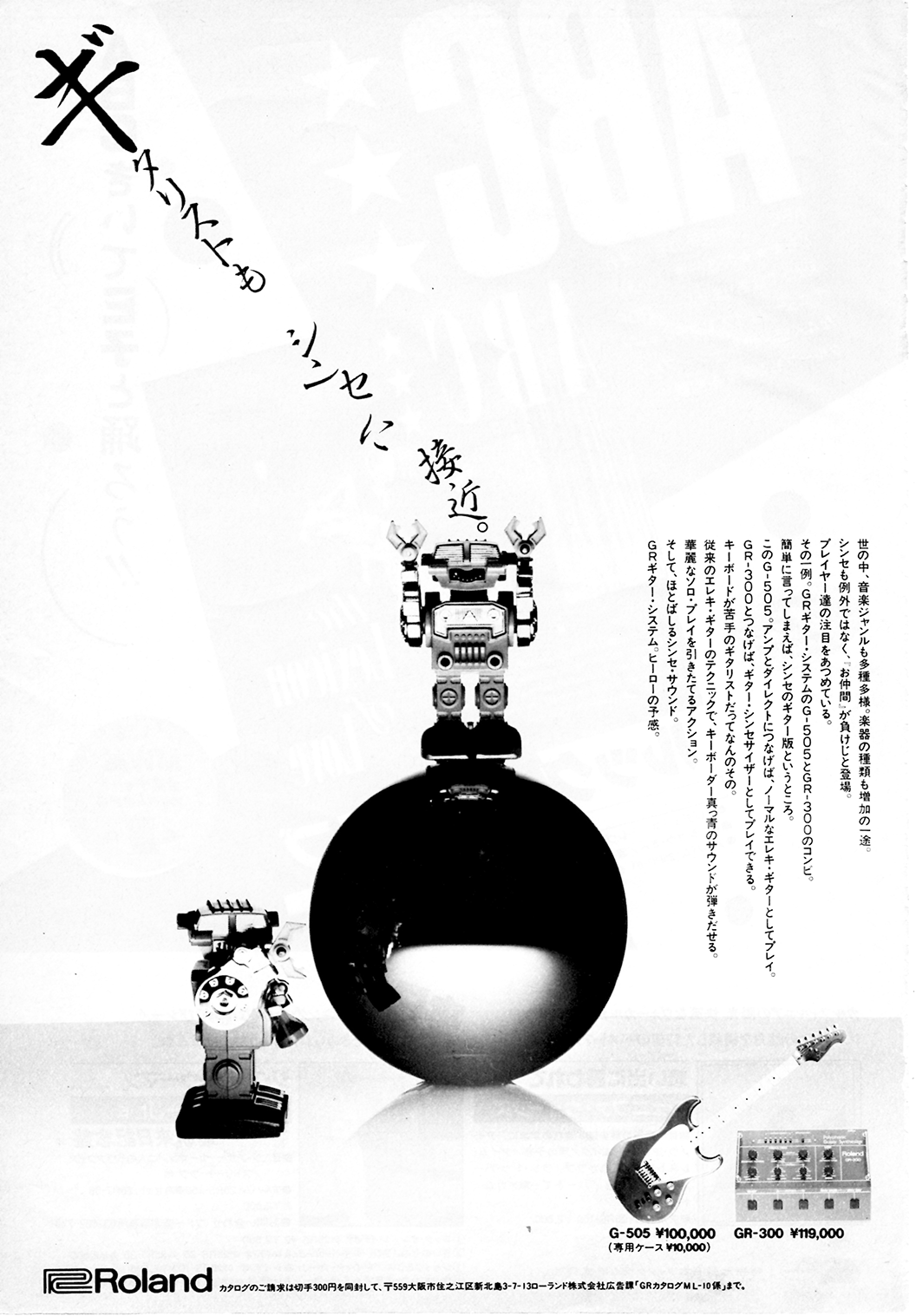
Page six of the 1984 Roland GR series brochure lists several options and accessories for the GR-700.
FV-200 volume pedal: The FV-200 volume pedal could be used to control the filter cutoff on all the vintage Roland synths, GR-100, GR-300, GR-33B and the GR-700. The FV-200 could also be used as a pitch pedal with the Roland GR-700.
And page five lists the Roland US-2 Unit Selector and the C-24D connecting cable.
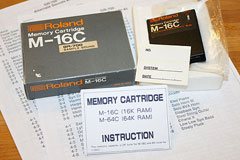
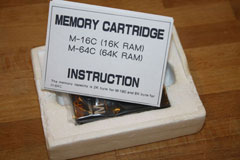
M-16C Memory Cartridge: These handy-dandy little cartridges double the memory of many Roland devices. Used with a Roland GR-700, patch memory goes from 64 to 128 patches. With a JX8P you add 32 more patches, and it can be used for synth patches on the JX-10 or for sequence memory!
More information on the Roland M-16C Memory Cartridge.
 |
 |
 |
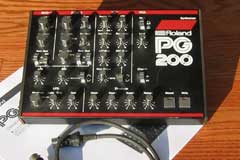
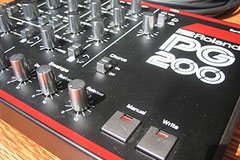
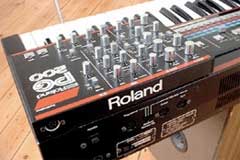
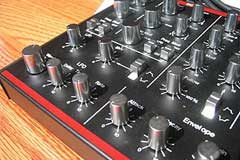
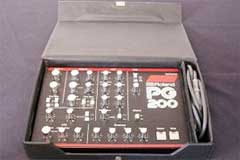
PG-200 Programmer: Roland also made the PG-200 programmer to help program the GR-700, JX-3P and MKS-30. Like other Roland programmers, the base is covered with a magnetic material to allow it to securely attach to the top of the GR-700 or the JX-3P synthesizer.
More information on the Roland PG-200 Synthesizer Programmer
 |
 |
 |
 |
 |
 |
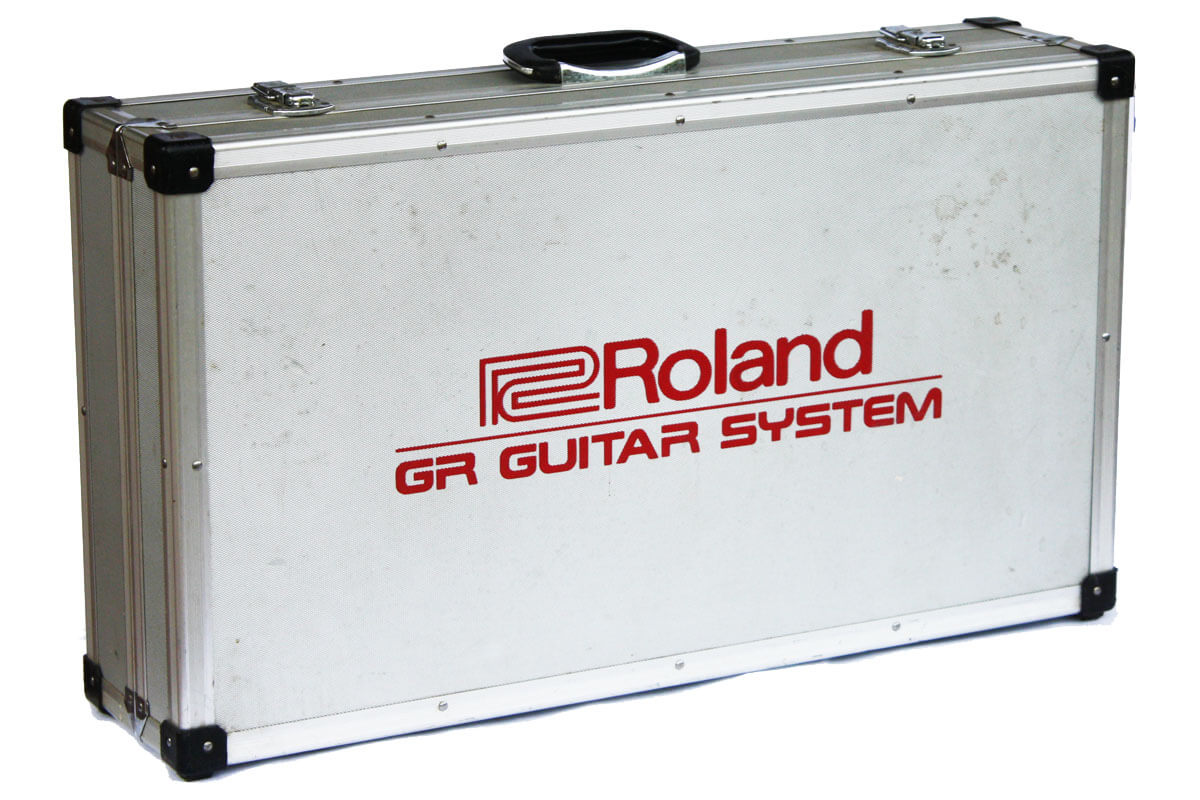
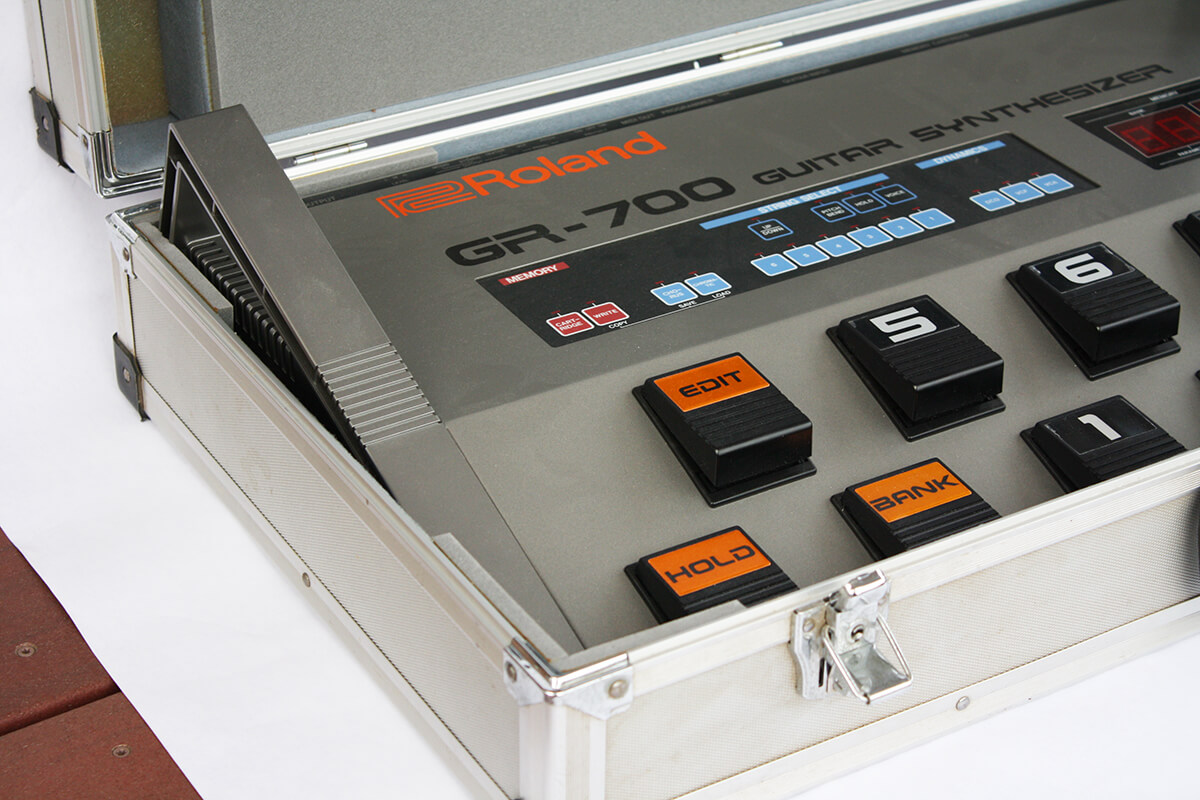
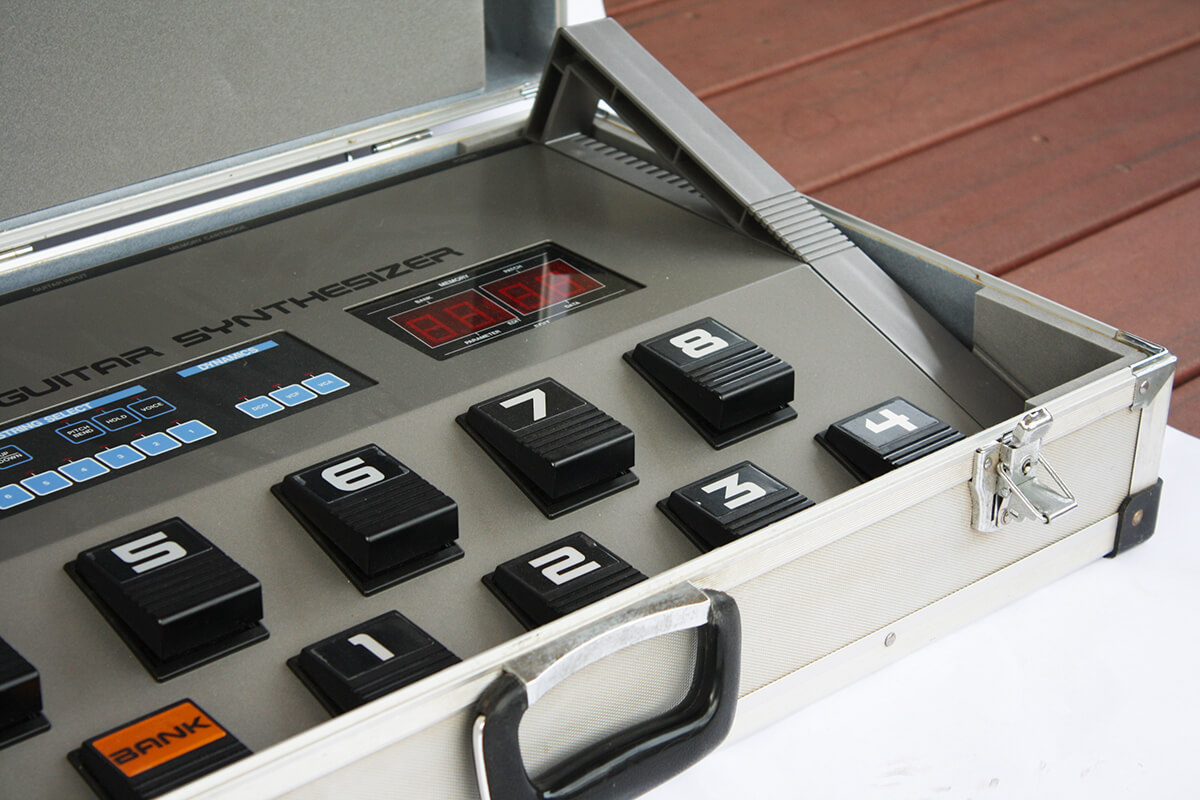
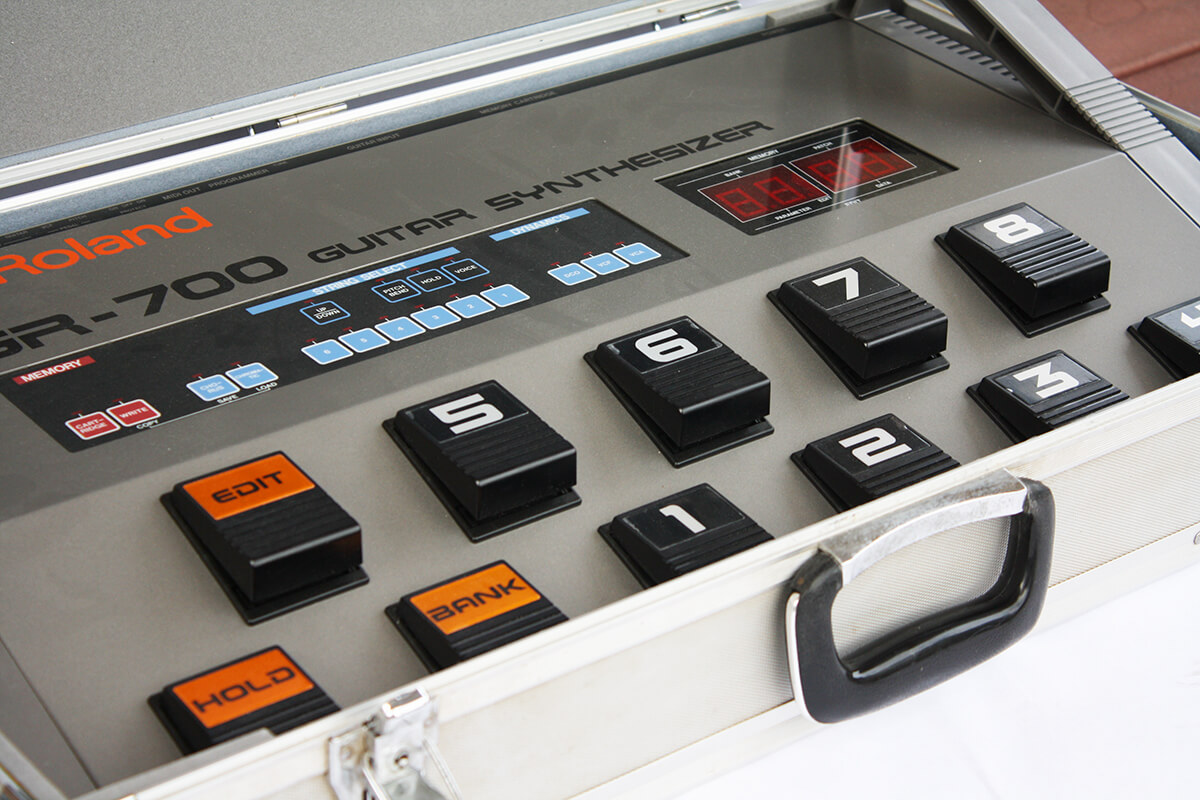
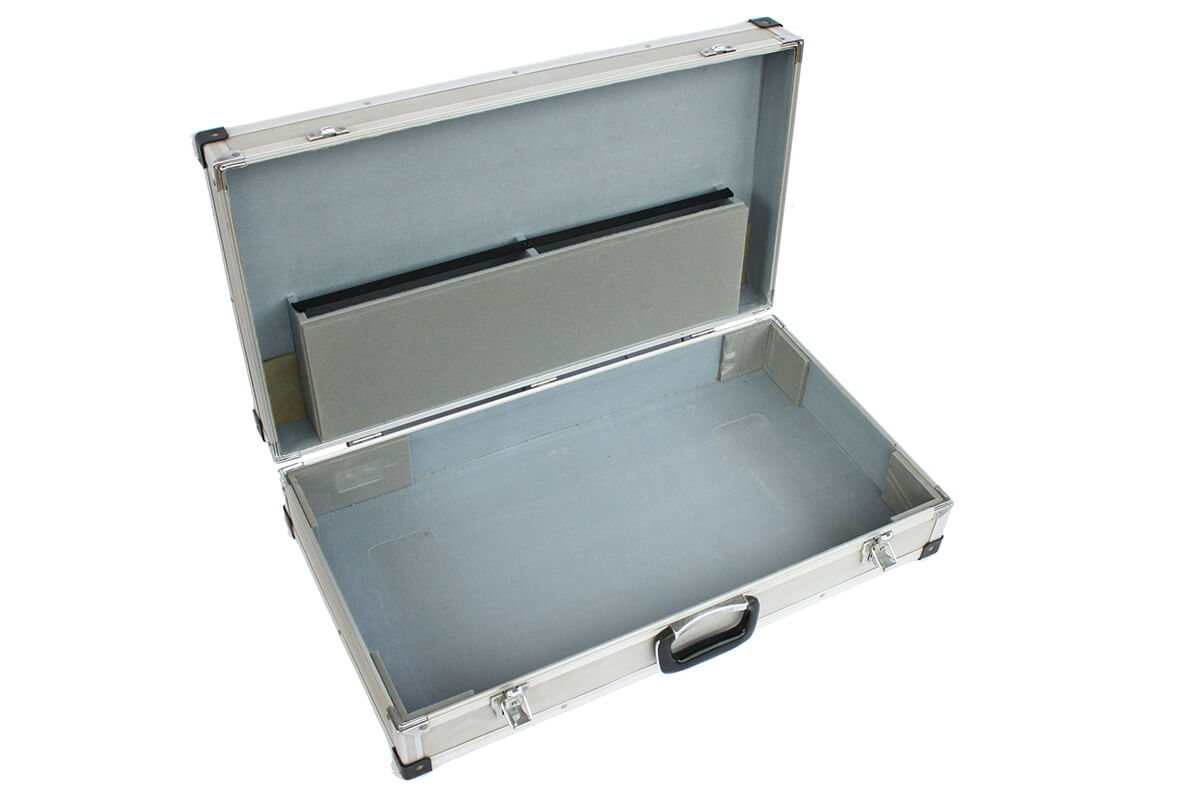
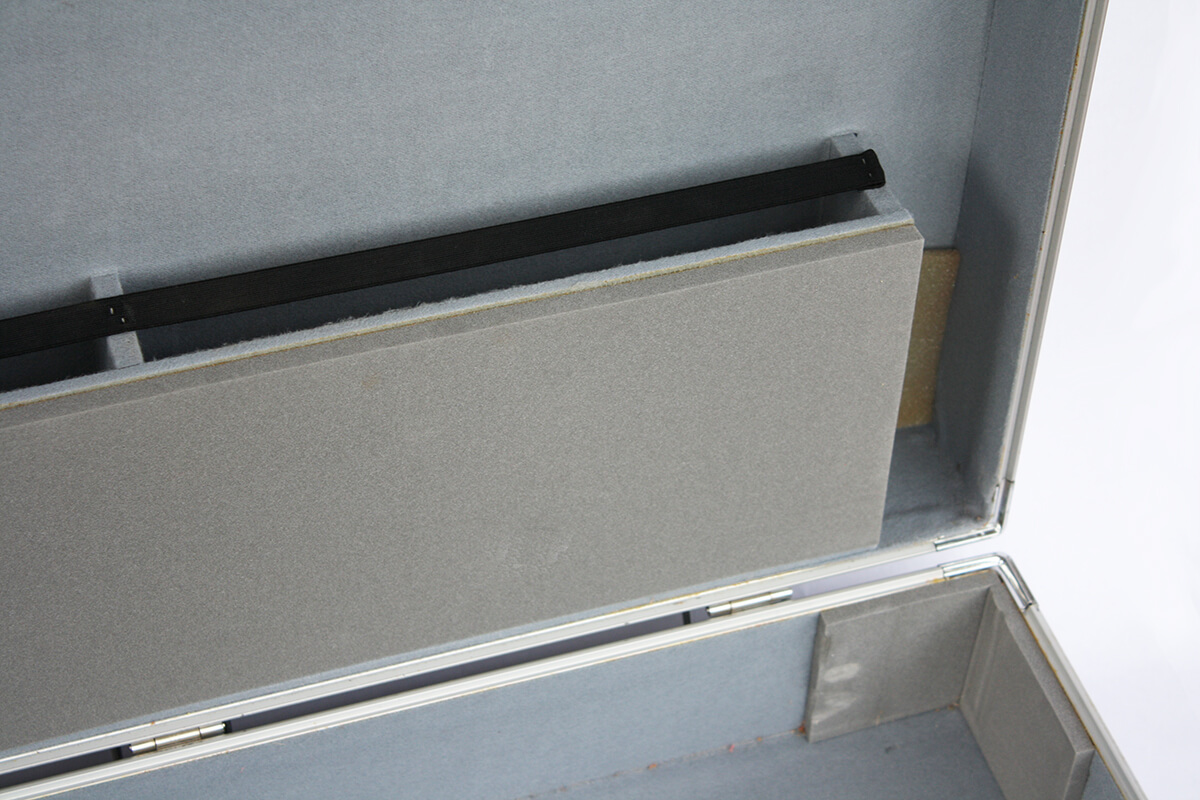
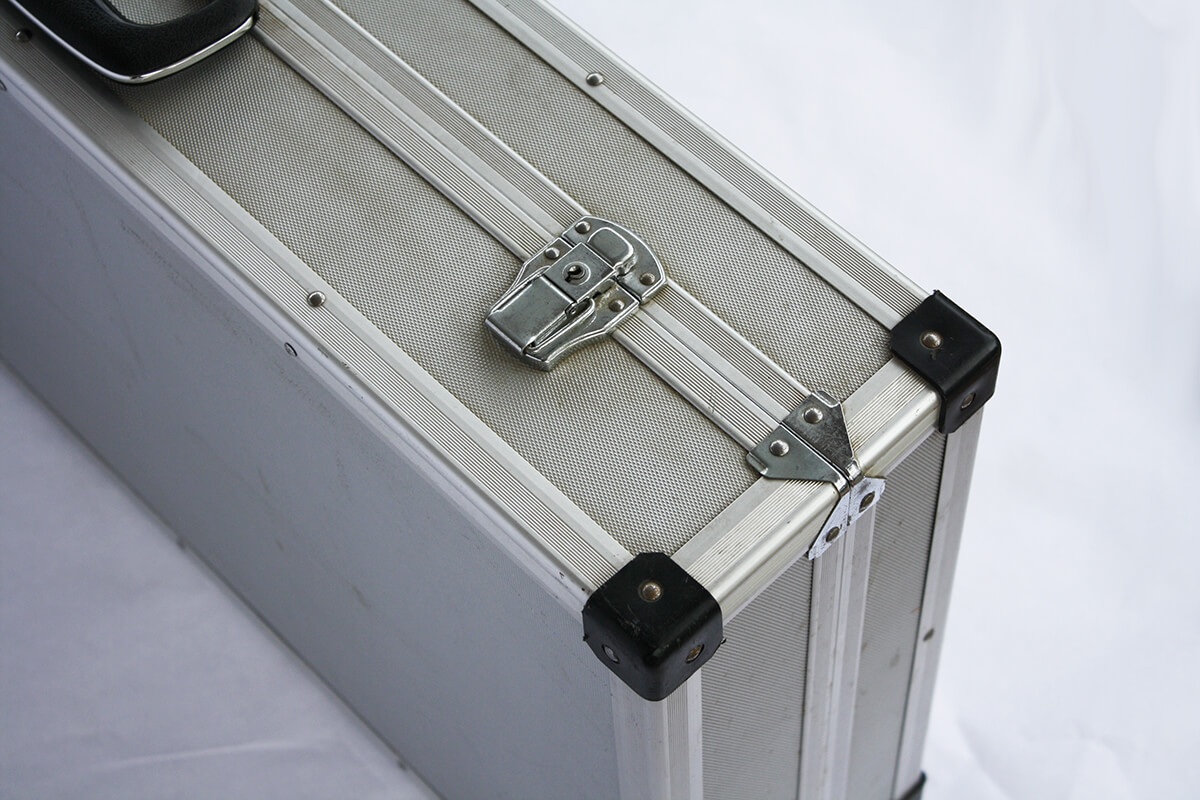
AB-700 GR Guitar System Case: For the heavy and bulky Roland GR-700, Roland made an aluminum case, the AB-700.
|

|
|

|
|
|
|

|
|

|

|
|
| Click on any image for larger view. | |||
Filter and Pitch Pedal:
GR-700 Filter Pedal Recommendation #1 - Korg EXP-2
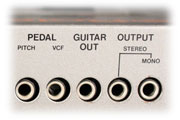 One of the best features of the Roland GR-700 is the excellent -24 dB per octave filter. The GR-700 shares the same general filter design as the Roland GR-300, based around the custom Roland IR3109 chips.
My favorite pedal is the flexible, versatile Korg EXP-2. With a Korg EXP-2, you do not have to re-wire the pedal, since it also doubles as a volume pedal. Just plug a standard guitar cable from the GR-700 filter/pitch pedal jack to the output of the EXP-2 volume pedal jack, and you will get a wide, musical range of filter sweeps.
GR-700 Filter Pedal Recommendation #2 - Behringer FCV-100
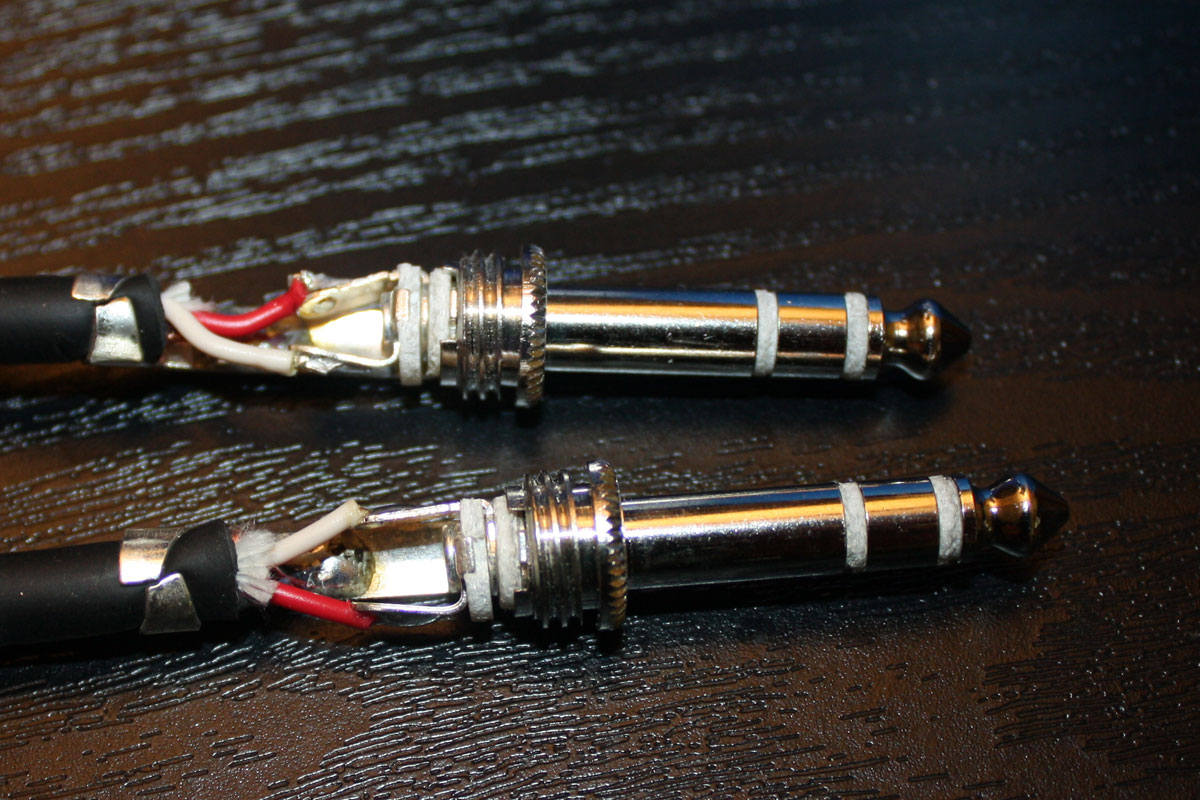
The Behringer FCV-100 is a pedal that can function as a dual, stereo volume pedal, or as a control voltage pedal with a 50K pot. However, the FCV-100 cannot be used directly with the GR-300 or GR-700. Since the FCV-100 has an internal PC board, the easiest way to adapt the pedal for the GR-300 or GR-700 is to modify a TRS tip-ring-sleeve cable. To make the FCV-100 compatible with the GR-300, just reverse the tip and ring wires on one end of a tip-ring-sleeve cable. The other end should be left unchanged. This will reverse the operation of the pedal, resulting in pedal up (dark, filter closed), pedal down (bright, filter opened), as shown in the YouTube clip. I have tested this with both a GR-300, and GR-700. It works with the GR-700 with either the filter or pitch input. It does not matter which end of the cable is plugged into the synth.
|
|
Click on image to enlarge
|
I would note that GR-300 user Joe Bartone, of the band Thelonius Dub, found that the FCV-100 did not hold up well on the gig. By the third gig, the rubber pad came off the pedal. Joe patiently bought some epoxy and took care of that problem...then the bottom of the pedal disconnected from the chassis. Not a big issue, but it meant constantly putting it back together every time he took it out for use. Finally, Joe reported that the pedal went "soft" meaning that it would tilt down when he took his foot off it. It does not stay in position like a quality pedal does. Taking Joe's remarks in hand, I would not give the FCV-100 a strong recommendation at this time.
Modifications - GR-700 MIDI Input
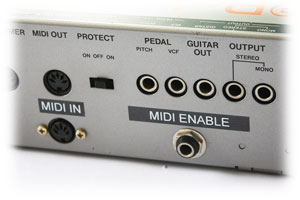
I frequently receive emails from people asking about adding a MIDI INPUT modification to the GR-700. In fact, there is a MIDI INPUT modification for the GR-700!
The GR-700 MIDI Input modification is credited to Mark Tsuruta, who I understand had come from Roland Japan to work at the Roland headquarters in Los Angeles in the 1980s.
As recently as 2005, Mark Tsuruta is listed as the executive vice president with Roland System Solutions. In any case, adding a MIDI input would have required a talented engineer with access to the original, commented, uncompiled operating system code for the GR-700.
The MIDI input requires both a change in the operating system, plus additional hardware and processing to convert the MIDI signals into the proper format for the GR-700’s computer. A look inside the GR-700 shows quite a few modifications made to support the MIDI input.
Roland GR-700 MIDI Input Documentation
Thanks so much to Ben Miler who sent me the "holy grail" of the Roland GR-700 MIDI input modification: the paper documentation on the exact features of the MIDI input modification!
Download the original MIDI Input Documentation (pdf)
While I reversed engineered many of the features, the part I like best is an explanation of the improved tracking in version 1.5 software: sensing the pitch of the note in one half cycle (waveform).
While this is the modern standard, the early versions of the GR-700 required a full-cycle. And the V1.5 software lets you select which mode to use: with the switch in mode 2 (the middle position), your GR-700 uses the original tracking algorithm, and in the mode 3 position, you get the faster tracking!
Overview:
I have probably seen six of these rare birds for sale on ebay in the last ten years. Not surprisingly, most have been located in Los Angeles, where I got this GR-700. This is the only MIDI IN GR-700 that I have personally worked with, and the unit did not come with any additional documentation, so what I do know about the features of the rare GR-700 comes my personal experimentation, or trial and error.
First, a basic tip-sleeve, latching (not momentary) on/off foot switch is needed to toggle between regular guitar mode, and MIDI operation. Without the foot switch, the GR-700 always operates in standard guitar synthesizer mode. Plug in the foot switch and you can toggle between MIDI and guitar mode. The GR-700 does not respond to MIDI controller 7, volume. In fact, even in MIDI IN mode, the GR-700 volume is still controller by the volume knob on the guitar, and all editing parameters are controlled by the guitar. If you do not have guitar connected, you will not get any output.
New MIDI Parameters
Here are the new MIDI parameters added to the MIDI input: MIDI Channel, Program Change (on or off), Sustain (MIDI #64 on or off), Pitch Bend response (on or off), and Modulation (MIDI #1 on or off).
To change these parameters, press and hold down the Chorus switch. Pressing either switches 3, 4, 5 or 6 will show the status of the four MIDI controller settings. Just like the standard GR-700 editing mode, if a block is in the lower position, the function is off, and if it is in the upper setting, it is on.
MIDI Channel:
Pressing foot switch 7 decrements the MIDI input channel, and foot switch 8 increments the MIDI channel.
Program Change:
Program change status, on or off is controller by foot switch 3. Pressing foot switch 3 will enable or disable program change commands to the GR-700. The GR-700 responds to program changes 1 through 64, corresponding to the 64 patches in the GR-700. With a memory cartridge installed, program changes 65-128 calls up patches on the memory cartridge. So program change 65 equals patch 1-1 on the memory cartridge, and program change 128 call up patch 8-8 on the memory cartridge. Without a memory cartridge, sending program changes 65-128 cycles through the original 64 patches, so sending program change 65 calls up internal patch 1-1, and sending program change 128 calls up internal patch 8-8.
Sustain:
Sustain on or off is controlled by foot switch 4.
Pitch Bend:
Pitch bend on or off is controlled by foot switch 5. Pitch bend range can the changed at anytime, it is not necessary to hold down the chorus switch. Press the pitch bend switch, and the pitch bend range is displayed. Now pressing the VOICE switch increments the range, up to seven semitones, and pressing the HOLD switch decrements the range. Pressing pitch bend again exits pitch bend range.
Modulation (LFO):
And modulation, or LFO on or off is controlled by foot switch 6.
With all four blocks in the up position, the GR-700 responds to program change, sustain, pitch bend and modulation. You will notice that when you enter MIDI Input mode, the dynamics LEDS turn off. In MIDI mode, the dynamics are always on. For example, factory patch 2-7, Bell, does not respond to dynamics in guitar mode, so how hard to pick the string does not effect the loudness, or brightness, or the sound. And the patch has chromatic mode enabled, so it does not respond to pitch bends. In MIDI input mode, the sound responds to both velocity. changing the loudness and brightness, and pitch bend as well.hat a Roland M-64C can be used to hold four banks of GR-700 sounds. Additional delay and ambience has been added during mix down.
Extended Operational Range:
The GR-700 MIDI input extends the range of the GR-700. Normally, the lowest note on the GR-700 is low E on the guitar, and GR-700 extends this to the A below low E on the guitar, adding another fifth to the lower range of the synth. If you play below the A, the octave repeats. On the high side, the GR-700 will respond to the highest possible MIDI note, more than two octaves above what is possible on the guitar. The highest note on a 88-key synth is C7. The GR-700 will respond to G8, or a fifth above the last note on a keyboard.
Can the MIDI INPUT modification be done today?
For all practical purposes, the answer is "no." While the version 1.5 software, which implements MIDI INPUT can be found, the additional technical details on the extensive wiring and additional electronic hardware are not documented. Even if you had all the details to do this, and knew how to make the additional hardware for the buffered MIDI output, etc. there is a good chance the GR-700 would not survive.
GR-700s are pretty fragile now, and use lots of parts that are no longer available. When the unit sold for thousands of dollars, and MIDI units were rare, this modification made sense. However, there is a ready-made GR-700 with a MIDI-IN: the Roland MKS-30. The MKS-30 has the exact same voice board as the GR-700, and the exact same parameters. Even better, it has built in MIDI implementation and is a better MIDI sound module than than a GR-700 with MIDI IN will ever be.
GR-700 with MIDI Input Videos:
GR-700 MIDI Input - Version 1.5 SoftwareThe GR-700 Turbo PLUS adds the sound of the GR-100 hexaphonic polydistortion to the Roland GR-700, with all the original features of the GR-700 Turbo. This includes a modern 13-pin input, top panel controls for string level and filter cutoff and EDIT parameters. The PLUS also adds a latching sustain input. |
GR-700 MIDI Input - Version 1.5 SoftwareWhat can you do with a GR-700 that has this modification? I use Digital Performer to play a sequence of Bach's 2-part invention in E minor, incorporating program changes to call up various patches. The internal sounds are the original GR-700 factory patches, and the cartridge sounds are the second generation factory patches. |
GR-700 with MIDI Input Interior Photos:
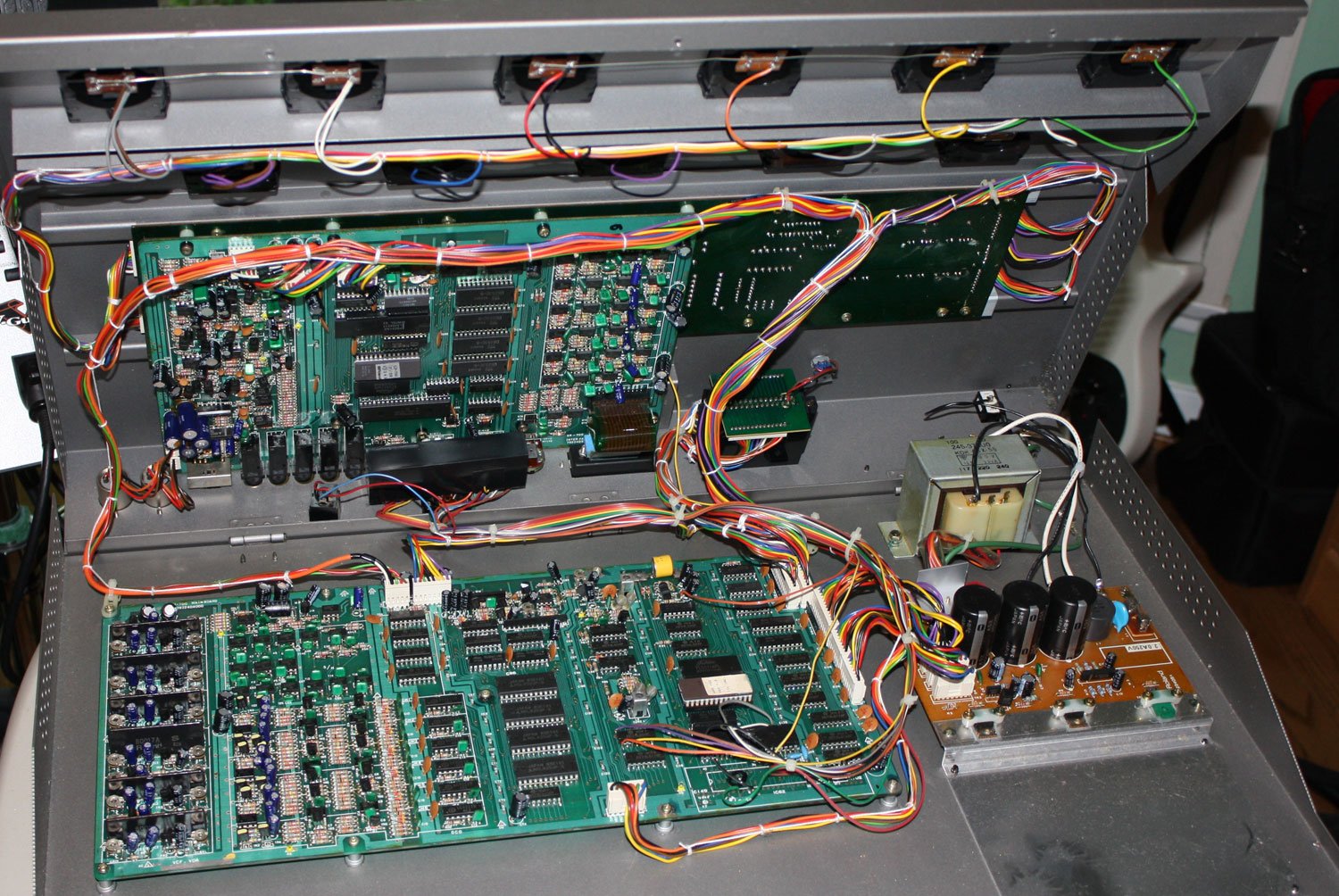
|

|
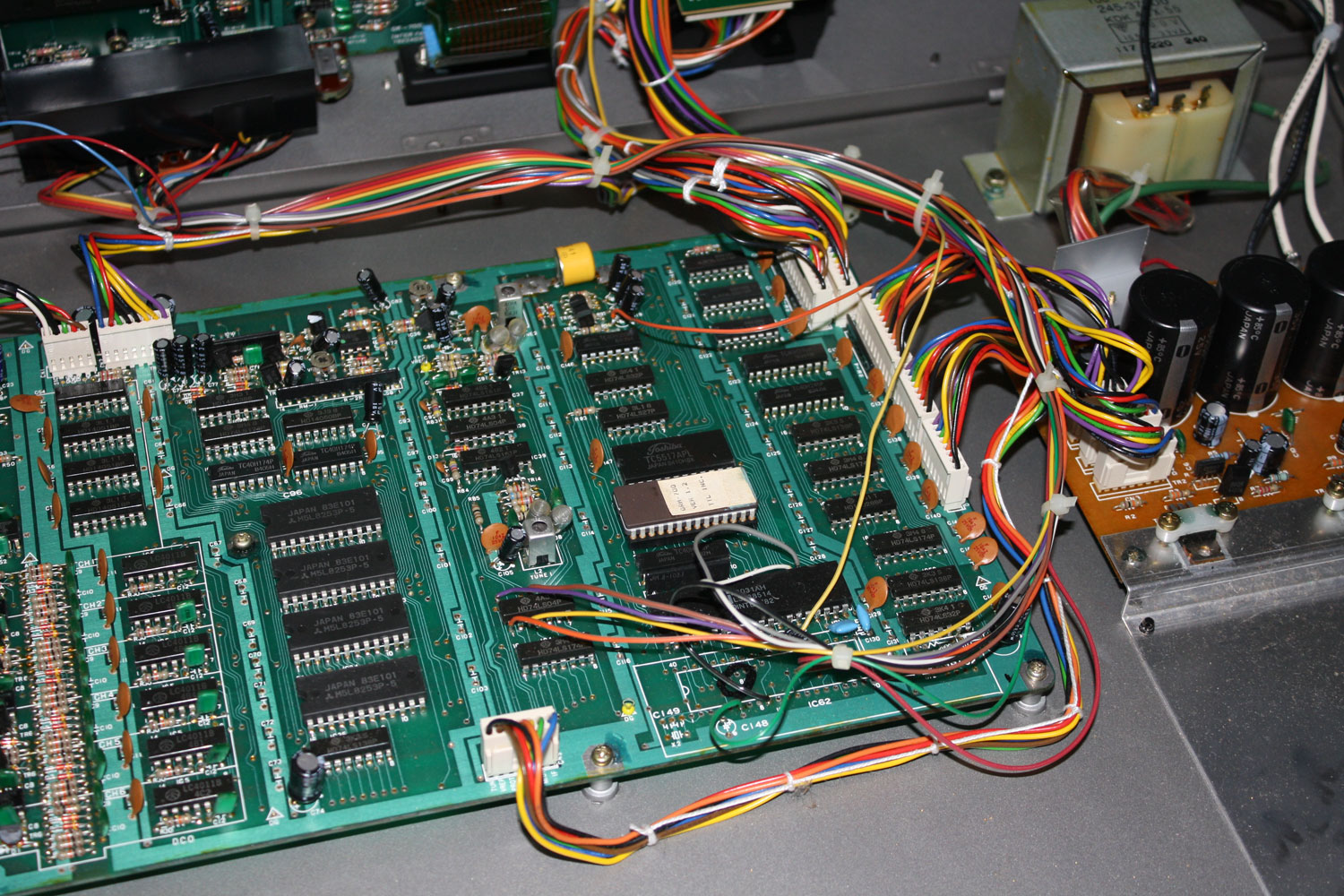
|
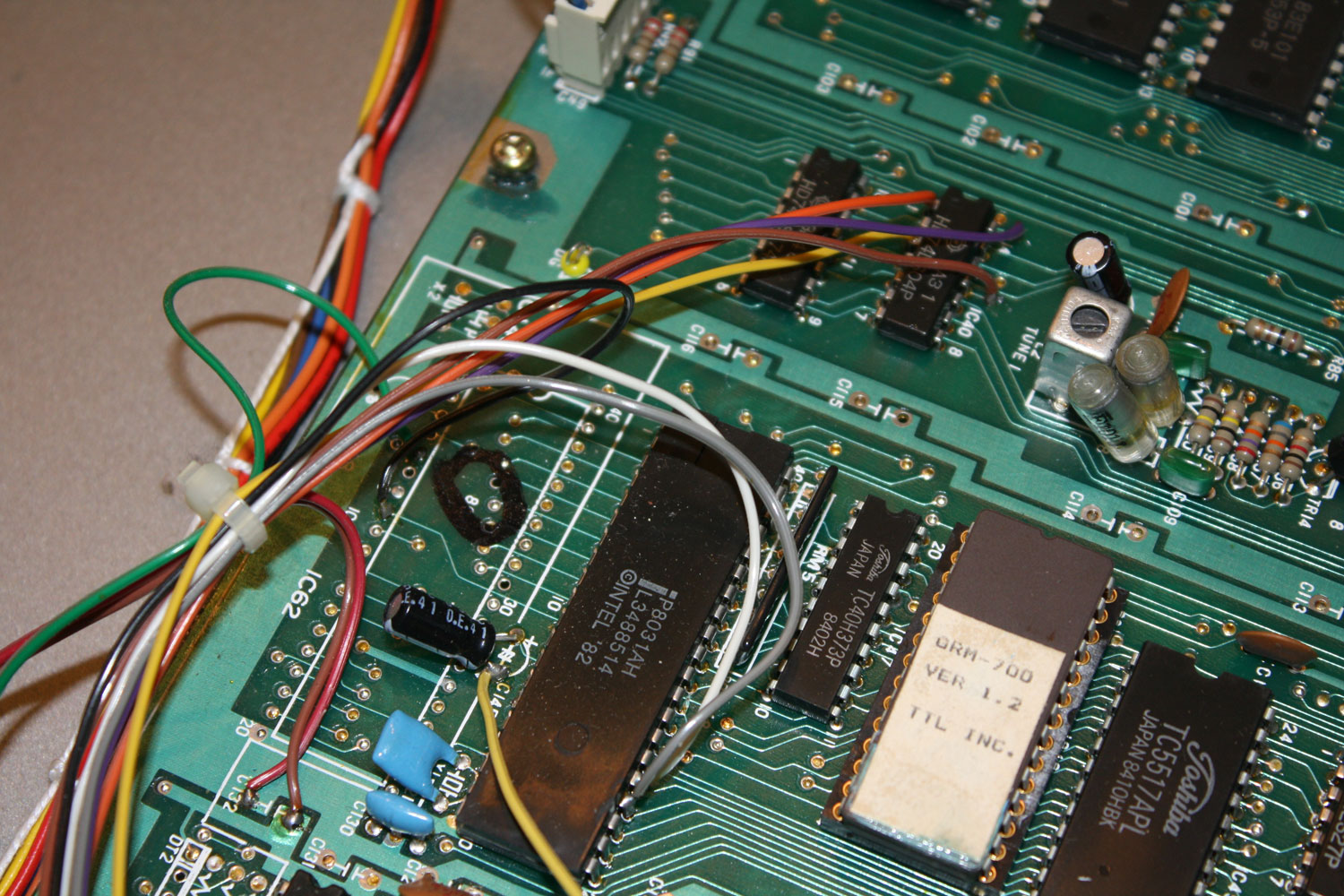
|

|

|
| Click on any image for larger view. |
||
Modifications - GR-700 With 13-Pin Output
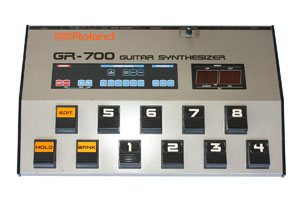
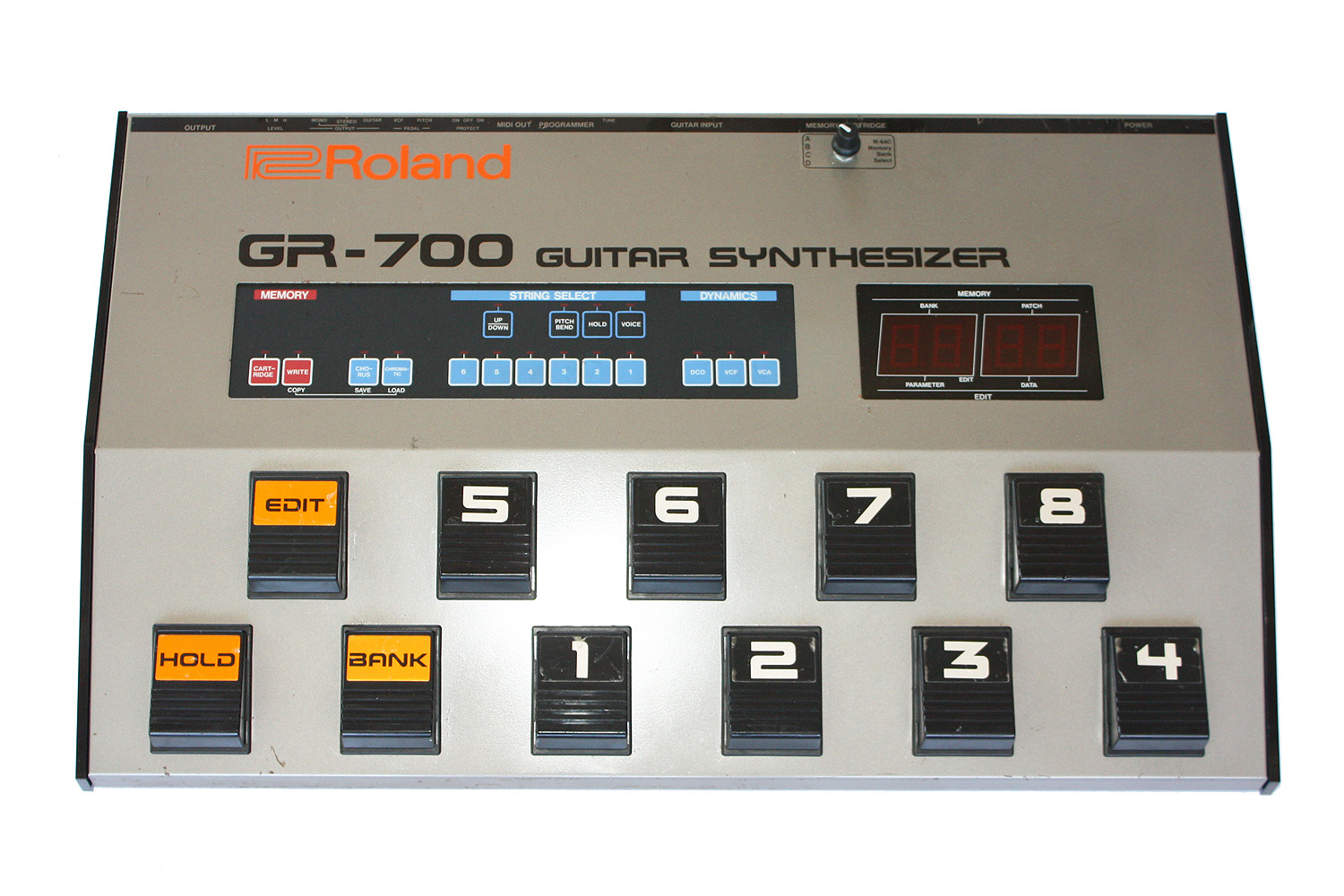
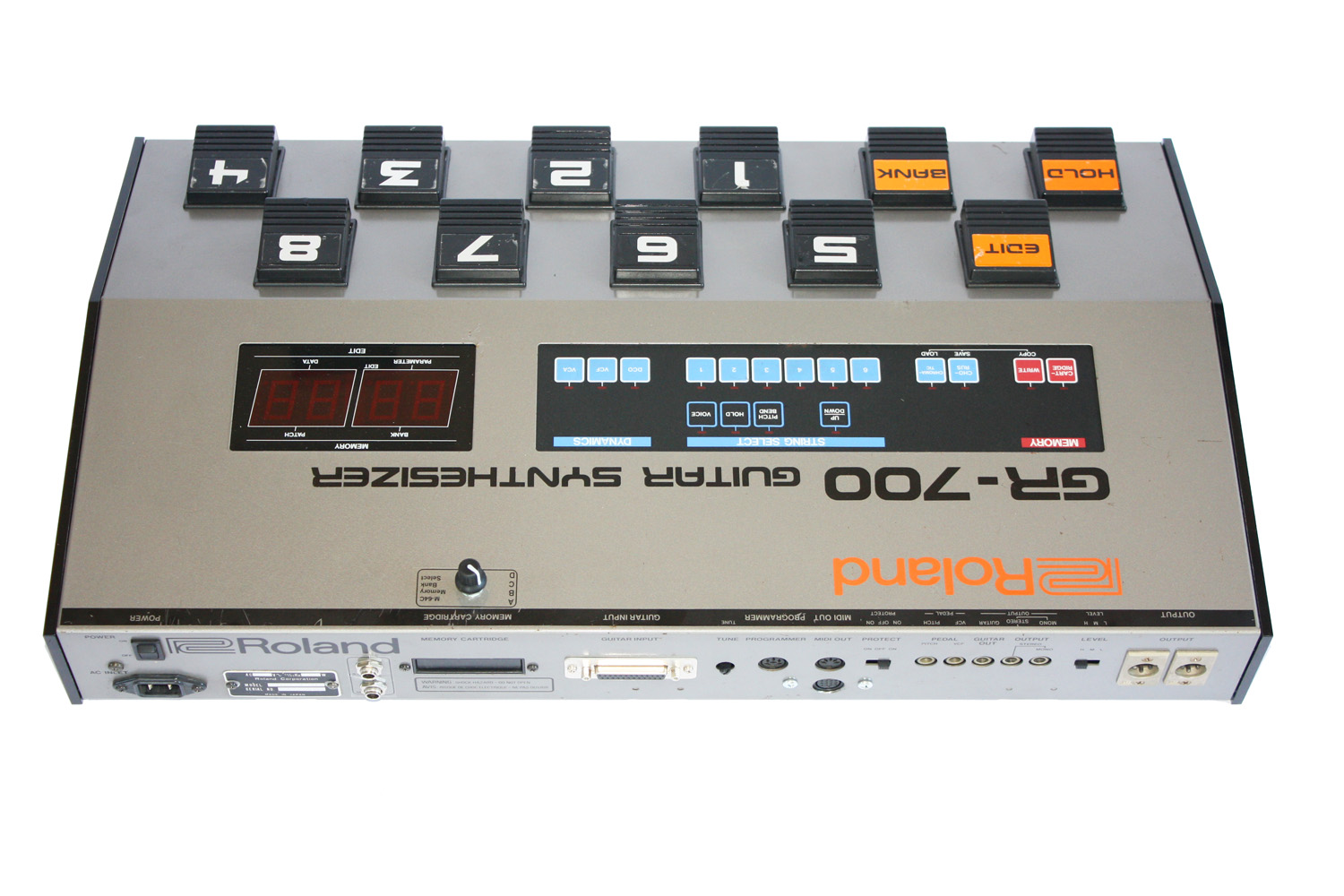
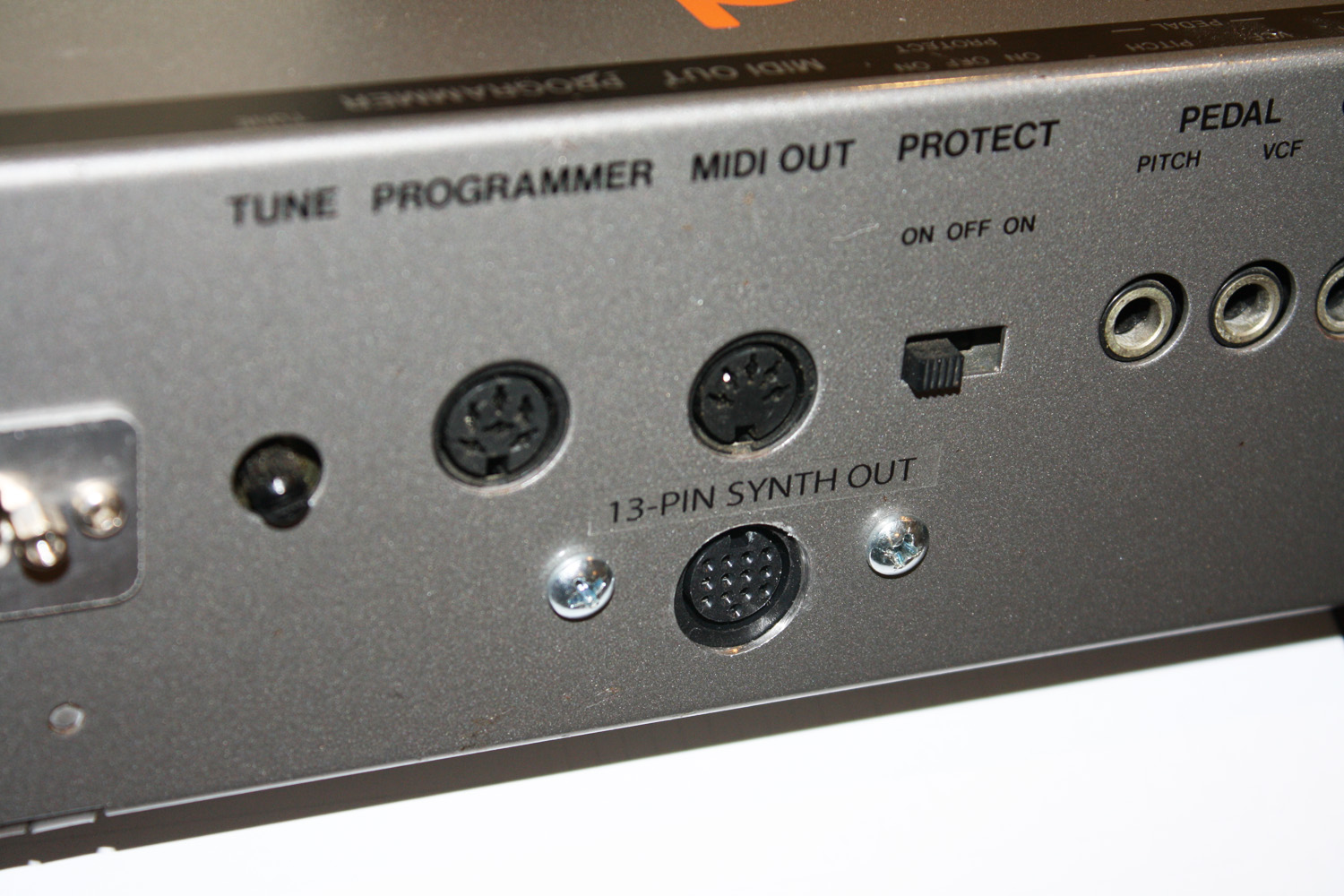
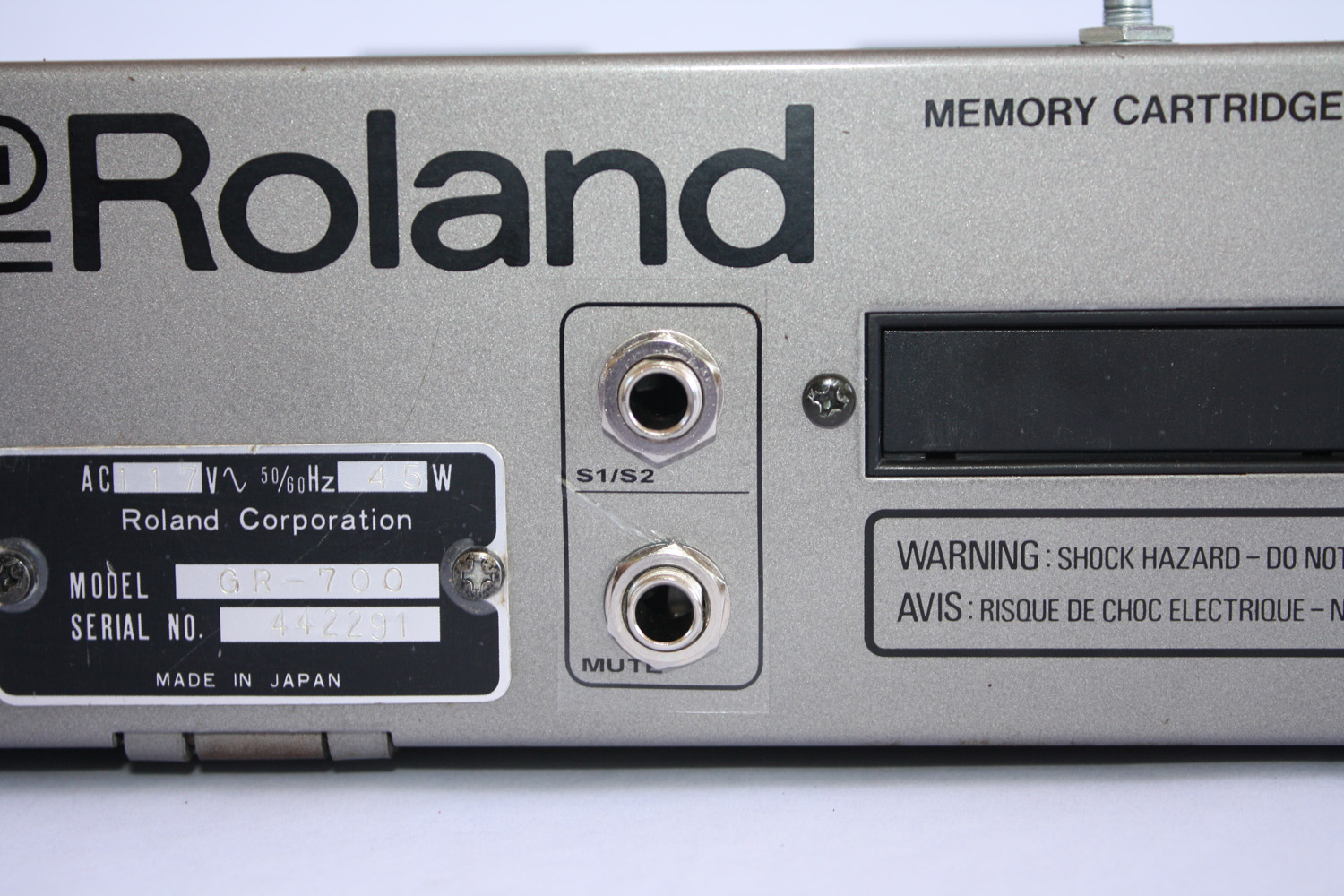
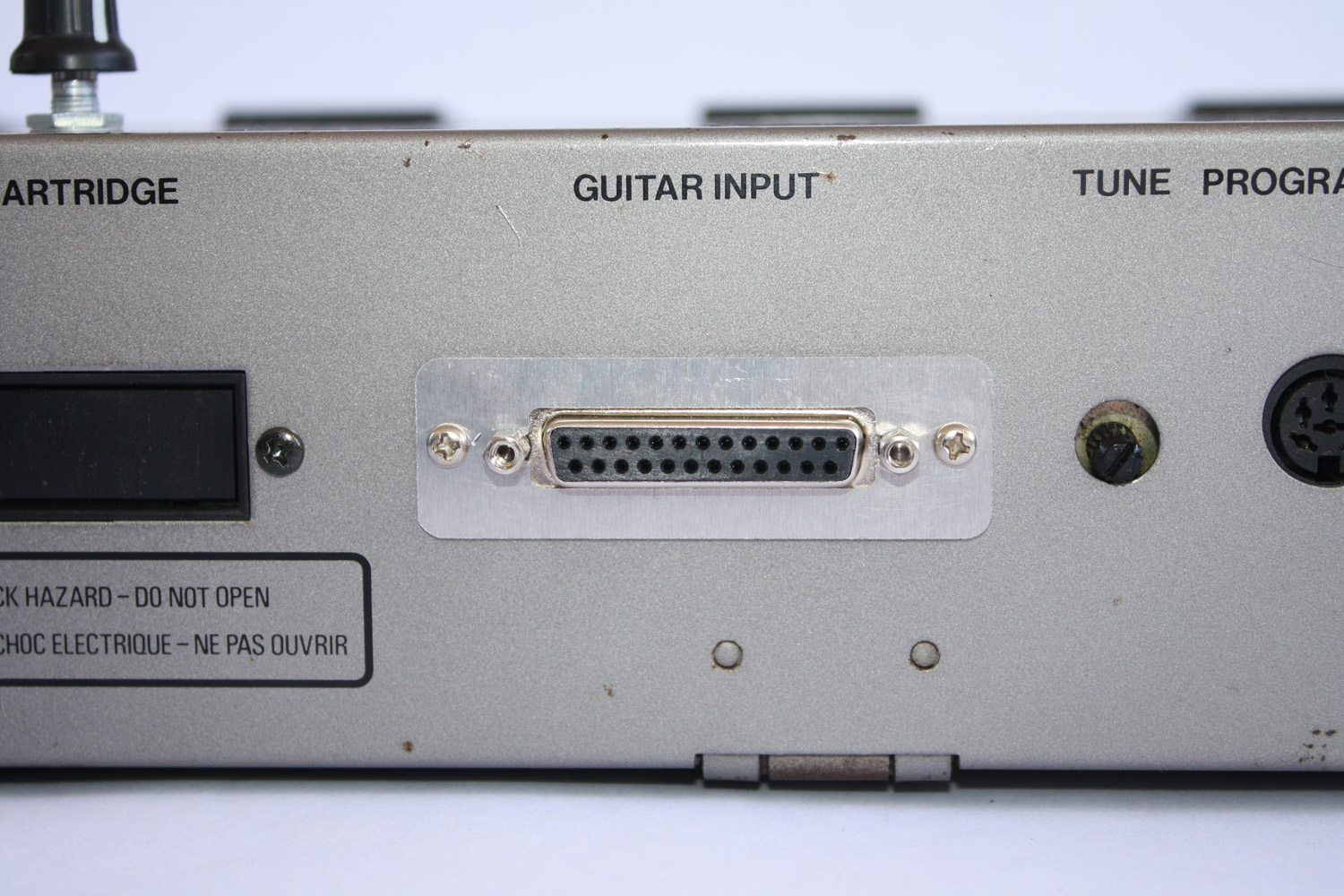
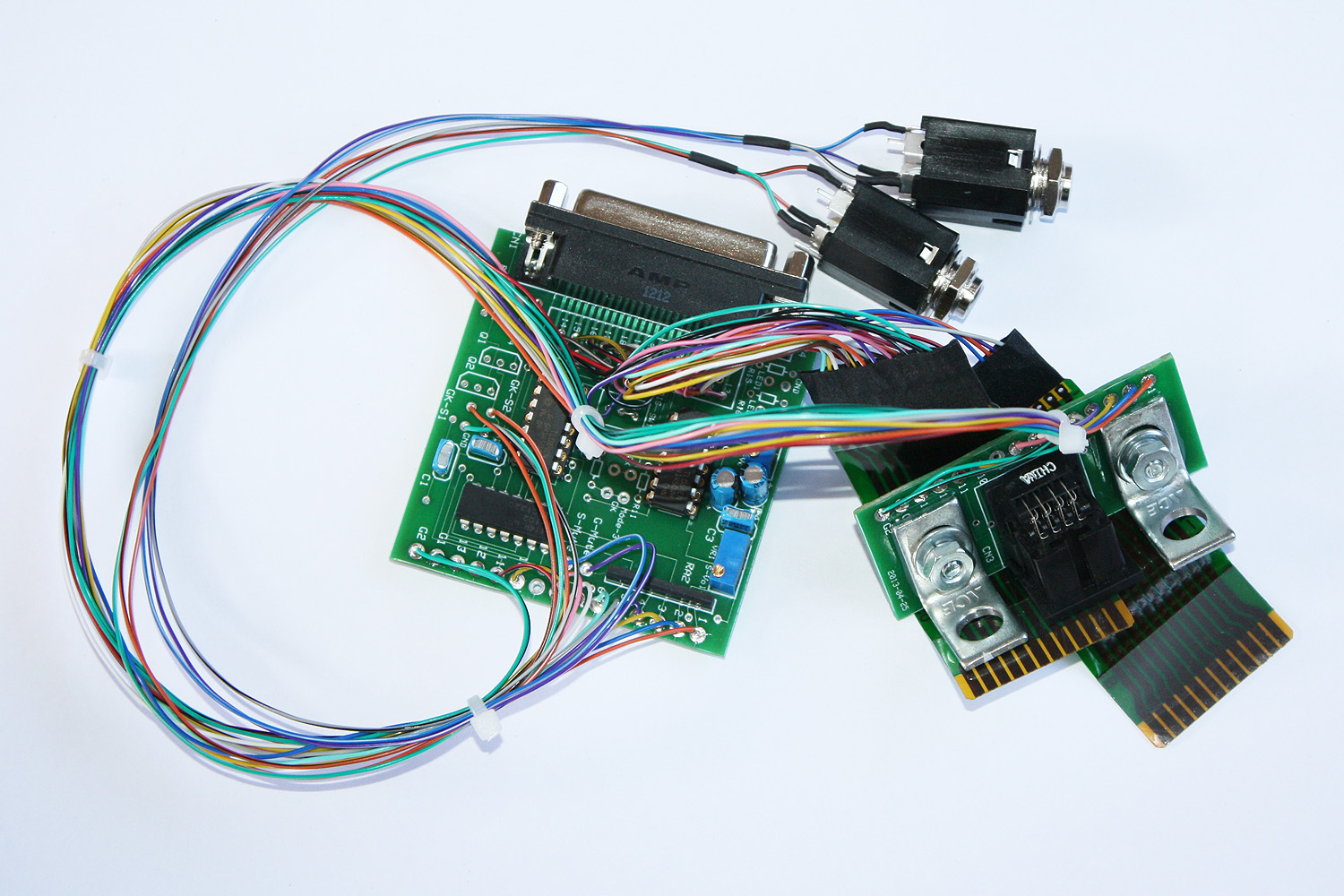
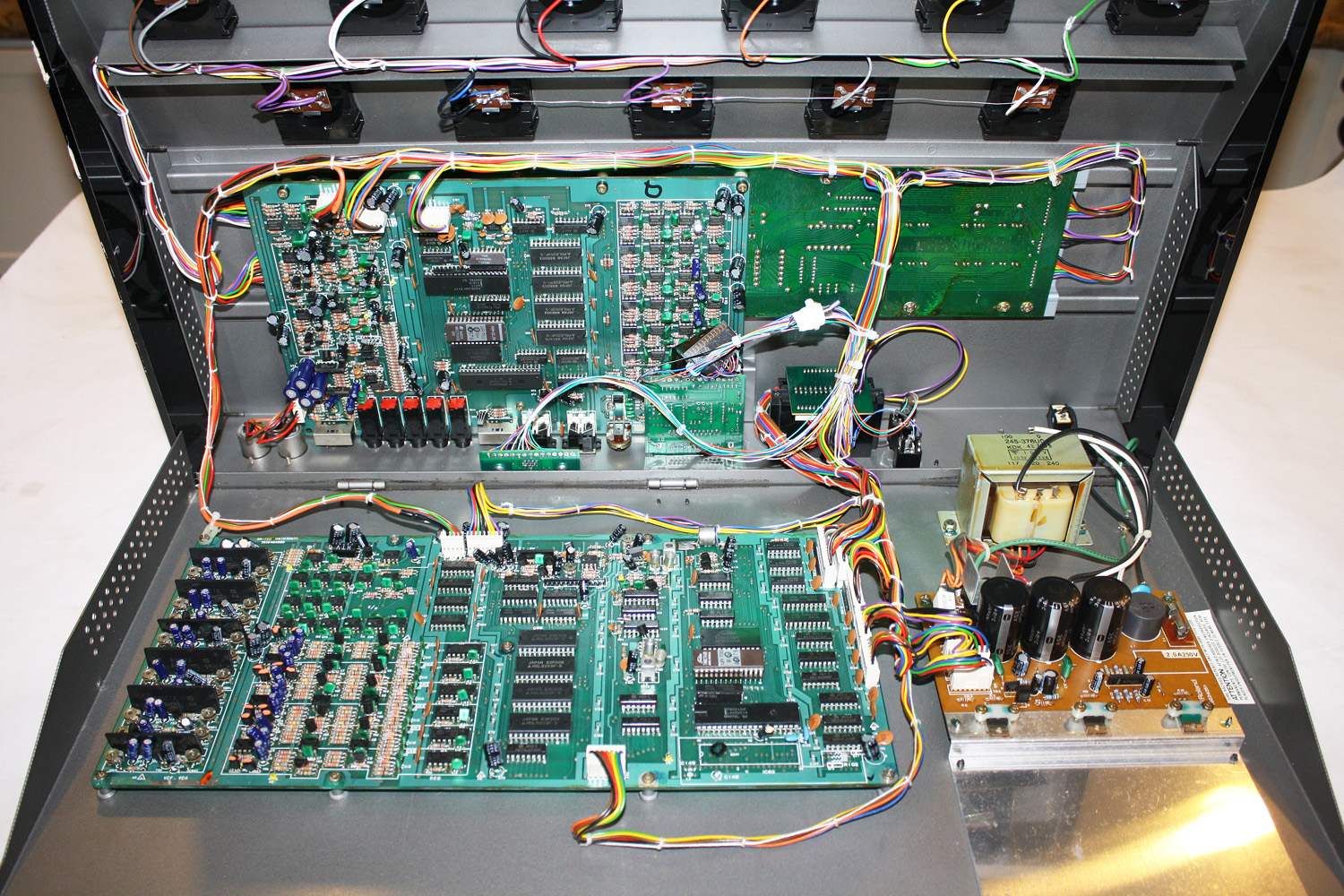
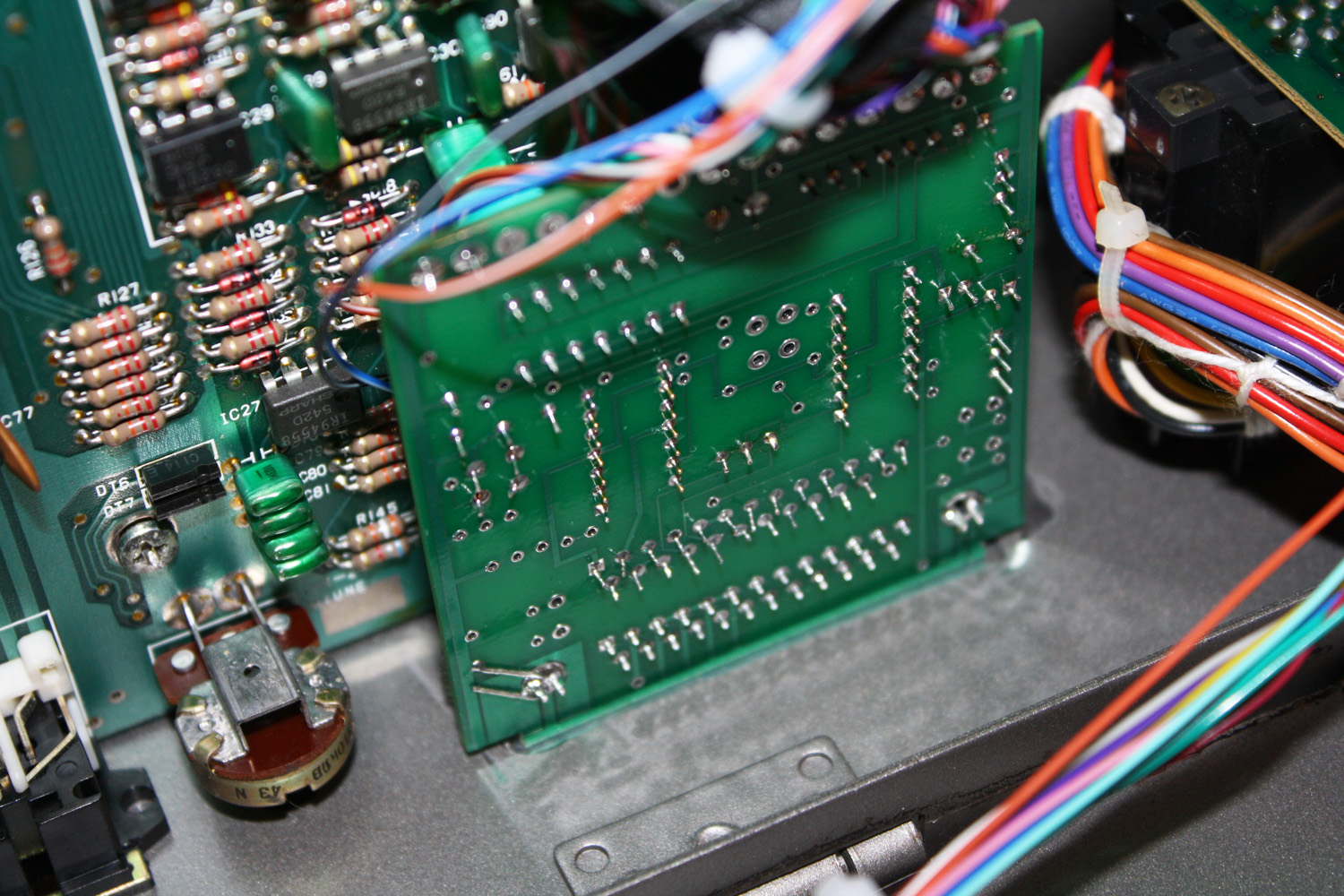
The standout feature of this GR-700 is the custom printed circuit board installed to buffer the internal guitar synth signals, and provide a modern, 13-pin Roland synthesizer output.
When the Ibanez IMG2010 is connected to this GR-700, you will be able to access both the classic analog sounds from the GR-700, plus the latest in cutting edge Roland guitar synth tones, using the Roland GR-55 or VG-99. It is like using a GR-700 with a Roland US-2 and BC-13.
The active circuitry is part of a DB25 input card, which frees the GR-700 user from searching for hard-to-find, expensive 24-pin cables. This GR-700 can use data-grade, shielded 25-pin cables which offer improved performance over the original Roland cable, at a fraction of the price.
Full Support for all Modern 13-pin Synth Controls:
The modern GK 13-pin controls have been integrated into the GR-700. The master volume control on the guitar controls the volume of the 13-pin synthesizer as well. There are two 1/4" jacks added for the controlling the 13-pin synth, both are TRS (tip-ring-sleeve) jacks. This first is for muting either the GK Volume (synthesizer volume) or the Guitar signal (hex fuzz), and this circuit works best with latching switches. The other TRS jack is for a momentary foot switches to send GK S1/S2 commands. Both the switches are basic on/off switches, connecting to ground. I like to use the Roland FS-6, a versatile pedal with latching or unlatching capability, and LED status indicators.
GR-700 with 13-pin Output Video:
GR-700 with Modern 13-pin Output - 4x Memory Expansion - Version 1.5 Software - New End Panels - Full Factory CalibrationThe standout feature of this GR-700 is the custom printed circuit board installed to buffer the internal guitar synth signals, and provide a modern, 13-pin Roland synthesizer output. A vintage Roland guitar connected to this GR-700 will be able to access both the classic analog sounds from the GR-700, plus the latest in cutting edge Roland guitar synth tones, using the Roland GR-55 or VG-99. It is like using a GR-700 with a Roland US-2 and BC-13. |
GR-700 with 13-pin Output Photos:
|
|
|
|
|
|
|
|

|
| Click on any image for larger view. |
||
Modifications - GR-700 Turbo PLUS (GR-100):
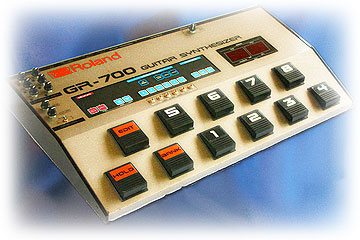
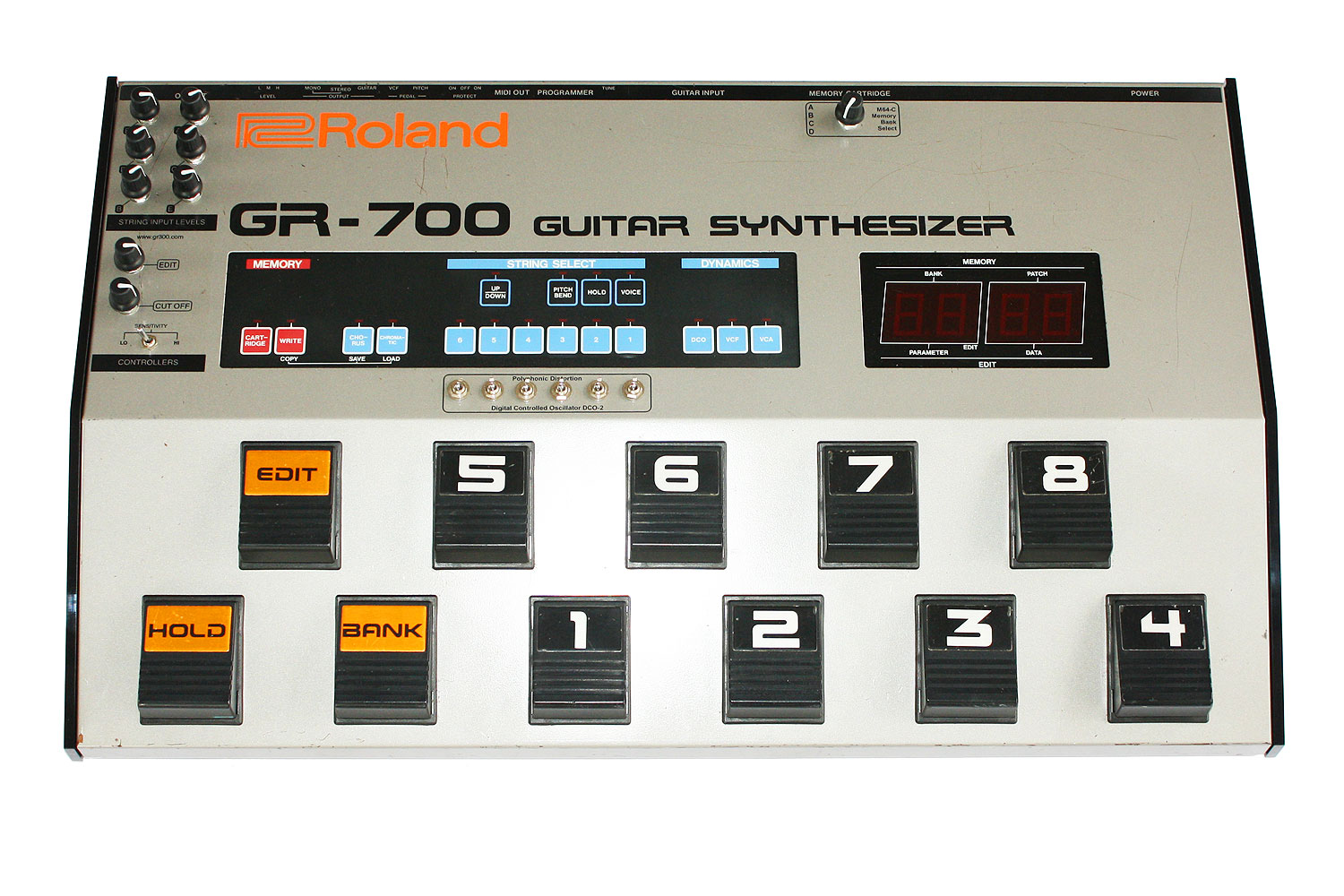
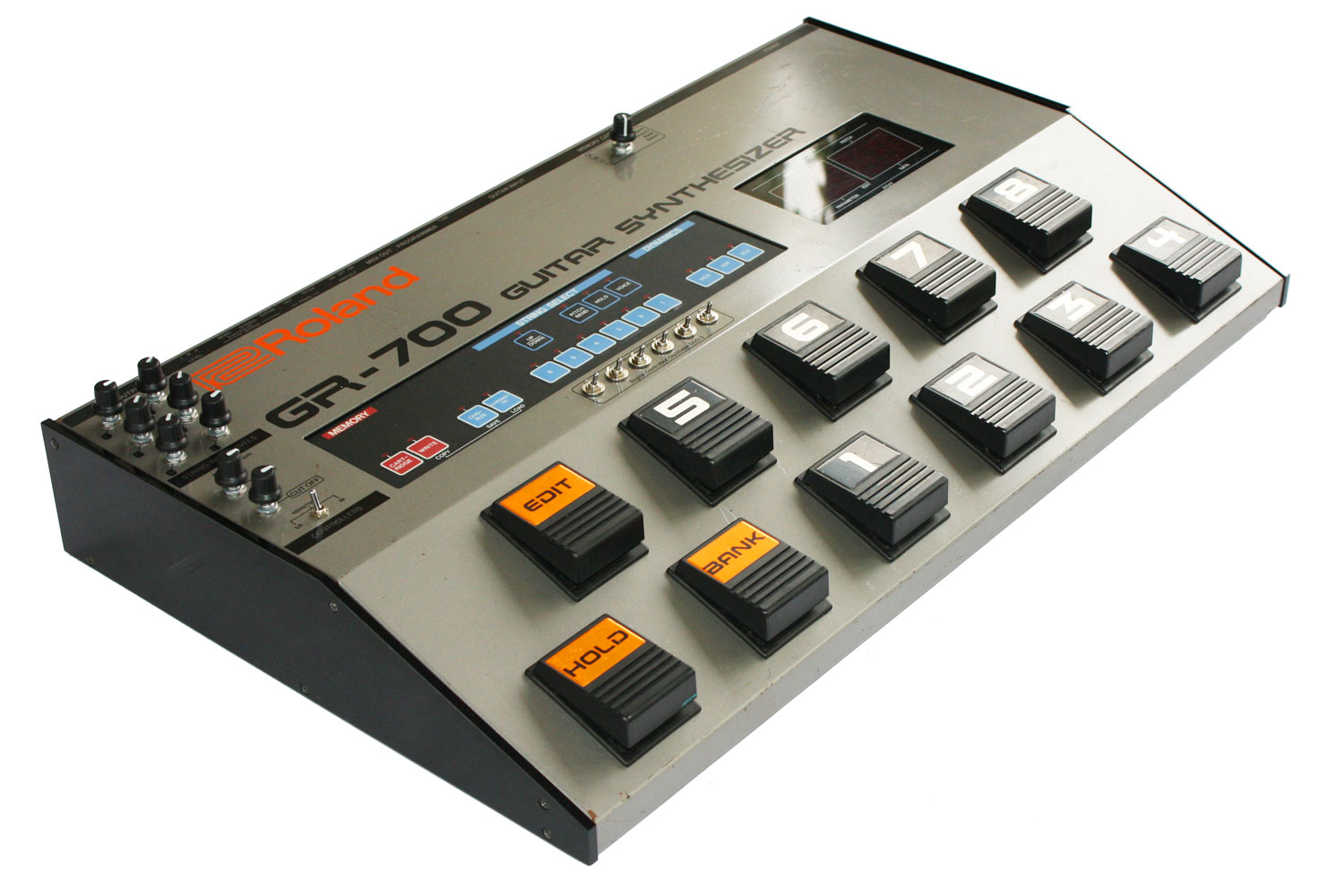
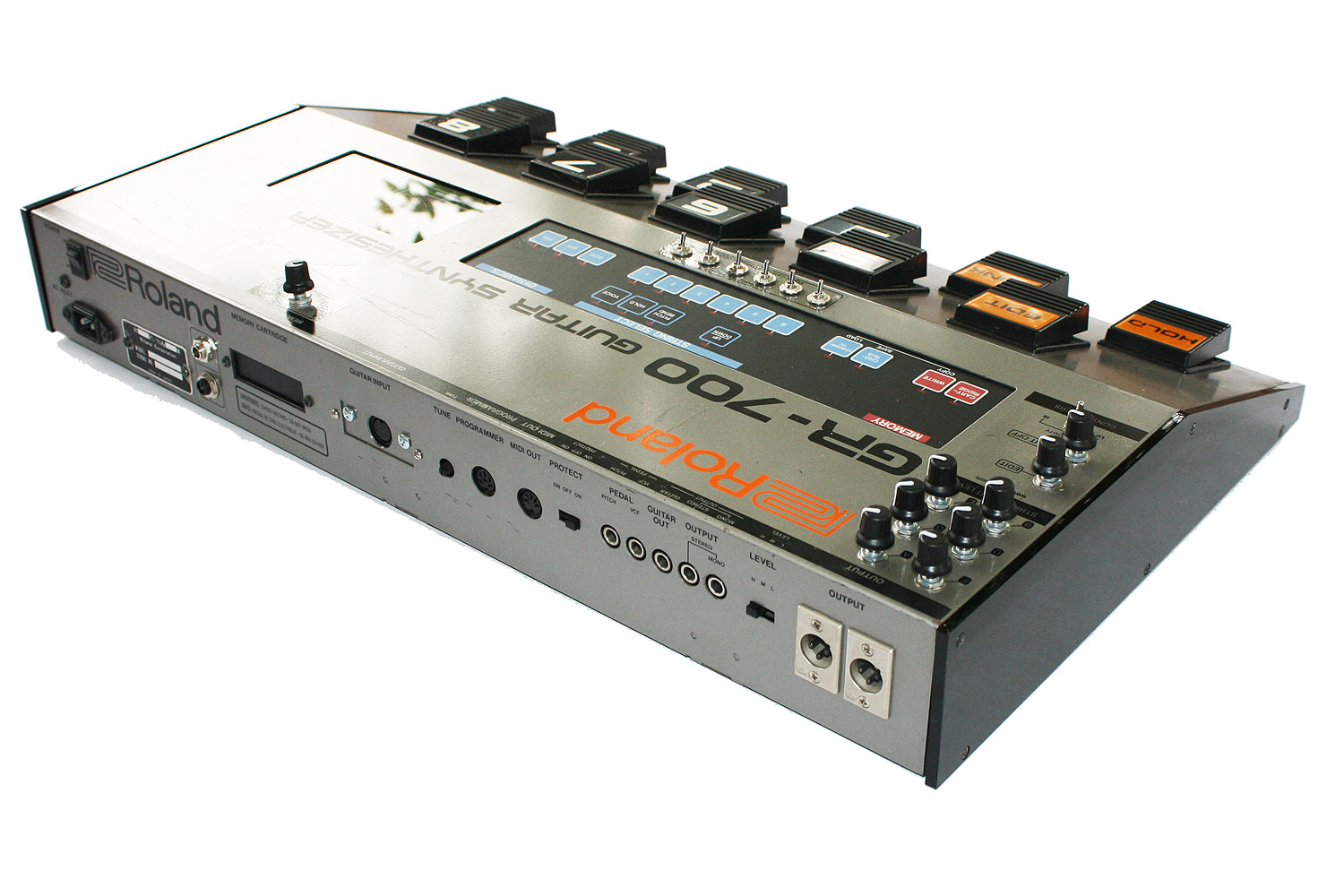
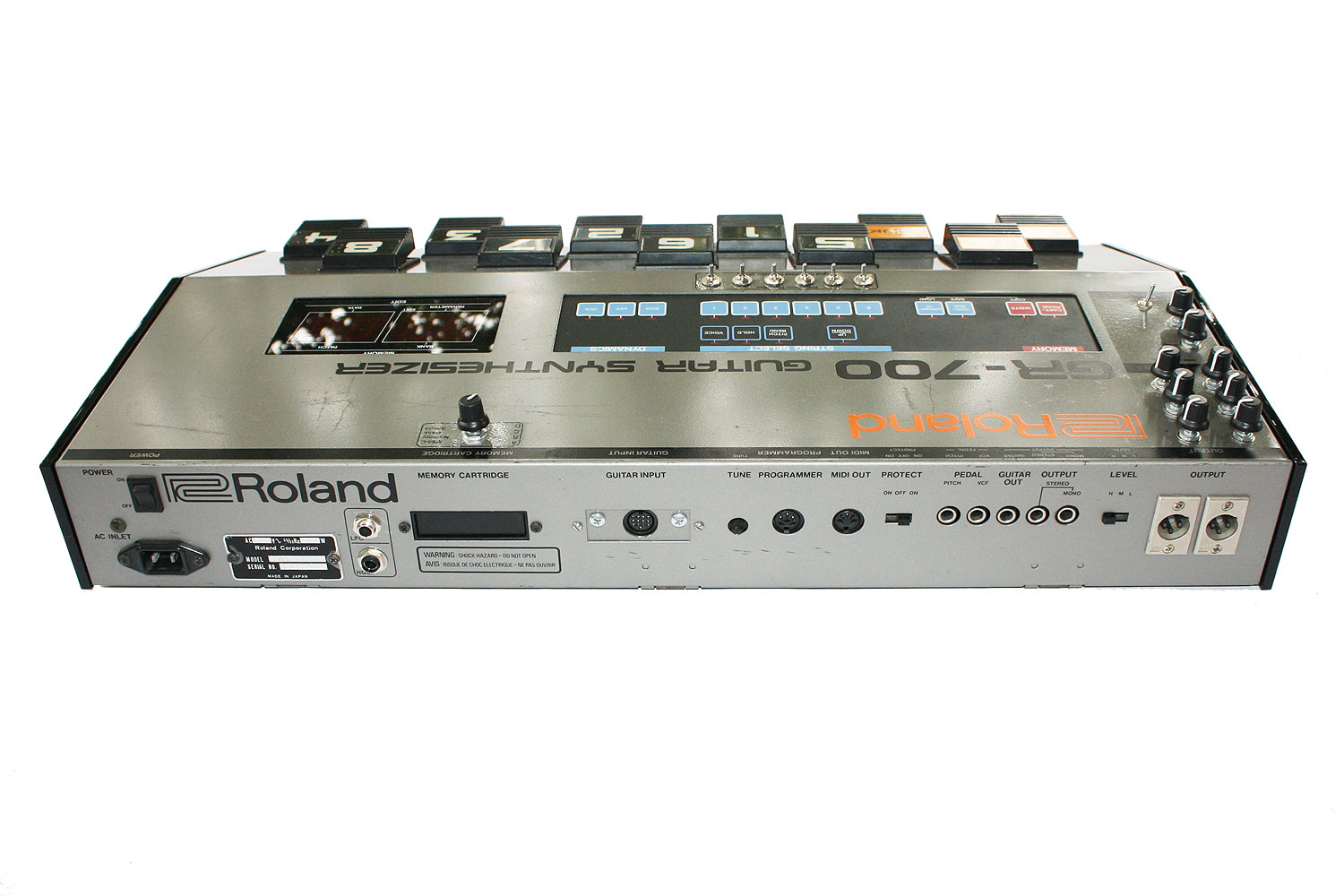
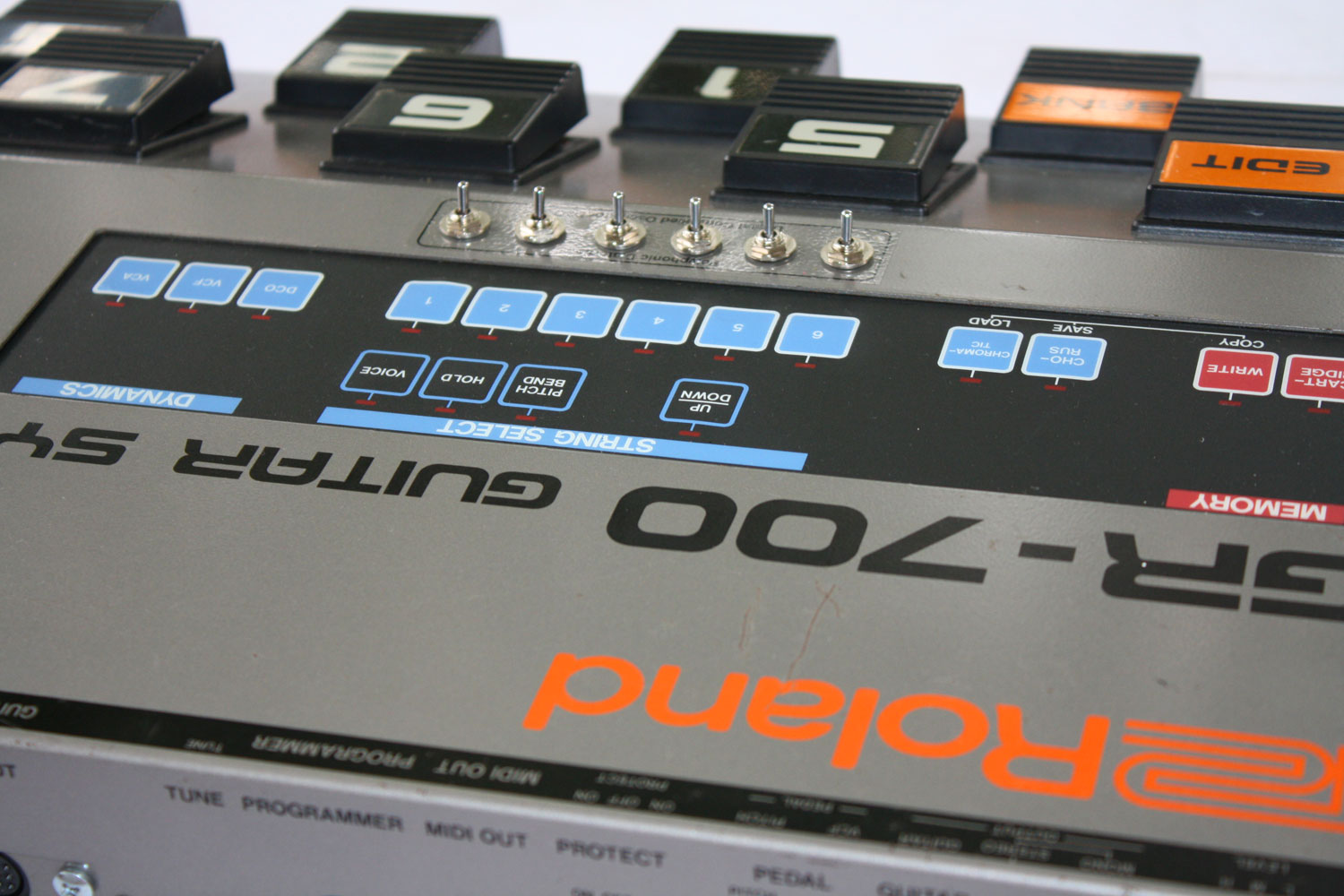
The GR-700 Turbo PLUS is an expansion of the original GR-700 Turbo. The primary feature of the original GR-700 Turbo is the modern 13-pin input, installed in place of the older 24-pin input, allowing a GK-2 or GK-3 equipped guitars to play the vintage Roland GR-700.
The Turbo PLUS goes one step further, integrating a vintage Roland GR-100 polyphonic distortion hex fuzz circuit with the processing power of the GR-700. It is like building a GR-100 inside a GR-700.
Each string has an input switch to select from the output of DCO-1, or from a hex fuzz signal. Parameter 18, Source Mix, controls the balance between the hex fuzz signal and DCO-2.
With the Source mix set at "00", the GR-700 sounds much more like the earlier Roland GR-100, with vintage Roland analog low-pass filters and rich analog chorus output. Sources can be mixed, with some strings outputting a blend of the two digitally controlled, analog oscillators, and some strings a mix of the polyphonic distortion hex fuzz, and the oscillator tone.
DCO-2 can be tuned independently of the hex fuzz signal, and oscillator synth and cross synchronization between DCO-1 and DCO-2 is still available, even when the string output is set to polydistortion, rather than DCO-1. The GR-700 improves on the feature set of the GR-100, with a four-stage envelope and LFO modulation, plus a high-pass filter.
Latching Sustain/Hold Pedal and LFO Depth Input
Another new feature of the GR-700 Turbo PLUS is a latching sustain switch. The Roland GR-700 sustain feature only works when the pedal is depressed. Once the foot is removed, the sustain stops. A custom built sustain foot switch can be plugged into the Turbo PLUS, for infinite sustain. Synth parameters can be edited while the sustain is engaged, and strings can be switched between DCO-1 and polydistortion, with control over the blend of synth and normal guitar sounds using the GK S-Volume and conventional volume control on the guitar.
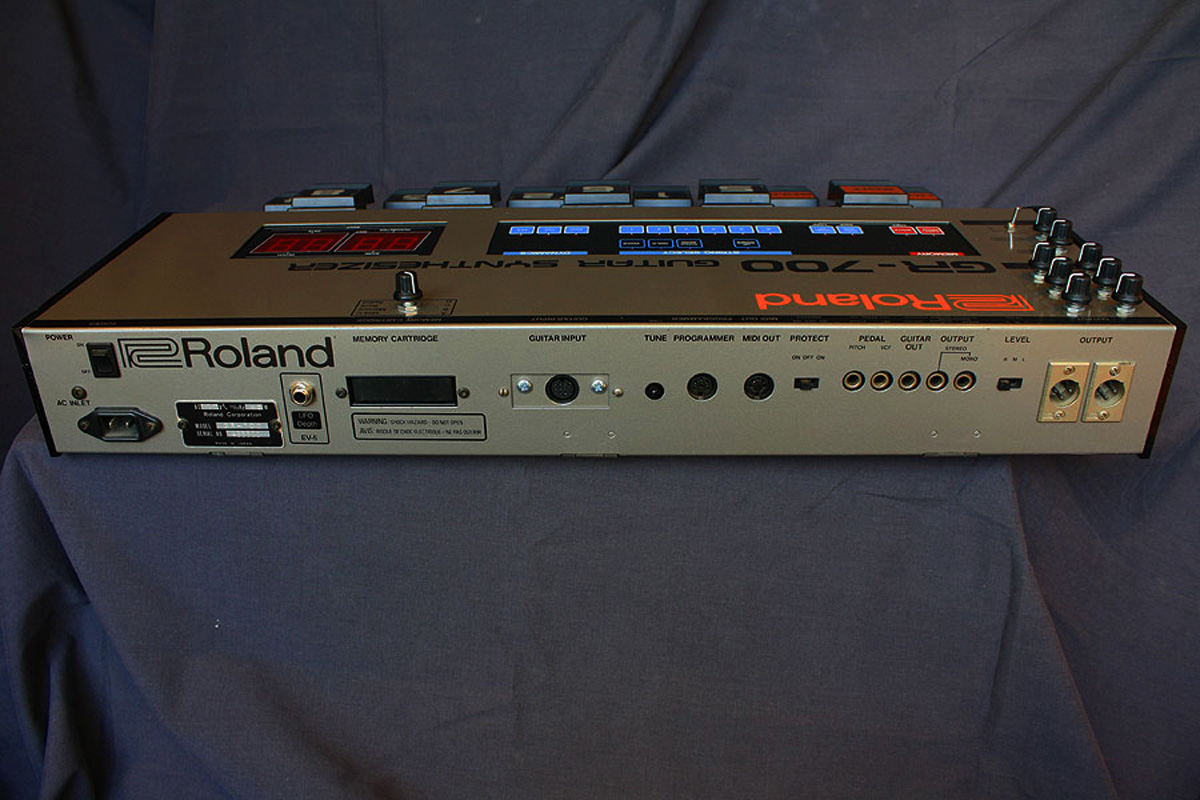
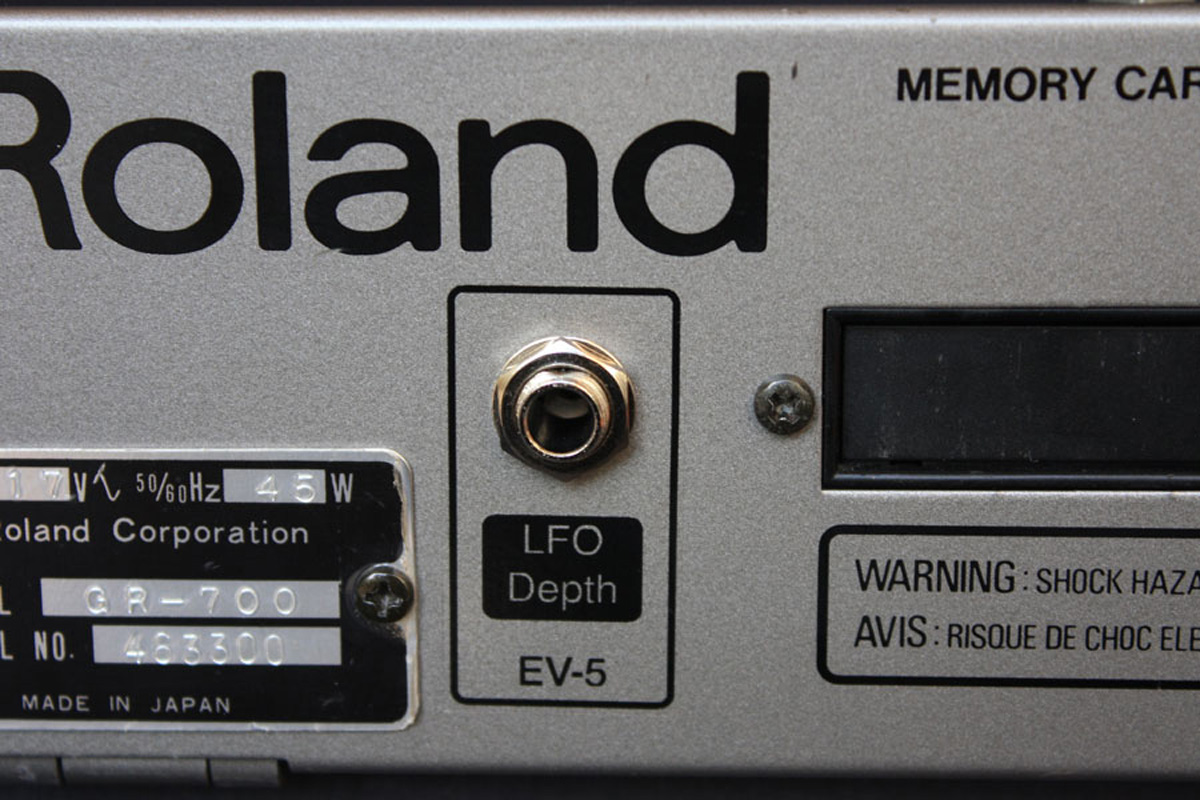
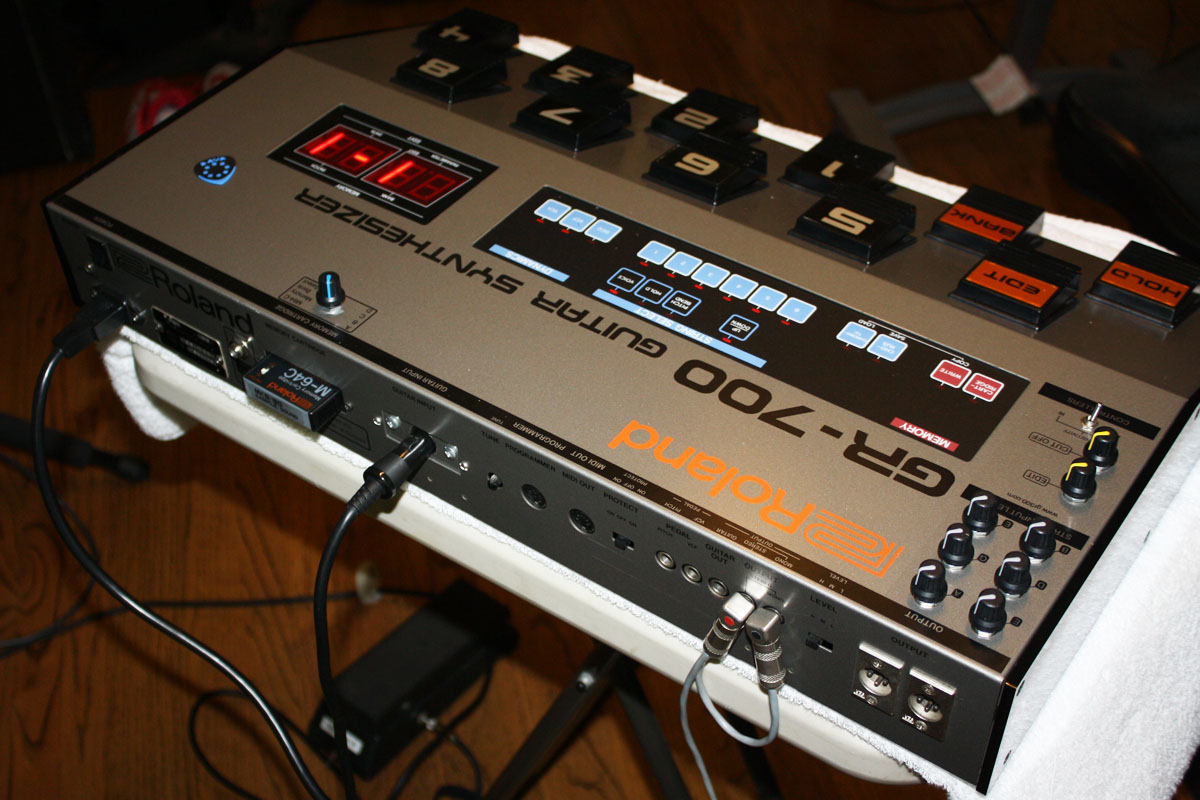
Like the original GR-700 Turbo, the Turbo PLUS has a foot switch input for LFO depth, designed for a Roland EV-5, plus a 4x memory expansion input, so that a Roland M-64C can be used to hold four banks of GR-700 sounds. Additional delay and ambience has been added during mix down.
Roland GR-700 Turbo PLUS (GR-100) Video:
GR-700 Turbo PLUS (GR-100)The GR-700 Turbo PLUS adds the sound of the GR-100 hexaphonic polydistortion to the Roland GR-700, with all the original features of the GR-700 Turbo. This includes a modern 13-pin input, top panel controls for string level and filter cutoff and EDIT parameters. The PLUS also adds a latching sustain input. The GR-700 Turbo PLUS has the ability to blend analog distortion with synthesizer tones for new synth sounds never heard before. |
Roland GR-700 Turbo PLUS (GR-100) Photos:
|
|
|
|
|

|
| Click on any image for larger view. |
||
Modifications - The Original GR-700 Turbo (2011):
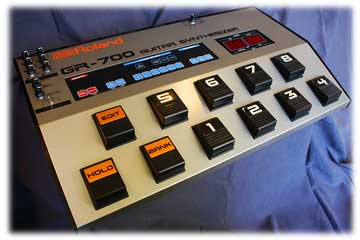
In place of the proprietary and awkward 24-pin input, the GR-700 Turbo has been retrofitted with a modern, 13-pin Roland-Ready input jack. Now you can directly play a vintage Roland guitar synthesizer without having to search for a costly vintage Roland guitar, and the expensive and rare 24-pin connecting cable.
4x Memory Expansion
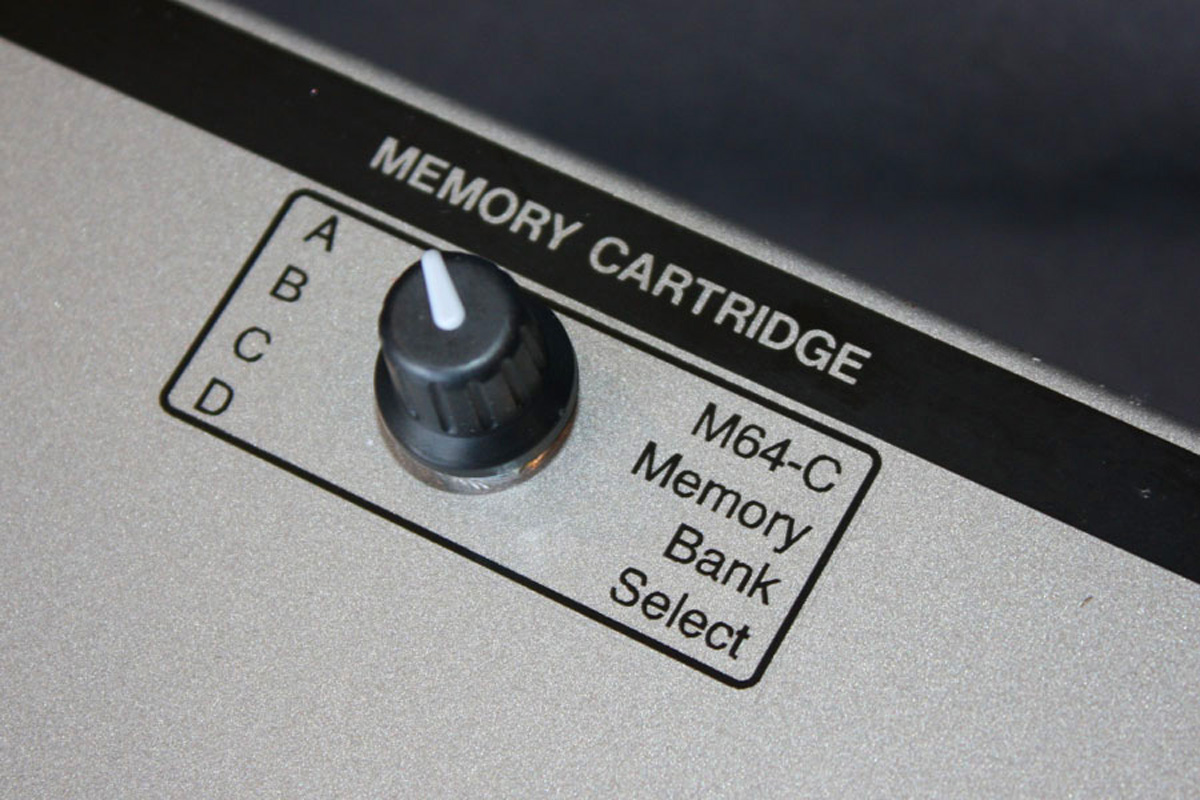
A stock Roland GR-700 has 64 memory locations for storing synth patches. If you insert a Roland M-16C memory cartridge into the GR-700, the memory expands to 128 patches. However, the GR-700 Turbo has the ability to store an astonishing 320 patches with a Roland M-64C cartridge! How is this possible? A special 4-position switching circuit has been added to the GR-700 Turbo, which basically divides a stock Roland M-64C (64K) memory cartridge into four individually addressable 16K memory banks!
These are labeled as banks A, B, C and D. This upgrade does not effect M-16C cartridges! Regardless of the memory switch position, a M-16C will store 64 patches. This auction does not include the M-16C or M-64C cartridge.
Final Release Version 5 Roland Factory Software
There are four documented versions of GR-700 software noted in the GR-700 service manual. Version four (1.4) is the most common software found in the GR-700. However, some of the last GR-700s made by Roland shipped with the rare, version 5 (1.5) software. The GR-700 Turbo has the rare version 5.0 software! Unlike the earlier upgrades, version 5.0 software does not add any new features, but instead improves on the most neglected aspect of the GR-700: faster and more accurate tracking. On average, version 5.0 is 1.5 milliseconds faster than version 4.0. The GR-700 Turbo does not reach the speed and accuracy of modern synthesizers, but it is an improvement over earlier versions, and includes the final revisions of the GR-700 factory patches.
Filter, Edit, Response Controls plus External EV-5 LFO Pedal Input
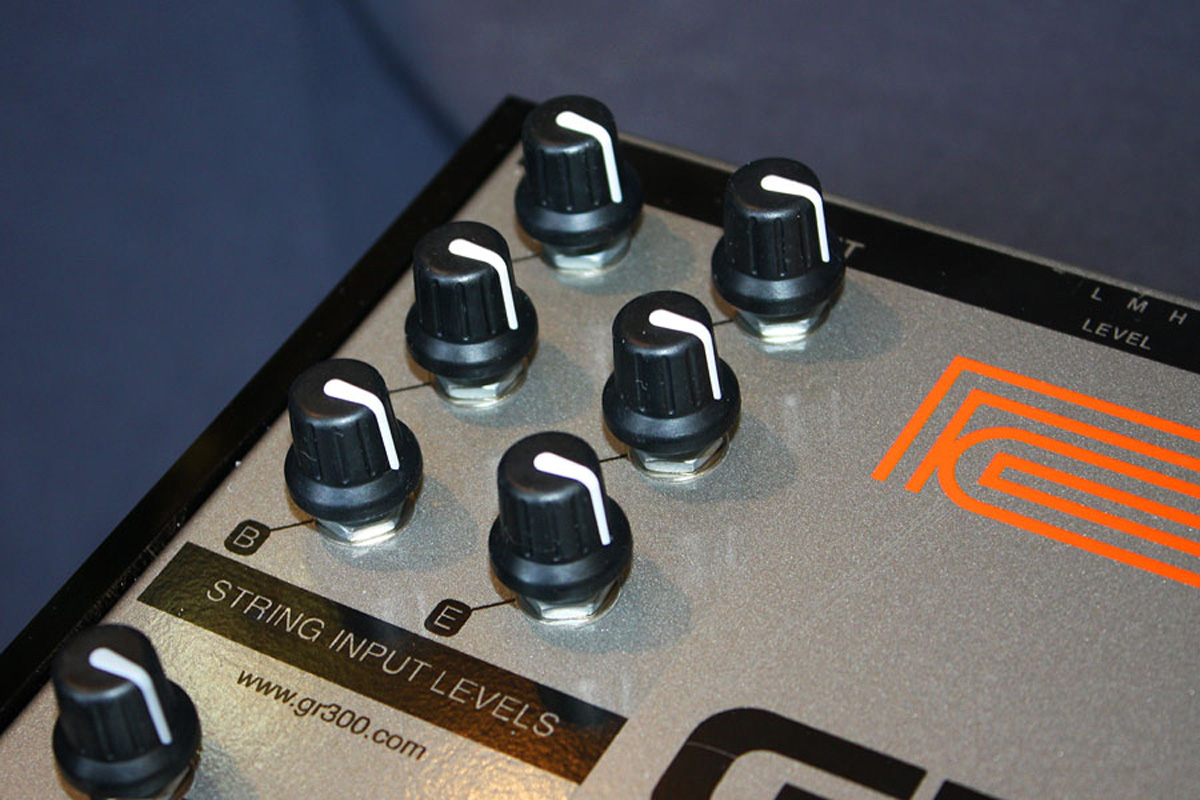
To take advantage of all cool features and programmability of the GR-700, new controls had to be added to replace the synthesizer controls found on a vintage Roland guitar synth controller like the G-303 or G-707. The GR-700 Turbo has top panel controls for filter cutoff, and edit value. In addition, there is a high/low sensitivity switch. To replace the LFO touch pads and LFO depth control found on a vintage guitar, a Roland EV-5 control pedal input has been added to the back of the GR-700 Turbo. This is a real advantage over the original Roland system, since the touch pads on a vintage Roland guitar were notoriously unreliable.
Final Version Voice Board with NEW Lithium Memory Battery
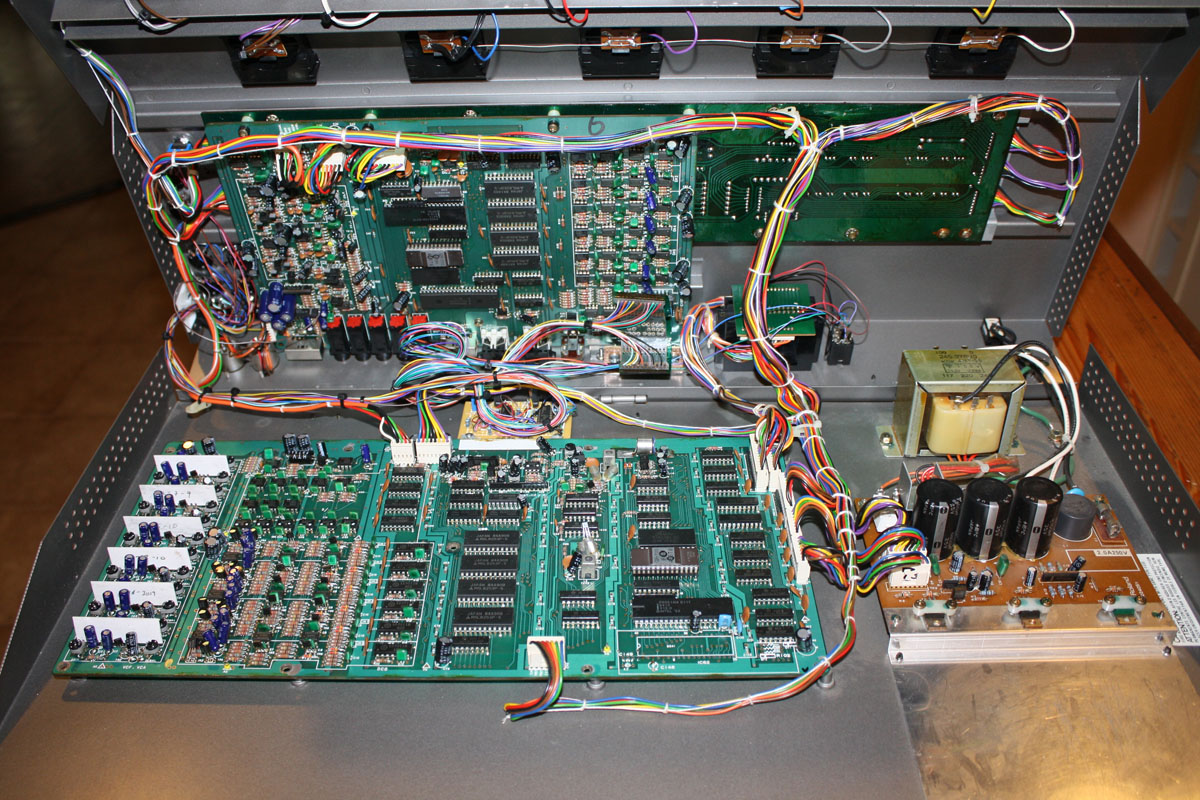
The GR-700 Turbo also has the final revision of the GR-700 Voice Board, plus a new battery for patch memory backup. The early GR-700 voice boards used open frame trimmers for the adjusting the critical parameters of each voice chip: level, DC balance, filter cutoff and resonance. The GR-700 Turbo has the last revision of the Voice Board with closed trimmers. The later Voice Boards also have additional test points to make testing and adjusting the board easier. And finally the 3 volt lithium memory backup battery has been replaced. This is the battery used to power the memory chip so that patches are retained even when the unit is turned off. This battery should last five years, so the original GR-700 batteries are long overdue for replacement!
Original GR-700 Turbo (2011) Features:
- 13-Pin Moden GK-2/GK-3 Input
- Six Top Panel String Input Level Controls
- Top Panel Filter Cutoff Amount
- Top Panel EDIT Control
- Top Panel Sensitivity Response Switch (Hi/Lo)
- LFO Depth (Roland EV-5) Input
- 4x Memory Expansion! 320 Patch Memory with M-64C Cartridge
- NEW! Acrylic Side Panels by California Acrylic Design
- Final Version Voice Board with NEW Lithium Memory Battery
- Restored VCF/VCA 80017a Voice Chips
- Final Version 1.5 GR-700 Software
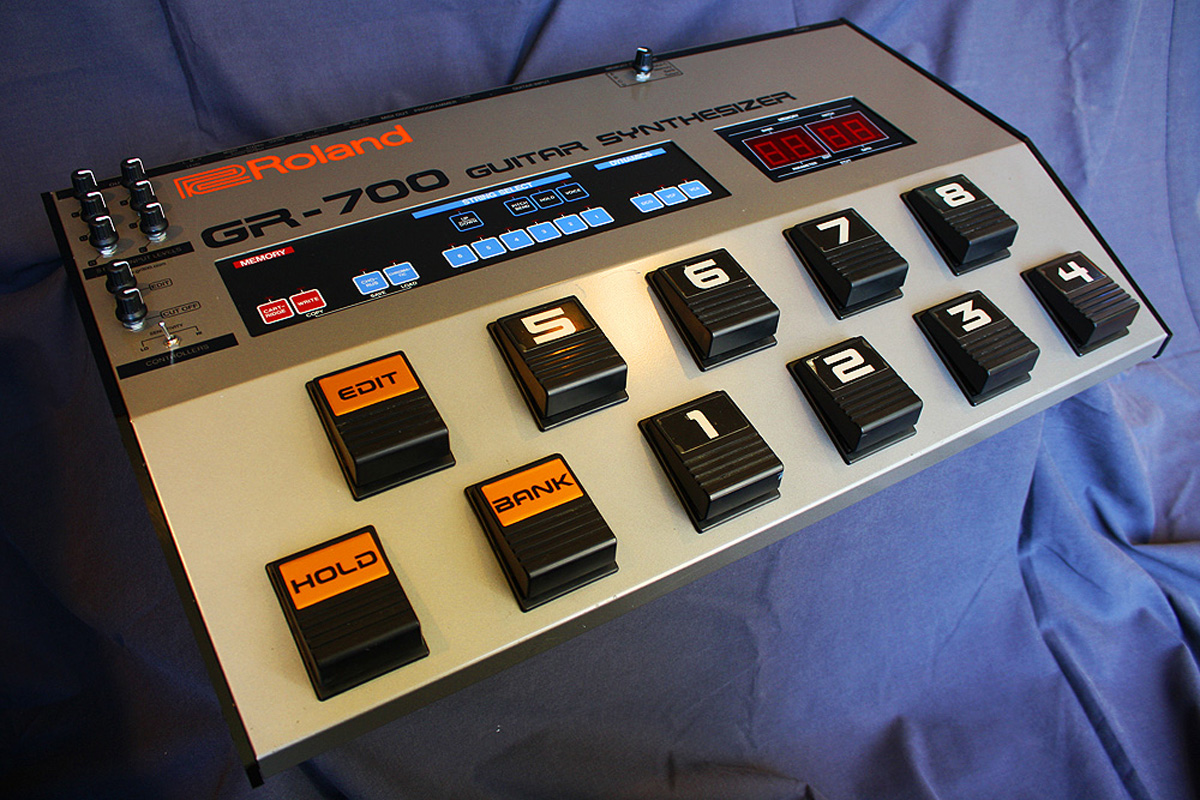
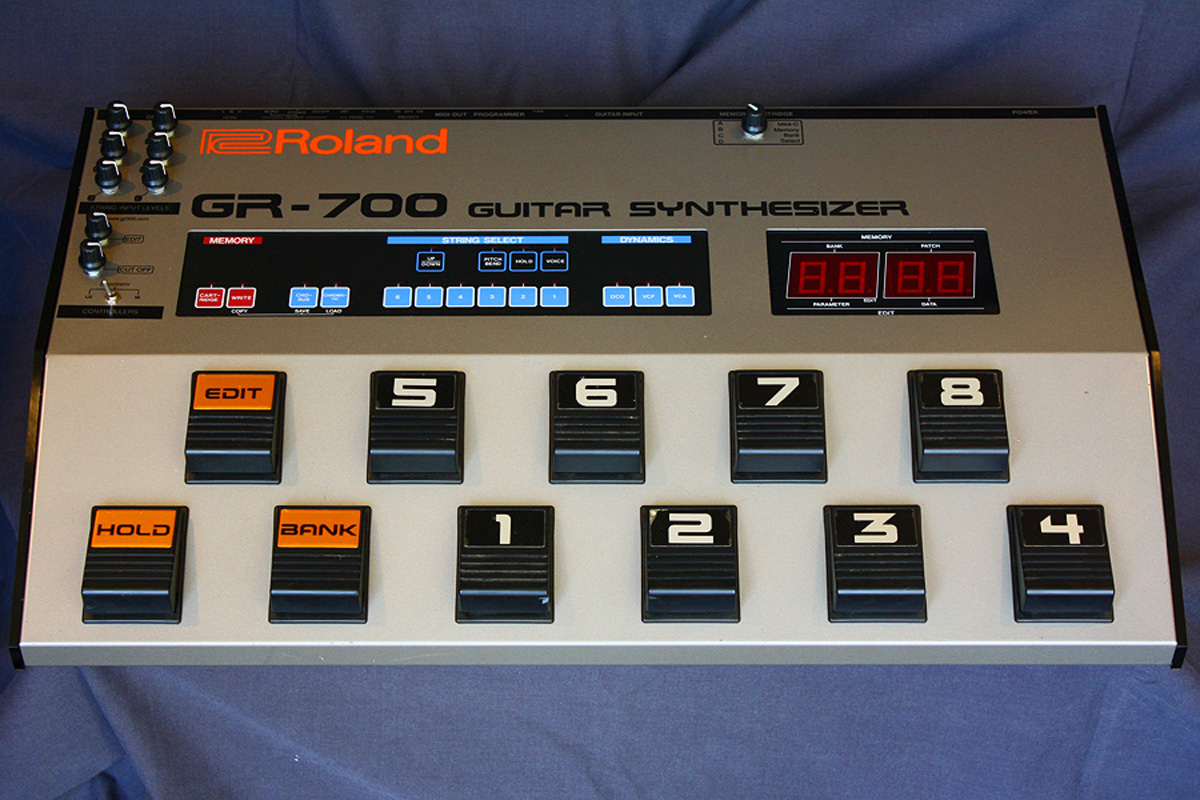
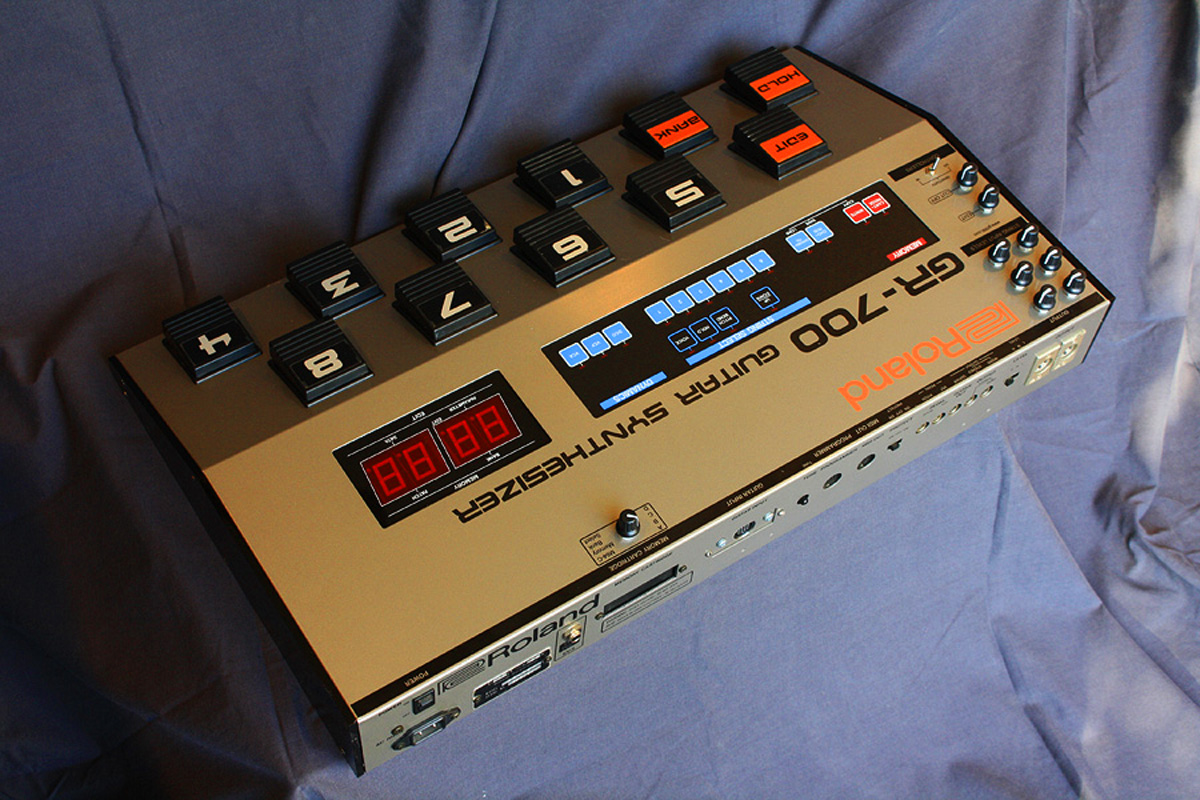
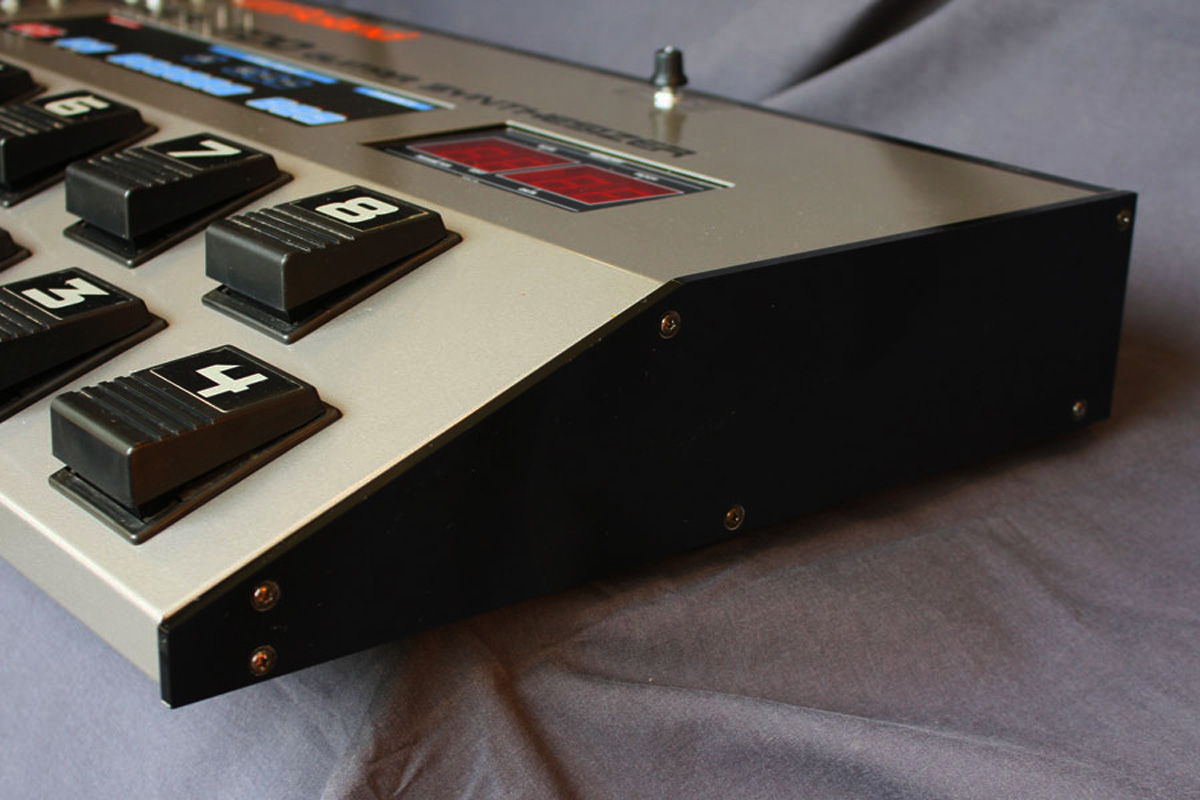
Roland GR-700 Turbo Photos
|
|
|
|
|

|
|

|
|
|
|
|
| Click on any image for larger view. |
||